Greener pet aftercare in Geneva, Illinois
About 650 dogs and cats are lost in Geneva each year, by our estimate. If you'd like your pet's ashes to grow into a tree or return to the water, this page covers the soil, the season and the cost.
- When to plant in your season
- How much ash your urn must hold
- Aquamation providers in your area

Geneva, Illinois
Living memorials in Geneva: the local picture
Winters along the Fox River bring hard frosts and plenty of freeze-thaw cycles. For outdoor memorials, granite and bronze last for generations, while cheaper cast pieces split. If your yard slopes toward the river, set a marker on a leveled gravel base so frost doesn't tilt it, and keep any glass or ceramic pieces indoors from November to April.
Geneva's Swedish heritage, still celebrated each summer at Swedish Days, shows in a love of simple, well-made things, and some families echo that with a plain wooden box or a stone engraved with just a name. Others share ashes among relatives or seal a little inside a pendant. Paw prints or a lock of fur have to be asked for before cremation, since the chance passes quickly.
In rural areas around Geneva, family pets are sometimes buried whole on the property rather than cremated. If you'd prefer that, check local rules on depth and distance from water. If you'd like a tree above the grave, plant it beside the grave, not directly on it, so the roots aren't disturbed and the ground can settle. For cremated pets, a planting urn gives you the tree without a large grave, and it can be placed exactly where you want.
Geneva's population is around 21,138, the 115th-largest of the 151 Illinois communities we cover. Some of the providers who serve Geneva are based about 36 miles away in Chicago, the nearest larger centre, so collection times reflect that drive.
Geneva sits within easy reach of Batavia (3 miles), St. Charles (3 miles) and North Aurora (5 miles). A provider based in any of them will usually collect from Geneva; ask what the mileage adds to the bill.
Our estimate
7,800
Geneva: dog- or cat-owning households, our estimate
How we calculated this
21,138 ÷ 2.5 = 8,455 households; × 53% (dog) + 39% (cat) = 7,800. Homes are counted once however many pets they keep.
Our estimate
650
dog and cat deaths per year in Geneva, our estimate
How we calculated this
7,800 dog/cat-owning homes ÷ average lifespan (dog: 12.69 yrs + cat: 11.18 yrs) ≈ 650 a year. The real figure is unlikely to be lower.
53%[1]
53% of US households own a dog, which is about 71 million households.
12.69 years[2]
US dogs have an average life expectancy at birth of 12.69 years.
39%[3]
39% of US households own a cat, which is about 53 million households.
11.18 years[4]
US cats seen at Banfield hospitals have an average life expectancy at birth of 11.18 years.
If a number here surprises you, the primary material is American Pet Products Association (APPA) 2025 State of the Industry and Montoya et al. 2023, Frontiers in Veterinary Science; we only apply it to this.

Why cremation culture in Illinois shapes your options
About 60.2%[5] of people who die in Illinois are cremated. That's a human statistic, but it shapes local services: in places where cremation is common but not dominant, there are usually enough crematories to compare, while greener options like water cremation may be less widespread. It's worth asking any provider directly whether they offer aquamation, and whether the ashes come back in a simple container you can plant from.
We take the Illinois rate from NFDA 2024 Cremation & Burial Report state projections (via Occasional Sage) (2024). It is a human statistic; there is no equivalent pet figure for Geneva, and we would rather show a real number than invent one.
Weather, soil and planting windows in Geneva
In Geneva, average lows fall below freezing in January, February, March, November and December, and frozen ground makes digging hard or impossible. That's no reason to rush. Ashes keep safely indoors for as long as you like, so many families wait for spring, once the soil has thawed and drained. Early autumn works too, as long as the tree has about six weeks of open ground to root in before the hard frosts.
Snow can hide a young memorial tree and the damage done around it. In Geneva, where lows average about 16°F in January, voles and rabbits chew bark under the snow line, and snowplows or shovels can snap a sapling. Put a tall stake beside the planting so you can find it, and fit a loose guard around the trunk before the first snow.
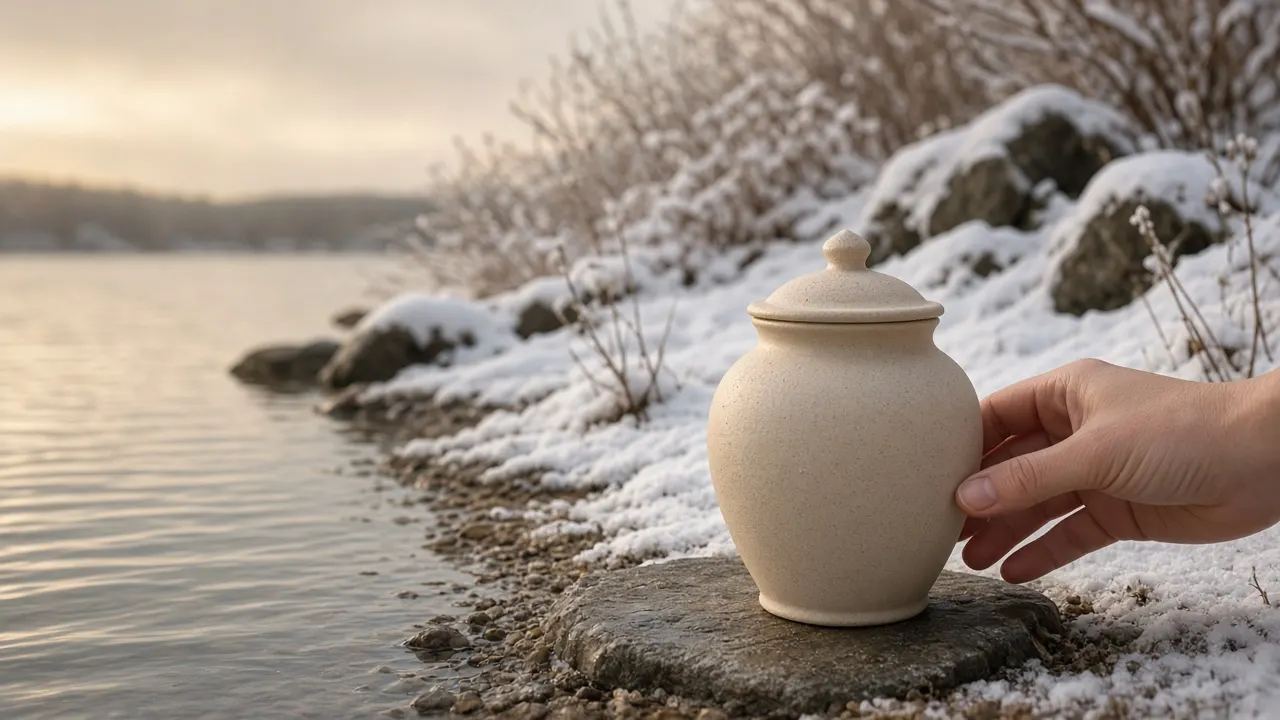
Eco memorial prices, from urn to tree
It helps to compare a planted memorial with the alternatives. A pet cemetery burial for a dog averages about $831[6] in the US, which by our estimate is around 3.2 times the national average for private cremation[7]. Private cremation plus a bio urn and a sapling in your own Geneva garden usually comes in far below a cemetery plot, and there are no yearly maintenance fees.
The full price table by product is on our Illinois page, and the services page explains what each option includes.

Free tool
Memorial budget planner
Add up cremation, urn, keepsakes and a farewell so the total holds no surprises.
Land, water and permission in Illinois
Carrying ashes from one place to another is usually simple, but keep the paperwork. The certificate or letter from the crematory shows what's in the container, which helps if you're crossing borders, flying out of Illinois or handing the ashes to a cemetery. Keep a copy with the ashes and another somewhere safe at home.
To find your county or city office in Illinois, start with the official Illinois local government directory.
The rules that apply across Illinois (home burial, scattering and who oversees pet cremation) are summarized on our Illinois page. Geneva may add its own conditions, so check with the city or county before digging.
What to do first, and what can wait for the right season
- Confirm the ashes will come back. Communal cremation usually means no ashes are returned, and you can't plant what you don't receive.
- Pick the type of bio urn: a planting urn for a tree, a plain burial urn for a garden corner, a water urn for a lake or the sea.
- Ask permission from the landowner, landlord or park manager for anywhere that isn't yours.
- Plan for the weather. In Geneva, avoid frozen, baked or waterlogged ground; a calm, mild day is best for planting or a release.
- Release gently on water. Set the urn on the surface, let it float and sink on its own, and add only loose petals.
- Come back in a year. Top up the mulch, see how much the tree has put on, and photograph it to record the first anniversary.
Remembering your pet, in Geneva and wherever you go next
Geneva has a strong sense of history, with carefully kept old houses and gardens, and many families here choose a memorial that fits that character: a hand-carved wooden urn, a bronze plaque in the garden, or a framed photograph and paw print in a hallway. There is no rush to decide; the ashes will keep safely in their temporary box.
The services page is the place to compare what is included, browse in-depth guides or recent articles, or see what other families chose in the poll results, try the free planning tools. Close to Geneva we also cover Naperville, Aurora, Rockford and Chicago; the full list for Illinois and for the United States is a click away.

Reader polls
What would you choose?
Vote anonymously and see how other readers answered. The results are live counts from people who visit this site, so they show real opinions, not a scientific sample.
If you rent or might move, how would you handle a memorial planting?
Tap an answer to vote and see how others answered. Anonymous.
Would you consider releasing your pet's ashes in water?
Tap an answer to vote and see how others answered. Anonymous.
If you had to decide today, which aftercare would you choose for your pet?
Tap an answer to vote and see how others answered. Anonymous.

Free tools to help you plan
Memorial budget planner
Add up cremation, urn, keepsakes and a farewell so the total holds no surprises.

Memorial tree finder
Pick a tree for a planting urn that suits your climate, space and pet.

Aftercare options compared
Compare private, communal and water cremation with burial on cost, timing and what comes home.
Questions people ask
Roughly how many pets die in Geneva each year?
Our estimate is around 650. It comes from Geneva's population (about 21,138), the average household size, the share of homes with a dog or cat (about 7,800 households here) and the average lifespan. It is arithmetic, not a count, so read it as a rough floor.
Can a provider from a neighbouring town collect from Geneva?
Usually yes. Batavia is about 3 miles away, St. Charles is about 3 miles away and North Aurora is about 5 miles away, all inside a normal collection radius. Get the mileage written into the quote so there is no surprise on the day.
When is the hardest time of year to arrange a burial in Geneva?
January, February, March, November and December: average lows are below freezing then, and frozen ground makes a home grave slow or impossible until it thaws. The other pressure point is July, when highs around 84°F mean a body needs cooling and collecting quickly.
How do Illinois attitudes to cremation compare?
NFDA 2024 Cremation & Burial Report state projections (via Occasional Sage) (2024) puts the Illinois human cremation rate at about 60.2%[5]. We show it on the Geneva page because pet aftercare choices tend to track it: where cremation is normal for people, communal and private pet cremation are both easy to find.
What if the soil in Geneva is already alkaline?
Then ashes push it further, so be generous with compost and composted bark, choose a lime-tolerant tree or shrub, and test the pH before planting. Chalky and limestone soils are common in many regions. Plants that dislike lime, such as azaleas and blueberries, are a poor choice for an ash planting anywhere.
Will the seed in a tree urn grow?
Not always. Seeds from kits can fail to sprout if they weren't stored or chilled correctly, and alkaline soil around them makes it harder. A young tree from a nursery near Geneva is far more reliable, and most planting urns work just as well with a sapling in the top chamber.


Sources and our estimates
- [1] 53% of US households own a dog, which is about 71 million households. American Pet Products Association (APPA) 2025 State of the Industry, 2025.
- [2] US dogs have an average life expectancy at birth of 12.69 years. Montoya et al. 2023, Frontiers in Veterinary Science - Banfield Pet Hospital life expectancy tables (13.3 million dogs, 2.4 million cats, 2013-2019), 2023.
- [3] 39% of US households own a cat, which is about 53 million households. American Pet Products Association (APPA) 2025 State of the Industry, 2025.
- [4] US cats seen at Banfield hospitals have an average life expectancy at birth of 11.18 years. Montoya et al. 2023, Frontiers in Veterinary Science - Banfield Pet Hospital life expectancy tables (13.3 million dogs, 2.4 million cats, 2013-2019), 2023.
- [5] The NFDA projected Illinois's cremation rate at 60.2% for 2024. NFDA 2024 Cremation & Burial Report state projections (via Occasional Sage), 2024.
- [6] CareCredit's 2025 cost study put the US national average for pet cemetery burial of a dog at $831 (range $659-$1,513). CareCredit (Synchrony) - How Much Does It Cost To Euthanize a Dog? (2025 ASQ360 procedural cost study), 2025.
- [7] US pet cemetery burial for a dog costs about 3.2x a private cremation ($831 vs $260 national averages). Our estimate: 831 / 260 = 3.20. How we calculate.
- [8] U.S. pet flame cremations emit on the order of 47,000 t CO2e a year. Our estimate: 1.5M pet cremations x 31.3 kg CO2e. How we calculate.
Tell us about your pet and your garden
Tell us what you need and where you are. We'll reply by email with clear options and prices so you can decide in your own time.