Growing something from the goodbye in Sycamore
About 590 dogs and cats are lost in Sycamore each year, by our estimate. If you'd like your pet's ashes to grow into a tree or return to the water, this page covers the soil, the season and the cost.
- Options for renters and apartments
- Water release rules in plain words
- No obligation, we reply by email

Sycamore, Illinois
Bio urns, trees and water in Sycamore
Northern Illinois frost reaches deep, and memorials made of concrete, resin or glazed ceramic tend to crack after a few DeKalb County winters. Solid granite and bronze are worth the extra cost for anything left outdoors. Bed a flat marker in packed gravel so it sits level through the freeze and thaw, and wait until the soil has dried out in spring before planting a memorial tree.
Sycamore households tend to have room outdoors, whether a deep town lot near the courthouse or a few acres outside the city limits. That makes a garden memorial a natural fit: an engraved stone among perennials, a young tree planted in spring, or a bench by a vegetable patch. Indoors, a small urn or a framed paw print works just as well. There is no need to decide quickly.
Small towns tend to have long memories, and a memorial tree in Sycamore is often planted with a lot of history around it: the same yard for decades, a family farm, a favorite fishing spot. If the land is likely to stay in the family, a long-lived native tree is a lovely choice. If it might be sold, consider a shrub bed, a portion of ashes kept back, or a water release that doesn't depend on who owns the ground in twenty years.
About 19,083 people live in Sycamore, which makes it the 129th-largest of the 151 Illinois communities we cover. Some of the providers who serve Sycamore are based about 55 miles away in Chicago, the nearest larger centre, so collection times reflect that drive.
Families in Sycamore often end up using a provider from DeKalb (6 miles, a larger centre), Huntley (17 miles) and South Elgin (19 miles). That is normal: crematories serve a radius, not a single town, and the drive is priced into collection.
Our estimate
7,000
How many dog- or cat-owning households Sycamore has (estimate)
How we calculated this
19,083 ÷ 2.5 = 7,633 households; × 53% (dog) + 39% (cat) = 7,000. Multi-pet homes count once.
Our estimate
590
Estimated dog and cat losses in Sycamore each year
How we calculated this
7,000 dog/cat-owning homes ÷ average lifespan (dog: 12.69 yrs + cat: 11.18 yrs) ≈ 590 a year. Treat it as a minimum.
53%[1]
53% of US households own a dog, which is about 71 million households.
12.69 years[2]
US dogs have an average life expectancy at birth of 12.69 years.
39%[3]
39% of US households own a cat, which is about 53 million households.
11.18 years[4]
US cats seen at Banfield hospitals have an average life expectancy at birth of 11.18 years.
The published sources behind those figures are Montoya et al. 2023, Frontiers in Veterinary Science and American Pet Products Association (APPA) 2025 State of the Industry.

What local attitudes to cremation mean in Illinois
Faith shapes these choices in Illinois, where cremation covers about 60.2%[5] of deaths and burial much of the rest. Some traditions that prefer burial for people have no view on pets; others do. If this matters to anyone in your household, ask a faith leader you trust. A planting urn puts the ashes back into the ground, which many people find sits comfortably with a burial tradition.
That Illinois rate is a human one, published by NFDA 2024 Cremation & Burial Report state projections (via Occasional Sage) (2024). We quote it for Sycamore only as a pointer to how families here already think about cremation.
Weather, soil and planting windows in Sycamore
Snow can hide a young memorial tree and the damage done around it. In Sycamore, where lows average about 13°F in January, voles and rabbits chew bark under the snow line, and snowplows or shovels can snap a sapling. Put a tall stake beside the planting so you can find it, and fit a loose guard around the trunk before the first snow.
Freezing and thawing through January, February, March, November and December can heave a newly planted tree out of the ground in Sycamore. If you plant in autumn, mulch well after the first frost to keep the soil temperature steady, and check the base of the tree in spring. A spring planting avoids the problem entirely and gives roots a full growing season before the next winter.
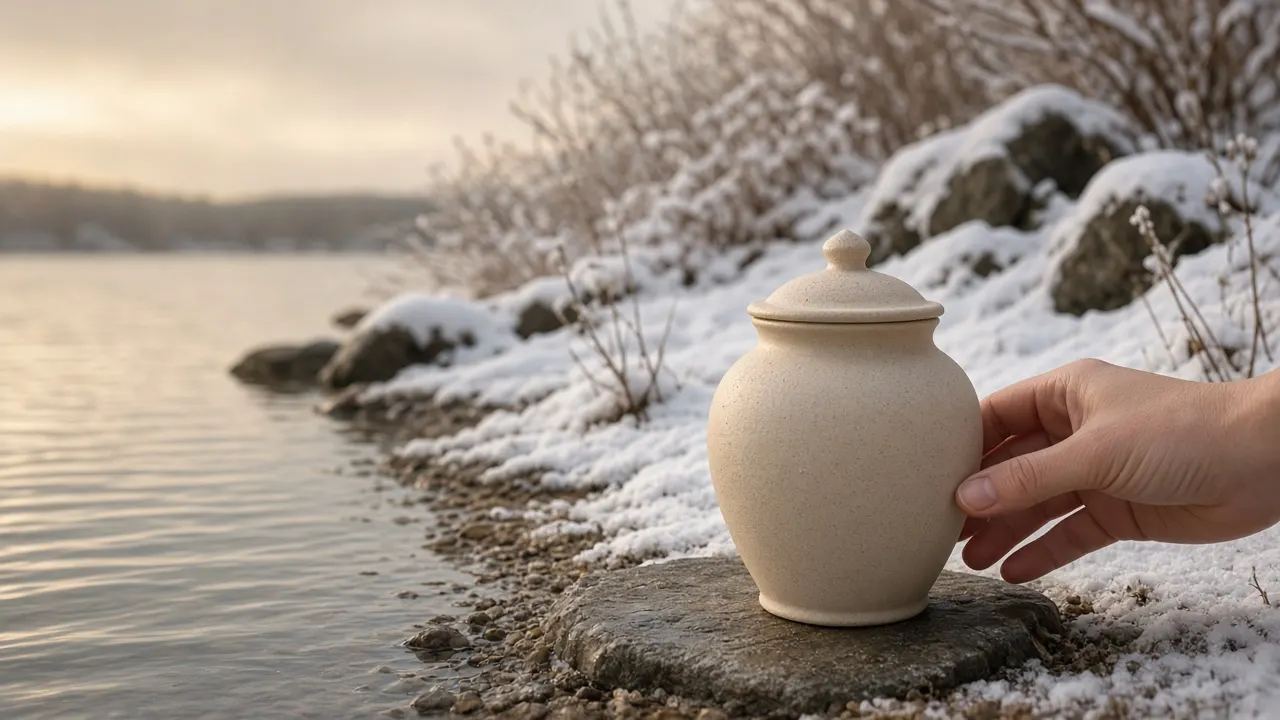
What a greener goodbye costs in Sycamore
A living memorial in Sycamore has two costs: the cremation and the urn. Biodegradable pet urns are among the cheaper urns you can buy, listed at about $15–$80[6] in one national price guide, and a sapling from a local nursery often costs less than a decorative display urn. If you'd like water cremation, one pet insurer's guide lists aquamation at $80 to $450 depending on size[7]. The table shows published examples.
The full price table by product is on our Illinois page, and the services page explains what each option includes.

Free tool
Memorial budget planner
Add up cremation, urn, keepsakes and a farewell so the total holds no surprises.
Who to ask before you plant or scatter in Illinois
Cremated remains aren't a health hazard in the way a body is, which is why planting ashes in your own garden is rarely restricted. Public places are different. Parks, nature reserves, beaches and waterways in Illinois each have a manager with their own policy, and some don't allow scattering or planting at all. A short email before the day saves an awkward conversation.
Illinois keeps an official directory of local governments; use it to reach the county or city office that covers Sycamore.
Home burial and scattering are governed at the Illinois level first; our Illinois rules summary has the detail. Then check whether Sycamore or your HOA adds anything.
Your next steps, whatever your situation
- Decide what the memorial is for. Wanting somewhere to sit, a living plant, a release on water or simply the gentlest footprint each leads you toward a different kind of urn.
- If a greener cremation matters, ask about aquamation before anything else; it's the step with the biggest environmental difference.
- Keep a small portion back in a keepsake in case a house move or a second memorial is on the cards down the line.
- Buy the tree locally. A native sapling from a nursery near Sycamore will usually outgrow a seed from a kit.
- Prepare the soil a season ahead if the timing allows, so the ash and compost blend is ready on planting day.
- Plant with the people who loved your pet; hand everyone a task of their own, whether blending, backfilling or watering.
Remembering your pet in Sycamore
Farm families near Sycamore sometimes keep memorials plain: a name painted on a barn board, a collar hung on a nail by the door, ashes scattered along a fence line the animal loved. Others prefer something more lasting, like a keepsake pendant or a small hardwood box. Ask for a paw print or a clipping of fur before cremation, because it cannot be made afterward.
use the free tools before you ring anyone, or see what other families chose in the poll results, Our services overview lays out every option side by side, look through our guides and the blog. You can also browse every city in the United States. Nearby, we also cover Elgin, Aurora, Joliet and Chicago, and every city in Illinois.

Reader polls
What would you choose?
Vote anonymously and see how other readers answered. The results are live counts from people who visit this site, so they show real opinions, not a scientific sample.
Would you consider releasing your pet's ashes in water?
Tap an answer to vote and see how others answered. Anonymous.
What kind of tree or plant would you choose?
Tap an answer to vote and see how others answered. Anonymous.
If you had to decide today, which aftercare would you choose for your pet?
Tap an answer to vote and see how others answered. Anonymous.

Free tools to help you plan
Memorial budget planner
Add up cremation, urn, keepsakes and a farewell so the total holds no surprises.

Memorial tree finder
Pick a tree for a planting urn that suits your climate, space and pet.

Aftercare options compared
Compare private, communal and water cremation with burial on cost, timing and what comes home.
Questions people ask
Can a provider from a neighbouring town collect from Sycamore?
Usually yes. DeKalb is about 6 miles away, Huntley is about 17 miles away and South Elgin is about 19 miles away, all inside a normal collection radius. Get the mileage written into the quote so there is no surprise on the day.
Is Sycamore big enough to have several pet aftercare providers?
Probably, on the numbers. By our estimate about 7,000 Sycamore households keep a dog or cat and around 590 lose one each year, which is enough steady demand to support more than one provider. We derive that from population (about 19,083), household size and national ownership and lifespan figures.
Why does the Sycamore page quote a human cremation rate?
Because it is the best local signal we have. NFDA 2024 Cremation & Burial Report state projections (via Occasional Sage) (2024) reports about 60.2%[5] of Illinois residents are cremated. There is no official pet equivalent, and inventing one would be worse than quoting a real, clearly labelled number.
How does Sycamore's weather affect pet aftercare?
July is the hottest month in Sycamore, with average highs around 83°F, so prompt collection matters most then. Average lows drop below freezing in January, February, March, November and December, which can make digging a grave hard until spring.
Do bio urns work with ashes from flame cremation?
Yes. A bio urn works with ashes from flame cremation or water cremation. Both leave mineral-rich, alkaline ash, so the soil advice is the same either way: dilute the ashes well through compost and soil, let the mix rest if you can, and test the pH before a young tree goes in.
What happens to the memorial tree if I move away from Sycamore?
It stays with the land, and ashes mixed into soil can't be recovered. If a move is possible, plant in a large container, plant at a relative's home, or keep a small portion of the ashes back for a future garden. Cuttings from many shrubs root easily, so you can take a piece of the plant with you.


Sources and our estimates
- [1] 53% of US households own a dog, which is about 71 million households. American Pet Products Association (APPA) 2025 State of the Industry, 2025.
- [2] US dogs have an average life expectancy at birth of 12.69 years. Montoya et al. 2023, Frontiers in Veterinary Science - Banfield Pet Hospital life expectancy tables (13.3 million dogs, 2.4 million cats, 2013-2019), 2023.
- [3] 39% of US households own a cat, which is about 53 million households. American Pet Products Association (APPA) 2025 State of the Industry, 2025.
- [4] US cats seen at Banfield hospitals have an average life expectancy at birth of 11.18 years. Montoya et al. 2023, Frontiers in Veterinary Science - Banfield Pet Hospital life expectancy tables (13.3 million dogs, 2.4 million cats, 2013-2019), 2023.
- [5] The NFDA projected Illinois's cremation rate at 60.2% for 2024. NFDA 2024 Cremation & Burial Report state projections (via Occasional Sage), 2024.
- [6] Memorials.com's pet urn cost guide puts biodegradable pet urns at $15–$80. Memorials.com – Pet Urn Cost Guide, 2025.
- [7] Embrace Pet Insurance lists US communal cremation at $30-$200, partitioned at $50-$250, private at $100-$500+ and aquamation at $80-$450. Embrace Pet Insurance - Bury or Cremate Your Dog? Costs, Pros & Cons, 2025.
- [8] U.S. pet flame cremations emit on the order of 47,000 t CO2e a year. Our estimate: 1.5M pet cremations x 31.3 kg CO2e. How we calculate.
Plan a living memorial in Sycamore
Tell us what you need and where you are. We'll reply by email with clear options and prices so you can decide in your own time.