A living memorial for your pet in Sanford
Sanford has an estimated 8,350 dog- or cat-owning households. When a planting or water memorial feels right for yours, here's what works in the local climate and what to ask before you buy.
- When to plant in your season
- How much ash your urn must hold
- Aquamation providers in your area

Sanford, Maine
Living memorials in Sanford: the local picture
With freezing months stretching from November into April, outdoor keepsakes around Sanford need to be tough. Granite and bronze handle frost heave and snow; painted wood and plaster crack quickly. A tree urn should wait until late May or June, when the soil is warm, and pick a cold-hardy native such as white pine, which grows well across western York County.
Sanford homes range from mill-era houses downtown to cottages by lakes and ponds, so memorials vary widely. A windowsill urn suits a compact home; families with land may prefer a stone marker under a favorite tree at the edge of the yard. Ash jewelry and paw prints travel easily if relatives live farther away in Maine or across the line in New Hampshire.
Country land around Sanford gives you options city families don't have, and a few extra things to think about. Keep ash plantings well away from wells, springs and streams, and away from ground where livestock graze or crops are grown. Choose a spot with some shelter from wind for a young tree, and remember that deer and rabbits find new plantings quickly; a simple tree guard or wire cage for the first few years can make all the difference.
Sanford's population is around 22,663, the 6th-largest of the 13 Maine communities we cover.
The closest communities we cover are Rochester (14 miles), Kennebunkport (15 miles) and Dover (18 miles). Providers serving those towns often travel to Sanford too, so it can be worth asking them for a quote.
Our estimate
8,350
Sanford: dog- or cat-owning households, our estimate
How we calculated this
22,663 ÷ 2.5 = 9,065 households; × 53% (dog) + 39% (cat) = 8,350. Multi-pet homes count once.
Our estimate
690
dog and cat deaths per year in Sanford, our estimate
How we calculated this
8,350 dog/cat-owning homes ÷ average lifespan (dog: 12.69 yrs + cat: 11.18 yrs) ≈ 690 a year. The real figure is unlikely to be lower.
53%[1]
53% of US households own a dog, which is about 71 million households.
12.69 years[2]
US dogs have an average life expectancy at birth of 12.69 years.
39%[3]
39% of US households own a cat, which is about 53 million households.
11.18 years[4]
US cats seen at Banfield hospitals have an average life expectancy at birth of 11.18 years.
If a number here surprises you, the primary material is American Pet Products Association (APPA) 2025 State of the Industry and Montoya et al. 2023, Frontiers in Veterinary Science; we only apply it to this.

Cremation habits in Maine, and what they mean for a bio urn
Scattering gardens and woodland memorials are familiar sights in Maine, where cremation is the choice for around 74.7%[5] of people who die. Many families already have a place where a grandparent's ashes were scattered. If that place is on land you own or have permission to use, a pet's ashes can join it quietly. Human cemeteries and crematoria grounds are different, and most don't accept animal remains, so ask first.
That Maine rate is a human one, published by Direct Cremate (citing CANA) (2024). We quote it for Sanford only as a pointer to how families here already think about cremation.
When to plant in Sanford's climate
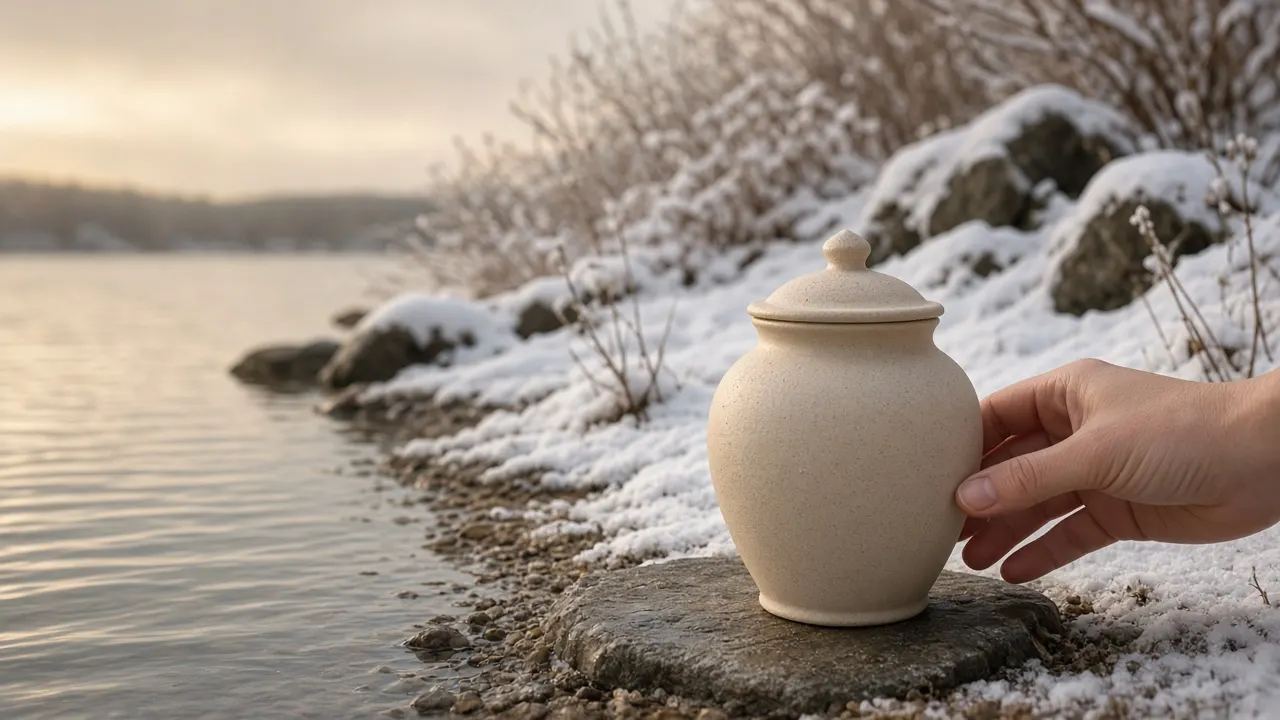
Water releases need open water, and in Sanford lakes and ponds may ice over around January. Never walk out onto ice to release an urn. If a lake or river was your pet's place, plan the release for spring or summer, when the shoreline is safe and a water-soluble urn can float and dissolve as it's meant to. Keep the ashes at home until then.
Early spring in Sanford is when nurseries sell bare-root trees, often at a lower price than trees in pots. They need planting quickly, as soon as the ground can be dug after January, February, March, April, November and December, which fits well with ashes that have waited through the winter. Have the soil blend ready beforehand, soak the roots for an hour, and plant on a calm, overcast day.
Eco memorial prices, from urn to tree
A living memorial in Sanford has two costs: the cremation and the urn. Biodegradable pet urns are among the cheaper urns you can buy, listed at about $15–$80[6] in one national price guide, and a sapling from a local nursery often costs less than a decorative display urn. If you'd like water cremation, one pet insurer's guide lists aquamation at $80 to $450 depending on size[7]. The table shows published examples.
We keep the detailed Maine price table on one page so it stays current: see Maine prices.

Free tool
Memorial budget planner
Add up cremation, urn, keepsakes and a farewell so the total holds no surprises.
What Maine allows for ashes, in general terms
Cremated remains aren't a health hazard in the way a body is, which is why planting ashes in your own garden is rarely restricted. Public places are different. Parks, nature reserves, beaches and waterways in Maine each have a manager with their own policy, and some don't allow scattering or planting at all. A short email before the day saves an awkward conversation.
The official Maine local government directory lists every county and city office, which is the quickest way to find who to ask in Sanford.
The Maine page sets out who oversees pet cremation and what the state says about burial and scattering. Sanford's own bylaws can sit on top of that, so ask before you dig.
From ashes to a growing tree: the steps
- Decide what the memorial is for. A place to visit, something growing, a return to water or a lower-impact goodbye each point to a different choice.
- If a greener cremation matters, ask about aquamation first, since no other choice in the process changes the environmental picture as much.
- Keep a small portion back in a keepsake if there's any chance you'll move or want a second planting later.
- Buy the tree locally. A native sapling from a nursery near Sanford will usually outgrow a seed from a kit.
- Prepare the soil a season ahead if the timing allows, so the ash and compost blend is ready on planting day.
- Plant with the people who loved your pet; hand everyone a task of their own, whether blending, backfilling or watering.
Living memorials beyond the backyard
Ponds scattered around Sanford, along with the trails beside the Mousam, are places where many people spent time outdoors with their animals. A few families leave some ashes at a meaningful spot, after checking whether the landowner or the town allows it. Others keep ashes at home until they decide, and there is no deadline on that choice at all.
browse in-depth guides or recent articles, or compare your instinct with the poll results, try the free planning tools, Every option Sanford families choose between is on the services page. Close to Sanford we also cover Portland, Bangor, Auburn and Biddeford; the full list for Maine and for the United States is a click away.

Reader polls
What would you choose?
Vote anonymously and see how other readers answered. The results are live counts from people who visit this site, so they show real opinions, not a scientific sample.
If you rent or might move, how would you handle a memorial planting?
Tap an answer to vote and see how others answered. Anonymous.
Would you consider releasing your pet's ashes in water?
Tap an answer to vote and see how others answered. Anonymous.
If you had to decide today, which aftercare would you choose for your pet?
Tap an answer to vote and see how others answered. Anonymous.

Free tools to help you plan
Memorial budget planner
Add up cremation, urn, keepsakes and a farewell so the total holds no surprises.

Memorial tree finder
Pick a tree for a planting urn that suits your climate, space and pet.

Aftercare options compared
Compare private, communal and water cremation with burial on cost, timing and what comes home.
Questions people ask
Can a provider from a neighbouring town collect from Sanford?
Usually yes. Rochester is about 14 miles away, Kennebunkport is about 15 miles away and Dover is about 18 miles away, all inside a normal collection radius. Get the mileage written into the quote so there is no surprise on the day.
Is Sanford big enough to have several pet aftercare providers?
Probably, on the numbers. By our estimate about 8,350 Sanford households keep a dog or cat and around 690 lose one each year, which is enough steady demand to support more than one provider. We derive that from population (about 22,663), household size and national ownership and lifespan figures.
Is cremation common in Maine?
For people, yes: about 74.7%[5] of Maine deaths end in cremation, according to Direct Cremate (citing CANA) (2024). Nobody publishes the same figure for pets, but in our experience pet choices in Sanford follow the human pattern closely, so cremation is the default most families here start from.
Does the Sanford climate change what I should do first?
Only the timing. In July, with highs near 81°F, cool the body and book collection the same day. In January, February, March, April, November and December, when lows sit below freezing, a home burial may have to wait for a thaw, so cremation with ashes returned keeps your options open.
Can I plant my pet's ashes in winter in Sanford?
Not usually, if the ground is frozen. Keep the ashes indoors until spring, when the soil has thawed and drained, or plant in early autumn with several weeks of open ground before hard frosts. Winter is a good time to mix the ashes with compost in a covered tub and let the blend rest before planting.
How long does a water-soluble urn take to dissolve?
Most are made from salt, sand, paper or gelatin and dissolve within minutes to hours once they sink. Some float briefly first, long enough for a few words: one maker's water urn floats for several minutes before dissolving[9]. Calm water gives the best result, so check the forecast for wind before you go.


Sources and our estimates
- [1] 53% of US households own a dog, which is about 71 million households. American Pet Products Association (APPA) 2025 State of the Industry, 2025.
- [2] US dogs have an average life expectancy at birth of 12.69 years. Montoya et al. 2023, Frontiers in Veterinary Science - Banfield Pet Hospital life expectancy tables (13.3 million dogs, 2.4 million cats, 2013-2019), 2023.
- [3] 39% of US households own a cat, which is about 53 million households. American Pet Products Association (APPA) 2025 State of the Industry, 2025.
- [4] US cats seen at Banfield hospitals have an average life expectancy at birth of 11.18 years. Montoya et al. 2023, Frontiers in Veterinary Science - Banfield Pet Hospital life expectancy tables (13.3 million dogs, 2.4 million cats, 2013-2019), 2023.
- [5] Maine had a 74.7% cremation rate in 2024, among the highest in the US. Direct Cremate (citing CANA), 2024.
- [6] Memorials.com's pet urn cost guide puts biodegradable pet urns at $15–$80. Memorials.com – Pet Urn Cost Guide, 2025.
- [7] Embrace Pet Insurance lists US communal cremation at $30-$200, partitioned at $50-$250, private at $100-$500+ and aquamation at $80-$450. Embrace Pet Insurance - Bury or Cremate Your Dog? Costs, Pros & Cons, 2025.
- [8] U.S. pet flame cremations emit on the order of 47,000 t CO2e a year. Our estimate: 1.5M pet cremations x 31.3 kg CO2e. How we calculate.
- [9] The Living Urn's Eco Water Urn for water burial costs $149 and holds up to 225 cubic inches; it floats for several minutes before dissolving. The Living Urn – Eco Water Urn, 2026.
Get eco memorial ideas by email
Tell us what you need and where you are. We'll reply by email with clear options and prices so you can decide in your own time.