A living memorial for your pet in Marquette
Marquette has an estimated 8,100 dog- or cat-owning households. When a planting or water memorial feels right for yours, here's what works in the local climate and what to ask before you buy.
- Planting, garden and water urns compared
- Honest notes on local rules
- Help choosing a native species

Marquette, Michigan
Living memorials in Marquette: the local picture
Some Marquette families wait until June to hold a small planting, setting a compostable urn under a young spruce or paper birch that can take the cold. Others set aside a pinch for a locket and place the rest on their own land or at a family camp. Clay paw prints and fur keepsakes are only possible while the provider still has your companion, so mention them right away.
Marquette families often choose memorials drawn from the landscape: a wooden urn turned from U.P. maple or birch, a polished Lake Superior stone lettered with a name, a small agate set into a pendant. Others prefer a simple ceramic urn on the mantel. There's no need to decide quickly, especially if you're waiting for spring to plant or place anything outdoors, which here can mean May.
Most families in and around Marquette arrange cremation through their local vet, who works with a regional crematory, and then do the memorial themselves. That's a good split. Bio urns ship by mail, and the local feed store, nursery or hardware store usually has the compost, pine bark and a pH kit you need. The one thing worth buying locally is the tree, because a nursery near you already knows what survives your winters and summers.
Marquette's population is around 21,944, the 50th-largest of the 63 Michigan communities we cover.
The closest communities we cover are Charlevoix (133 miles), Howard (141 miles) and Petoskey (143 miles). Providers serving those towns often travel to Marquette too, so it can be worth asking them for a quote.
Our estimate
8,100
Estimated dog- or cat-owning households in Marquette
How we calculated this
21,944 ÷ 2.5 = 8,778 households; × 53% (dog) + 39% (cat) = 8,100. Multi-pet homes count once.
Our estimate
670
dog and cat deaths per year in Marquette, our estimate
How we calculated this
8,100 dog/cat-owning homes ÷ average lifespan (dog: 12.69 yrs + cat: 11.18 yrs) ≈ 670 a year. The real figure is unlikely to be lower.
53%[1]
53% of US households own a dog, which is about 71 million households.
12.69 years[2]
US dogs have an average life expectancy at birth of 12.69 years.
39%[3]
39% of US households own a cat, which is about 53 million households.
11.18 years[4]
US cats seen at Banfield hospitals have an average life expectancy at birth of 11.18 years.
None of the figures on this this page are ours alone: they rest on Montoya et al. 2023, Frontiers in Veterinary Science and American Pet Products Association (APPA) 2025 State of the Industry.

How Michigan feels about cremation
In Michigan, with a human cremation rate of roughly 69.5%[5], you'll often find pet cemeteries and pet crematories operating side by side. Some cemeteries now offer small plots for ashes, occasionally with a tree or shrub above them. That's worth comparing with a garden planting at home: a cemetery plot stays put if you move, while your own garden costs nothing and stays private.
NFDA 2024 Cremation & Burial Report state projections (via Occasional Sage) (2024) is where the Michigan figure comes from. It counts people; we use it because attitudes to cremating a pet in Marquette tend to follow attitudes to cremation generally.
When to plant in Marquette's climate
Snow can hide a young memorial tree and the damage done around it. In Marquette, where lows average about 7°F in February, voles and rabbits chew bark under the snow line, and snowplows or shovels can snap a sapling. Put a tall stake beside the planting so you can find it, and fit a loose guard around the trunk before the first snow.
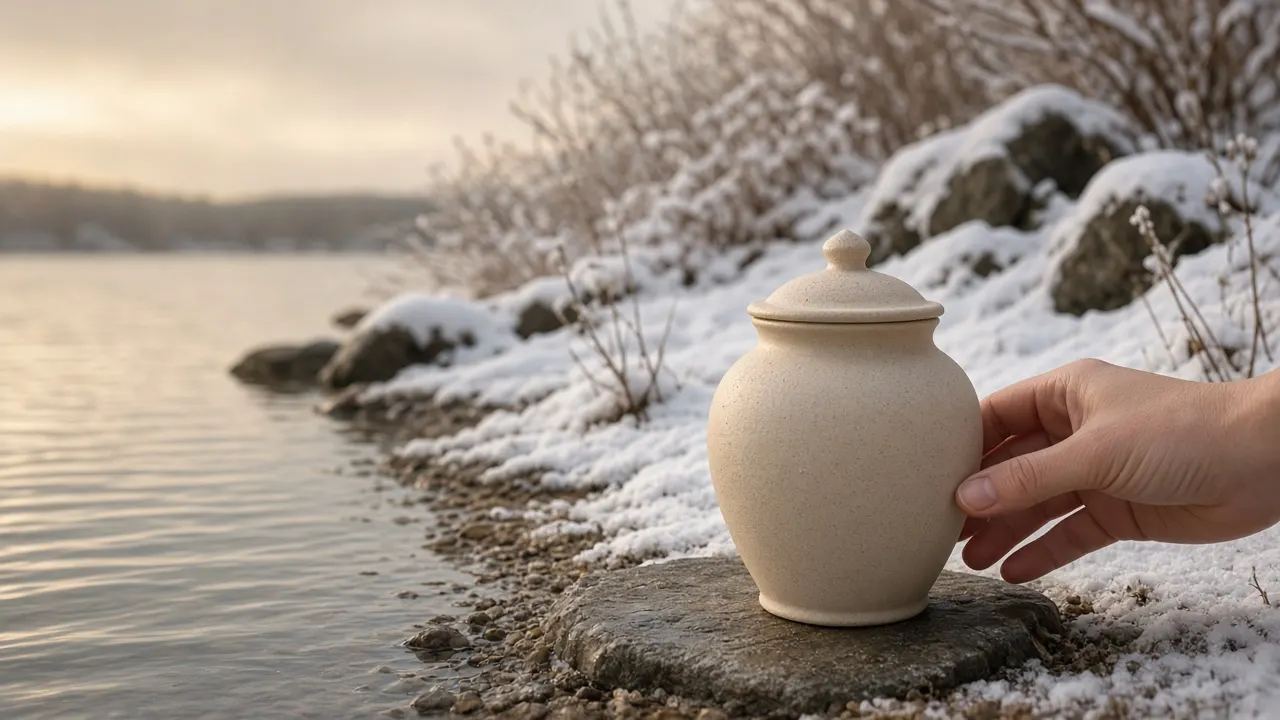
Water releases need open water, and in Marquette lakes and ponds may ice over around February. Never walk out onto ice to release an urn. If a lake or river was your pet's place, plan the release for spring or summer, when the shoreline is safe and a water-soluble urn can float and dissolve as it's meant to. Keep the ashes at home until then.
Price ranges for planting and water urns
Bio urns vary more in price than you might expect. A national guide puts biodegradable urns at $70–$260[6], depending on material, size and whether a seed or tree system is included. For a lake or sea release, one water urn designed to float briefly and dissolve sells for $149[7]. In Marquette, the tree and the soil amendments are usually the cheapest part of the whole memorial.
For a line-by-line price table, see the Michigan overview; for what's included in each option, see our services.

Free tool
Memorial budget planner
Add up cremation, urn, keepsakes and a farewell so the total holds no surprises.
Where you can plant or release ashes in Michigan
Burying ashes, scattering them loose and releasing them on water are often treated as three different things. In Michigan, a place that welcomes a scattering may forbid digging, and a lake that allows a release may not allow a gathering on the shore. When you ask permission, say exactly which one you have in mind.
To find your county or city office in Michigan, start with the official Michigan local government directory.
Start with the Michigan rules, which cover burial, scattering and oversight for the whole state, and treat Marquette's local ordinances as a possible extra layer.
Your next steps, whatever your situation
- If you're remembering more than one animal, decide early whether the ashes will be planted together or apart. Both are fine, but mixed ashes can't be separated later.
- Label each container clearly the moment it arrives, name and date on the lid, which matters most when the sets come home a long way apart.
- Choose a bigger planting area when there are several sets of ashes; a long hedge, a cluster of shrubs or a few fruit trees gives the minerals more ground to disperse into.
- Keep a spoonful of each in its own keepsake, so a family member who was closest to one particular pet has something just for them.
- Plan for the pets still living with you. A new planting that smells of bone attracts diggers, so protect it for the first few months.
- Add a marker for each name, or a single stone carrying all of them, so anyone visiting understands who is remembered there.
Ways to mark the spot and the date
Heavy snow, deep frost and six months of freezing punish outdoor memorials in Marquette. Granite and cast bronze last longest, though even they can heave out of level if set on bare soil. Bed a stone on crushed rock, keep it well away from where the plow throws snow, and consider keeping a marker on a covered porch or indoors until the ground softens in spring.
there are guides for the big decisions and articles for the details, try the free planning tools, or see how other readers answered in our polls, See what each option includes on our services page. You can also browse every city in the United States. Nearby, we also cover Detroit, Lansing, Sterling Heights and Grand Rapids, and every city in Michigan.

Reader polls
What would you choose?
Vote anonymously and see how other readers answered. The results are live counts from people who visit this site, so they show real opinions, not a scientific sample.
If you rent or might move, how would you handle a memorial planting?
Tap an answer to vote and see how others answered. Anonymous.
What kind of tree or plant would you choose?
Tap an answer to vote and see how others answered. Anonymous.
If you had to decide today, which aftercare would you choose for your pet?
Tap an answer to vote and see how others answered. Anonymous.

Free tools to help you plan
Memorial budget planner
Add up cremation, urn, keepsakes and a farewell so the total holds no surprises.

Memorial tree finder
Pick a tree for a planting urn that suits your climate, space and pet.

Aftercare options compared
Compare private, communal and water cremation with burial on cost, timing and what comes home.
Questions people ask
How many pet owners live in Marquette?
By our estimate, about 8,100 households in Marquette have at least one dog or cat, and around 670 are lost each year. We calculate this from the city's population of about 21,944, the average household size and national ownership and lifespan figures, so treat it as a floor rather than an exact count.
Is cremation common in Michigan?
For people, yes: about 69.5%[5] of Michigan deaths end in cremation, according to NFDA 2024 Cremation & Burial Report state projections (via Occasional Sage) (2024). Nobody publishes the same figure for pets, but in our experience pet choices in Marquette follow the human pattern closely, so cremation is the default most families here start from.
How does Marquette's weather affect pet aftercare?
July is the hottest month in Marquette, with average highs around 76°F, so prompt collection matters most then. Average lows drop below freezing in January, February, March, April, November and December, which can make digging a grave hard until spring.
Which nearby towns can I compare with Marquette?
The closest communities we cover are Charlevoix (about 133 miles), Howard (about 141 miles) and Petoskey (about 143 miles). Providers based in those places often serve Marquette too. Ask each one for a written total that includes collection, so the distance is priced in.
Can I plant a tree directly on my pet's ashes in Marquette?
It's better not to. Cremated remains have a very high pH, around 11.7[9], and they're high in sodium, so a solid layer of ash under the roots can yellow or kill a young tree. Mix the ashes through plenty of compost and soil across a wider area, test the pH, and plant once it has come down. There's no single mixing ratio that suits every pet and every soil.
Where can I buy a native tree for a pet memorial in Marquette?
A local nursery or garden center is the best place, because staff know what survives local heat, cold and soil. Some county extension offices and native plant societies run plant sales too. Ask for a two-year-old sapling of a species that tolerates slightly alkaline soil, and ask how much water it needs in its first summer.


Sources and our estimates
- [1] 53% of US households own a dog, which is about 71 million households. American Pet Products Association (APPA) 2025 State of the Industry, 2025.
- [2] US dogs have an average life expectancy at birth of 12.69 years. Montoya et al. 2023, Frontiers in Veterinary Science - Banfield Pet Hospital life expectancy tables (13.3 million dogs, 2.4 million cats, 2013-2019), 2023.
- [3] 39% of US households own a cat, which is about 53 million households. American Pet Products Association (APPA) 2025 State of the Industry, 2025.
- [4] US cats seen at Banfield hospitals have an average life expectancy at birth of 11.18 years. Montoya et al. 2023, Frontiers in Veterinary Science - Banfield Pet Hospital life expectancy tables (13.3 million dogs, 2.4 million cats, 2013-2019), 2023.
- [5] The NFDA projected Michigan's cremation rate at 69.5% for 2024. NFDA 2024 Cremation & Burial Report state projections (via Occasional Sage), 2024.
- [6] Funeral.com cites U.S. Funerals Online that biodegradable urns typically cost about $70–$260. Funeral.com – How Much Do Cremation Urns Cost in 2025, 2025.
- [7] The Living Urn's Eco Water Urn for water burial costs $149 and holds up to 225 cubic inches; it floats for several minutes before dissolving. The Living Urn – Eco Water Urn, 2026.
- [8] U.S. pet flame cremations emit on the order of 47,000 t CO2e a year. Our estimate: 1.5M pet cremations x 31.3 kg CO2e. How we calculate.
- [9] Cremated remains have a very high pH of approximately 11.7, which is toxic to plants without amendment. Larkspur Conservation — Giving Cremated Remains a New Life Through Science, 2024.
Plan a living memorial in Marquette
Tell us what you need and where you are. We'll reply by email with clear options and prices so you can decide in your own time.