A living memorial for your pet in Traverse City
About 490 dogs and cats are lost in Traverse City each year, by our estimate. If you'd like your pet's ashes to grow into a tree or return to the water, this page covers the soil, the season and the cost.
- A memorial that moves with you
- Why pure ashes harm young roots
- Written prices you can compare

Traverse City, Michigan
Living memorials in Traverse City: the local picture
In a region built on orchards, some families plant a young cherry tree, a paper birch or a white pine over a plantable urn, so the loss turns into something that grows and blossoms. Others keep a pinch in a pendant and place the rest on family land up the peninsula. Paw prints in clay and saved fur need to be requested on the first call, while there's still time.
Traverse City families often choose memorials tied to the landscape: an urn turned from local cherry wood, a smooth stone from the bay shore with a name carved in, or a glass keepsake tinted the blue-green of Grand Traverse Bay. Others keep it simple with a ceramic urn on the mantel. Many people hold the ashes in the provider's container through the winter and choose something once the snow melts.
Small towns tend to have long memories, and a memorial tree in Traverse City is often planted with a lot of history around it: the same yard for decades, a family farm, a favorite fishing spot. If the land is likely to stay in the family, a long-lived native tree is a lovely choice. If it might be sold, consider a shrub bed, a portion of ashes kept back, or a water release that doesn't depend on who owns the ground in twenty years.
About 15,832 people live in Traverse City, which makes it the 58th-largest of the 63 Michigan communities we cover.
Our pages for Charlevoix (42 miles), Petoskey (53 miles) and Mount Pleasant (91 miles) describe the same choices from those towns' point of view, and the providers overlap, so a quote from one often covers Traverse City as well.
Our estimate
5,850
Estimated dog- or cat-owning households in Traverse City
How we calculated this
15,832 ÷ 2.5 = 6,333 households; × 53% (dog) + 39% (cat) = 5,850. Multi-pet homes count once.
Our estimate
490
Traverse City families who lose a dog or cat each year (estimate)
How we calculated this
5,850 dog/cat-owning homes ÷ average lifespan (dog: 12.69 yrs + cat: 11.18 yrs) ≈ 490 a year. The real figure is unlikely to be lower.
53%[1]
53% of US households own a dog, which is about 71 million households.
12.69 years[2]
US dogs have an average life expectancy at birth of 12.69 years.
39%[3]
39% of US households own a cat, which is about 53 million households.
11.18 years[4]
US cats seen at Banfield hospitals have an average life expectancy at birth of 11.18 years.
To check the figures yourself, see Montoya et al. 2023, Frontiers in Veterinary Science and American Pet Products Association (APPA) 2025 State of the Industry.

The local attitude to ashes and memorials
The share of people cremated in Michigan, now about 69.5%[5], keeps inching up. For pet owners, that shift has brought more questions about what to do once the ashes come home. There's no need to decide on the day. Many families keep the ashes for a season, talk about what their pet loved, and only then settle on a tree, a pot or a lake.
That Michigan rate is a human one, published by NFDA 2024 Cremation & Burial Report state projections (via Occasional Sage) (2024). We quote it for Traverse City only as a pointer to how families here already think about cremation.
Traverse City seasons and your memorial tree
A Traverse City winter is a useful waiting room. With 5 months of freezing lows, you can mix the ashes with compost in a covered bin or tub in a garage or shed during the cold months and let the mix rest. One gardening guide suggests at least 90–120 days[6] before planting, which fits neatly between a winter loss and spring planting. Test the pH before the tree goes in.
Water releases need open water, and in Traverse City lakes and ponds may ice over around February. Never walk out onto ice to release an urn. If a lake or river was your pet's place, plan the release for spring or summer, when the shoreline is safe and a water-soluble urn can float and dissolve as it's meant to. Keep the ashes at home until then.
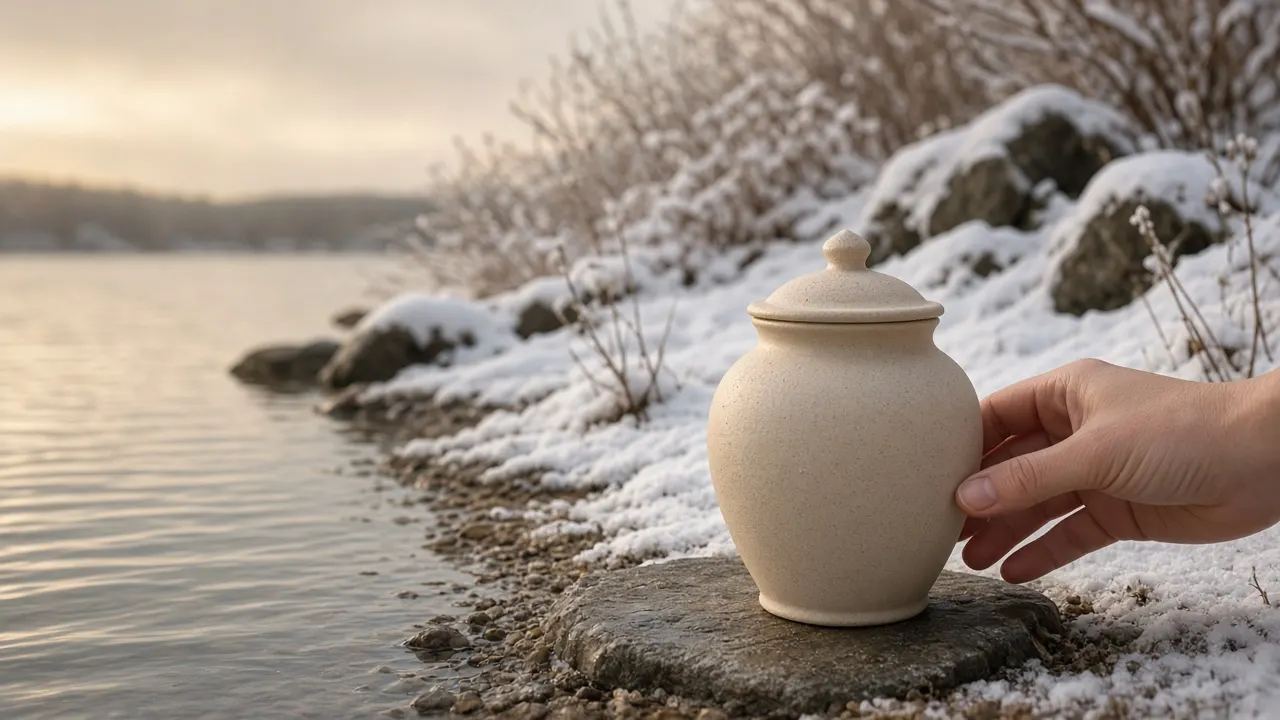
What bio urns and aquamation cost in Traverse City
Here's how the pieces add up for a Traverse City family. Private cremation of a dog averages about $260[7] nationally. A pet bio urn with a seed capsule is sold for about $99[8], and a planting system without the tree for $119[9]. Compost, pine bark and a pH kit add a few dollars more. Ask local providers for a written total before you choose.
The full price table by product is on our Michigan page, and the services page explains what each option includes.

Free tool
Memorial budget planner
Add up cremation, urn, keepsakes and a farewell so the total holds no surprises.
Scattering and planting rules in Michigan
If you live under a homeowners' association, a co-op board or a tenancy agreement in Michigan, its rules can matter more than any public law. Many restrict new trees, digging near shared pipes or heavy pots on balconies. A quick read of the rules, or one email to the manager, tells you whether a tree, a shrub bed or a container memorial is the right fit.
Not sure which office covers Traverse City? The Michigan local government directory is the official list.
The Michigan page sets out who oversees pet cremation and what the state says about burial and scattering. Traverse City's own bylaws can sit on top of that, so ask before you dig.
What to do first, and what can wait for the right season
- If you're remembering more than one animal, settle at the start on one shared planting or separate ones. Either works, but once the ashes are combined there's no undoing it.
- Label each container clearly with the name and date as it comes back, especially if the ashes return months or years apart.
- Choose a bigger planting area when there are several sets of ashes; a long hedge, a cluster of shrubs or a few fruit trees gives the minerals more ground to disperse into.
- Keep a spoonful of each in its own keepsake, so a family member who was closest to one particular pet has something just for them.
- Plan for the pets still living with you. A new planting that smells of bone attracts diggers, so protect it for the first few months.
- Add a marker for each name, or a single stone carrying all of them, so anyone visiting understands who is remembered there.
Living memorials beyond the backyard
Up here, a garden marker has to survive months under snow, spring meltwater, and frost that reaches deep into the ground. Granite and bronze are the materials that last; bed them on several inches of crushed stone so they don't heave, and keep them clear of the path where the plow or snowblower throws snow. Choose lettering cut deep enough to read after decades of northern weather.
Compare every option on our services page, run the numbers with the free planning tools, or look at how readers voted in our polls, look through our guides and the blog. If you live between Traverse City and Sterling Heights, Detroit, Warren and Ann Arbor, either page applies. Every other community in Michigan, and all of the United States, is listed too.

Reader polls
What would you choose?
Vote anonymously and see how other readers answered. The results are live counts from people who visit this site, so they show real opinions, not a scientific sample.
If water cremation (aquamation) were offered near you, would you choose it?
Tap an answer to vote and see how others answered. Anonymous.
What kind of tree or plant would you choose?
Tap an answer to vote and see how others answered. Anonymous.
If you had to decide today, which aftercare would you choose for your pet?
Tap an answer to vote and see how others answered. Anonymous.

Free tools to help you plan
Memorial budget planner
Add up cremation, urn, keepsakes and a farewell so the total holds no surprises.

Memorial tree finder
Pick a tree for a planting urn that suits your climate, space and pet.

Aftercare options compared
Compare private, communal and water cremation with burial on cost, timing and what comes home.
Questions people ask
Can a provider from a neighbouring town collect from Traverse City?
Usually yes. Charlevoix is about 42 miles away, Petoskey is about 53 miles away and Mount Pleasant is about 91 miles away, all inside a normal collection radius. Get the mileage written into the quote so there is no surprise on the day.
Roughly how many pets die in Traverse City each year?
Our estimate is around 490. It comes from Traverse City's population (about 15,832), the average household size, the share of homes with a dog or cat (about 5,850 households here) and the average lifespan. It is arithmetic, not a count, so read it as a rough floor.
How does Traverse City's weather affect pet aftercare?
July is the hottest month in Traverse City, with average highs around 81°F, so prompt collection matters most then. Average lows drop below freezing in January, February, March, November and December, which can make digging a grave hard until spring.
Is cremation common in Michigan?
For people, yes: about 69.5%[5] of Michigan deaths end in cremation, according to NFDA 2024 Cremation & Burial Report state projections (via Occasional Sage) (2024). Nobody publishes the same figure for pets, but in our experience pet choices in Traverse City follow the human pattern closely, so cremation is the default most families here start from.
Can I plant a tree directly on my pet's ashes in Traverse City?
It's better not to. Cremated remains have a very high pH, around 11.7[11], and they're high in sodium, so a solid layer of ash under the roots can yellow or kill a young tree. Mix the ashes through plenty of compost and soil across a wider area, test the pH, and plant once it has come down. There's no single mixing ratio that suits every pet and every soil.
Will the seed in a tree urn grow?
Not always. Seeds from kits can fail to sprout if they weren't stored or chilled correctly, and alkaline soil around them makes it harder. A young tree from a nursery near Traverse City is far more reliable, and most planting urns work just as well with a sapling in the top chamber.


Sources and our estimates
- [1] 53% of US households own a dog, which is about 71 million households. American Pet Products Association (APPA) 2025 State of the Industry, 2025.
- [2] US dogs have an average life expectancy at birth of 12.69 years. Montoya et al. 2023, Frontiers in Veterinary Science - Banfield Pet Hospital life expectancy tables (13.3 million dogs, 2.4 million cats, 2013-2019), 2023.
- [3] 39% of US households own a cat, which is about 53 million households. American Pet Products Association (APPA) 2025 State of the Industry, 2025.
- [4] US cats seen at Banfield hospitals have an average life expectancy at birth of 11.18 years. Montoya et al. 2023, Frontiers in Veterinary Science - Banfield Pet Hospital life expectancy tables (13.3 million dogs, 2.4 million cats, 2013-2019), 2023.
- [5] The NFDA projected Michigan's cremation rate at 69.5% for 2024. NFDA 2024 Cremation & Burial Report state projections (via Occasional Sage), 2024.
- [6] Gardening Know How advises letting an ash/soil-amendment mixture sit for at least 90 to 120 days before planting. Gardening Know How — Planting With Cremains: Is There a Safe Way to Bury Ashes, 2024.
- [7] CareCredit's 2025 cost study put the US national average for private dog cremation at $260 (range $206-$473). CareCredit (Synchrony) - How Much Does It Cost To Euthanize a Dog? (2025 ASQ360 procedural cost study), 2025.
- [8] The Bios Urn for pets, a biodegradable urn with a seed capsule, costs $99. Bios Urn – Pets, 2026.
- [9] The Living Urn's pet bio-urn planting system (without a tree) costs $119. The Living Urn – Pet tree urn, 2026.
- [10] About 59 million U.S. pet-owning households may be open to eco-friendly aftercare options. Our estimate: 86.9M pet households x 68% interested in green funeral options. How we calculate.
- [11] Cremated remains have a very high pH of approximately 11.7, which is toxic to plants without amendment. Larkspur Conservation — Giving Cremated Remains a New Life Through Science, 2024.
Ask about aquamation near Traverse City
Tell us what you need and where you are. We'll reply by email with clear options and prices so you can decide in your own time.