Growing something from the goodbye in Norfolk
About 820 dogs and cats are lost in Norfolk each year, by our estimate. If you'd like your pet's ashes to grow into a tree or return to the water, this page covers the soil, the season and the cost.
- Trees matched to Norfolk's climate
- Soil-safe planting method for ashes
- Real prices for bio urns and aquamation

Norfolk, Nebraska
Planning a greener goodbye in Norfolk
Norfolk families frequently have children and grandchildren who have moved to Omaha, Sioux City or farther away. Dividing the ashes means each household can keep something: a keepsake urn for one, a charm or bracelet for another, a portion planted under a tree at the home place. Mention it when booking so the provider can prepare separate portions, labeled if you ask.
In Norfolk, memorials often reflect a mix of town and farm life: a painted tin on the bookcase, a granite stone by the machine shed, a pendant for a teenager who showed the animal at the county fair. There's no need to decide in a hurry. Ashes stay safe in the crematory's box for as long as needed, so the family can take its time.
Country land around Norfolk gives you options city families don't have, and a few extra things to think about. Keep ash plantings well away from wells, springs and streams, and away from ground where livestock graze or crops are grown. Choose a spot with some shelter from wind for a young tree, and remember that deer and rabbits find new plantings quickly; a simple tree guard or wire cage for the first few years can make all the difference.
With roughly 26,677 residents, Norfolk is the 7th-largest of the 11 Nebraska communities we cover.
Our pages for Columbus (41 miles), Yankton (60 miles) and Sioux City (62 miles, a larger centre) describe the same choices from those towns' point of view, and the providers overlap, so a quote from one often covers Norfolk as well.
Our estimate
9,800
Estimated dog- or cat-owning households in Norfolk
How we calculated this
26,677 ÷ 2.5 = 10,671 households; × 53% (dog) + 39% (cat) = 9,800. Homes are counted once however many pets they keep.
Our estimate
820
Estimated dog and cat losses in Norfolk each year
How we calculated this
9,800 dog/cat-owning homes ÷ average lifespan (dog: 12.69 yrs + cat: 11.18 yrs) ≈ 820 a year. Treat it as a minimum.
53%[1]
53% of US households own a dog, which is about 71 million households.
12.69 years[2]
US dogs have an average life expectancy at birth of 12.69 years.
39%[3]
39% of US households own a cat, which is about 53 million households.
11.18 years[4]
US cats seen at Banfield hospitals have an average life expectancy at birth of 11.18 years.
None of the figures on this this page are ours alone: they rest on American Pet Products Association (APPA) 2025 State of the Industry and Montoya et al. 2023, Frontiers in Veterinary Science.

Cremation habits in Nebraska, and what they mean for a bio urn
About 62.2%[5] of people in Nebraska are cremated, which puts it in the middle: cremation is common, but so is burial. For pets, that often means families weigh a planting urn against a whole-body burial in the yard. Both can grow a tree. The planting urn takes less space and can go almost anywhere; a whole-body grave needs more depth and distance from water, and the tree should go beside it rather than directly on top.
NFDA 2024 Cremation & Burial Report state projections (via Occasional Sage) (2024) is where the Nebraska figure comes from. It counts people; we use it because attitudes to cremating a pet in Norfolk tend to follow attitudes to cremation generally.
What Norfolk's climate means for a living memorial
In places like Norfolk, driveways and sidewalks are often salted in January, February, March, November and December. Ashes already add sodium to the soil, and road salt splashed onto the same bed doubles the load. Keep a memorial planting well back from salted paths and the edge of the road, and away from where snow gets piled. A spot uphill from the drive is better than one downhill of it.
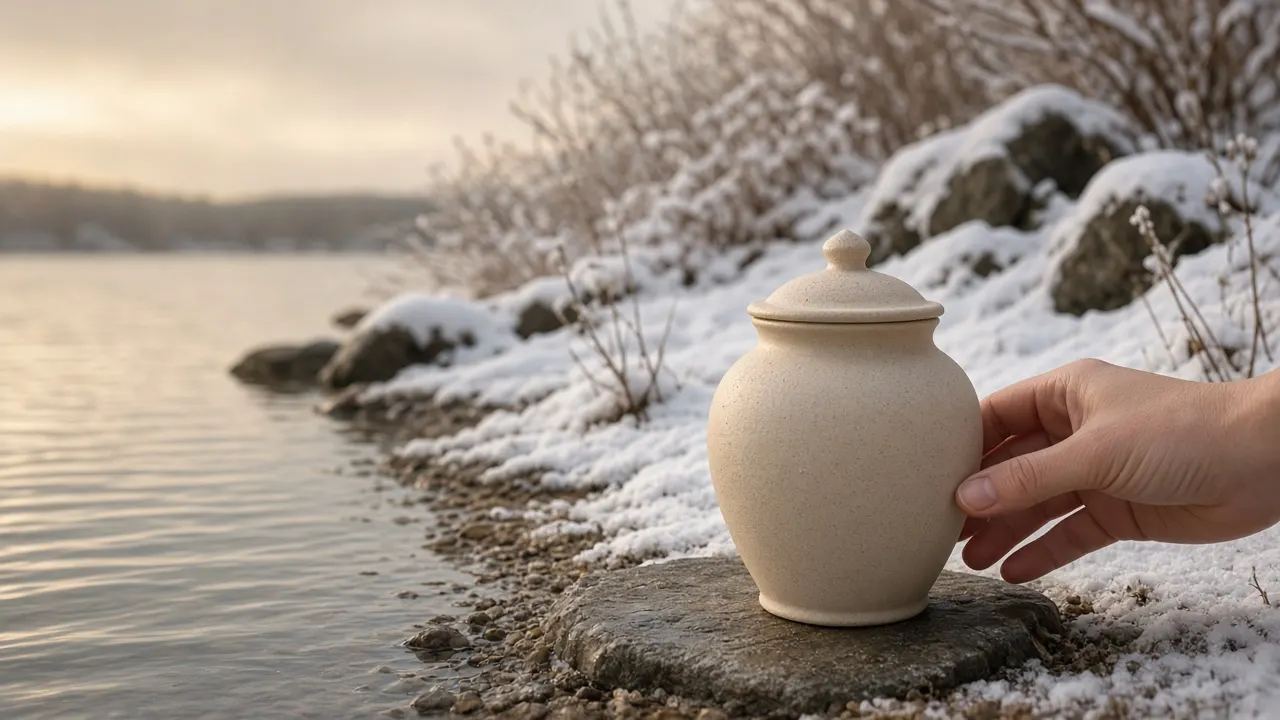
Water releases need open water, and in Norfolk lakes and ponds may ice over around January. Never walk out onto ice to release an urn. If a lake or river was your pet's place, plan the release for spring or summer, when the shoreline is safe and a water-soluble urn can float and dissolve as it's meant to. Keep the ashes at home until then.
What bio urns and aquamation cost in Norfolk
Add up every part before you commit. Beyond the cremation, a living memorial in Norfolk can include the bio urn, compost and bark, a pH kit, the tree or shrub, a guard against deer or rabbits, and perhaps a marker. Our memorial budget planner lists each line so nothing surprises you. Most families find the tree is the cheapest part and the cremation the most expensive.
For a line-by-line price table, see the Nebraska overview; for what's included in each option, see our services.

Free tool
Memorial budget planner
Add up cremation, urn, keepsakes and a farewell so the total holds no surprises.
Rules worth knowing in Nebraska before you scatter
What you plant can matter as much as where. Parks and nature reserves in Nebraska often forbid planting anything at all, and even on private land some trees and shrubs are listed as invasive in parts of the region. A local nursery or native plant society can steer you toward a species that won't spread into wild land.
To find your county or city office in Nebraska, start with the official Nebraska local government directory.
The Nebraska page sets out who oversees pet cremation and what the state says about burial and scattering. Norfolk's own bylaws can sit on top of that, so ask before you dig.
What to do first, and what can wait for the right season
- If your pet dies while you're away from Norfolk, ask a local vet near where it happened to arrange individual cremation there. Bringing a body home over a long distance is rarely practical.
- Ask how the ashes can reach you: collected in person, posted by a tracked courier service, or sent to your own vet.
- Flying home with the ashes? Carry them in your hand luggage in a container that can be X-rayed, with the crematory's certificate in the same bag.
- Don't buy the bio urn on the road. Hold off until you're back and have settled on a location, then choose an urn that suits it.
- Plant somewhere that links both places if the idea appeals: perhaps a species native to the area your pet died in, or one already growing at home, provided it can cope with the climate in Norfolk.
- Write down the date and place where your pet died and where it was cremated. Those details fade faster than you'd expect.
Remembering your pet in Norfolk
Northeast Nebraska's weather is hard on outdoor memorials, with hailstorms, strong winds and months of freezing temperatures. Granite and bronze will stand for generations, while plastics and molded cement give out early. Seat any marker on a bed of compacted gravel to keep it from heaving. Keep glass or ceramic keepsakes inside, away from frost and direct sun, perhaps grouped with family photos.
browse in-depth guides or recent articles, use the free tools before you ring anyone, Compare every option on our services page, or compare your instinct with the poll results. Close to Norfolk we also cover Bellevue, Omaha, Kearney and Lincoln; the full list for Nebraska and for the United States is a click away.

Reader polls
What would you choose?
Vote anonymously and see how other readers answered. The results are live counts from people who visit this site, so they show real opinions, not a scientific sample.
What kind of tree or plant would you choose?
Tap an answer to vote and see how others answered. Anonymous.
Would you consider releasing your pet's ashes in water?
Tap an answer to vote and see how others answered. Anonymous.
If you had to decide today, which aftercare would you choose for your pet?
Tap an answer to vote and see how others answered. Anonymous.

Free tools to help you plan
Memorial budget planner
Add up cremation, urn, keepsakes and a farewell so the total holds no surprises.

Memorial tree finder
Pick a tree for a planting urn that suits your climate, space and pet.

Aftercare options compared
Compare private, communal and water cremation with burial on cost, timing and what comes home.
Questions people ask
Is cremation common in Nebraska?
For people, yes: about 62.2%[5] of Nebraska deaths end in cremation, according to NFDA 2024 Cremation & Burial Report state projections (via Occasional Sage) (2024). Nobody publishes the same figure for pets, but in our experience pet choices in Norfolk follow the human pattern closely, so cremation is the default most families here start from.
Does the Norfolk climate change what I should do first?
Only the timing. In July, with highs near 86°F, cool the body and book collection the same day. In January, February, March, November and December, when lows sit below freezing, a home burial may have to wait for a thaw, so cremation with ashes returned keeps your options open.
Roughly how many pets die in Norfolk each year?
Our estimate is around 820. It comes from Norfolk's population (about 26,677), the average household size, the share of homes with a dog or cat (about 9,800 households here) and the average lifespan. It is arithmetic, not a count, so read it as a rough floor.
Can a provider from a neighbouring town collect from Norfolk?
Usually yes. Columbus is about 41 miles away, Yankton is about 60 miles away and Sioux City is about 62 miles away, all inside a normal collection radius. Get the mileage written into the quote so there is no surprise on the day.
I rent in Norfolk. Can I still have a living memorial?
Yes. Plant in a large container, such as a half-barrel or a big pot with a dwarf tree or flowering shrub, and it moves with you. Use only a small share of the ashes in the pot, well mixed with compost. If you'd like to plant in a rented yard, get the landlord's permission in writing, and remember the tree stays when you leave.
Will the seed in a tree urn grow?
Not always. Seeds from kits can fail to sprout if they weren't stored or chilled correctly, and alkaline soil around them makes it harder. A young tree from a nursery near Norfolk is far more reliable, and most planting urns work just as well with a sapling in the top chamber.


Sources and our estimates
- [1] 53% of US households own a dog, which is about 71 million households. American Pet Products Association (APPA) 2025 State of the Industry, 2025.
- [2] US dogs have an average life expectancy at birth of 12.69 years. Montoya et al. 2023, Frontiers in Veterinary Science - Banfield Pet Hospital life expectancy tables (13.3 million dogs, 2.4 million cats, 2013-2019), 2023.
- [3] 39% of US households own a cat, which is about 53 million households. American Pet Products Association (APPA) 2025 State of the Industry, 2025.
- [4] US cats seen at Banfield hospitals have an average life expectancy at birth of 11.18 years. Montoya et al. 2023, Frontiers in Veterinary Science - Banfield Pet Hospital life expectancy tables (13.3 million dogs, 2.4 million cats, 2013-2019), 2023.
- [5] The NFDA projected Nebraska's cremation rate at 62.2% for 2024. NFDA 2024 Cremation & Burial Report state projections (via Occasional Sage), 2024.
- [6] Switching one human-scale cremation to alkaline hydrolysis saves about 112 kg CO2e under TNO's accounting. Our estimate: 79.9 - (-31.8) kg CO2e. How we calculate.
Tell us about your pet and your garden
Tell us what you need and where you are. We'll reply by email with clear options and prices so you can decide in your own time.