Tree, garden and water memorials in Kingston
Kingston has an estimated 8,800 dog- or cat-owning households. When a planting or water memorial feels right for yours, here's what works in the local climate and what to ask before you buy.
- A memorial that moves with you
- Why pure ashes harm young roots
- Written prices you can compare

Kingston, New York
Your living memorial options around Kingston
Old stone walls, deep window ledges and long porches give Kingston houses natural places for a memorial. Some families set a flat piece of local bluestone near the door, others choose a turned wooden urn for the mantel, and apartment dwellers often pick jewelry or a small ceramic keepsake. You can take weeks, or longer, to settle on the right piece.
Hiking the Catskills, paddling the Rondout and sitting by the Hudson are how many Kingston households spend weekends, so it's natural to want a pet's ashes somewhere in that landscape. State forest land and parks have their own policies, so ask before scattering. Another option is a sapling planted with a biodegradable urn on family property. Its roots and branches become a living record of the animal you loved.
In a smaller place like Kingston, a living memorial often starts with more space than city families have: a larger yard, family land or a farm. That makes a memorial tree in the ground realistic. The services, though, may be further away. Pet water cremation is rarely based in small towns, so if it matters to you, ask your vet whether they work with a provider in a larger centre such as Yonkers, and how the ashes come back.
About 23,942 people live in Kingston, which makes it the 38th-largest of the 49 New York communities we cover. The nearest larger centre is Yonkers, about 68 miles (110 km) away, which is where some providers serving Kingston are based.
Nearby, we also have local pages for Poughkeepsie (16 miles), Newburgh (29 miles) and Middletown (40 miles), which can help if your vet or the provider you prefer is based there.
Our estimate
8,800
Kingston: dog- or cat-owning households, our estimate
How we calculated this
23,942 ÷ 2.5 = 9,577 households; × 53% (dog) + 39% (cat) = 8,800. A household with several pets counts once.
Our estimate
730
Estimated dog and cat losses in Kingston each year
How we calculated this
8,800 dog/cat-owning homes ÷ average lifespan (dog: 12.69 yrs + cat: 11.18 yrs) ≈ 730 a year. A floor, not a ceiling.
53%[1]
53% of US households own a dog, which is about 71 million households.
12.69 years[2]
US dogs have an average life expectancy at birth of 12.69 years.
39%[3]
39% of US households own a cat, which is about 53 million households.
11.18 years[4]
US cats seen at Banfield hospitals have an average life expectancy at birth of 11.18 years.
The numbers above come from American Pet Products Association (APPA) 2025 State of the Industry and Montoya et al. 2023, Frontiers in Veterinary Science, if you'd like to read the original sources.

What local attitudes to cremation mean in New York
In New York, roughly 55.7%[5] of people are cremated, a share that has been rising for years. That shift shows in pet aftercare too: more people now ask what to do with ashes, and bio urns are part of the answer. If some relatives prefer burial, a living memorial can be a good middle ground. The ashes go into the ground, just as a burial would, and the tree gives everyone a place to visit.
That New York rate is a human one, published by NFDA 2024 Cremation & Burial Report state projections (via Occasional Sage) (2024). We quote it for Kingston only as a pointer to how families here already think about cremation.
Seasons, soil and weather for a memorial in Kingston
A Kingston winter is a useful waiting room. With 4 months of freezing lows, you can mix the ashes with compost in a covered bin or tub in a garage or shed during the cold months and let the mix rest. One gardening guide suggests at least 90–120 days[6] before planting, which fits neatly between a winter loss and spring planting. Test the pH before the tree goes in.
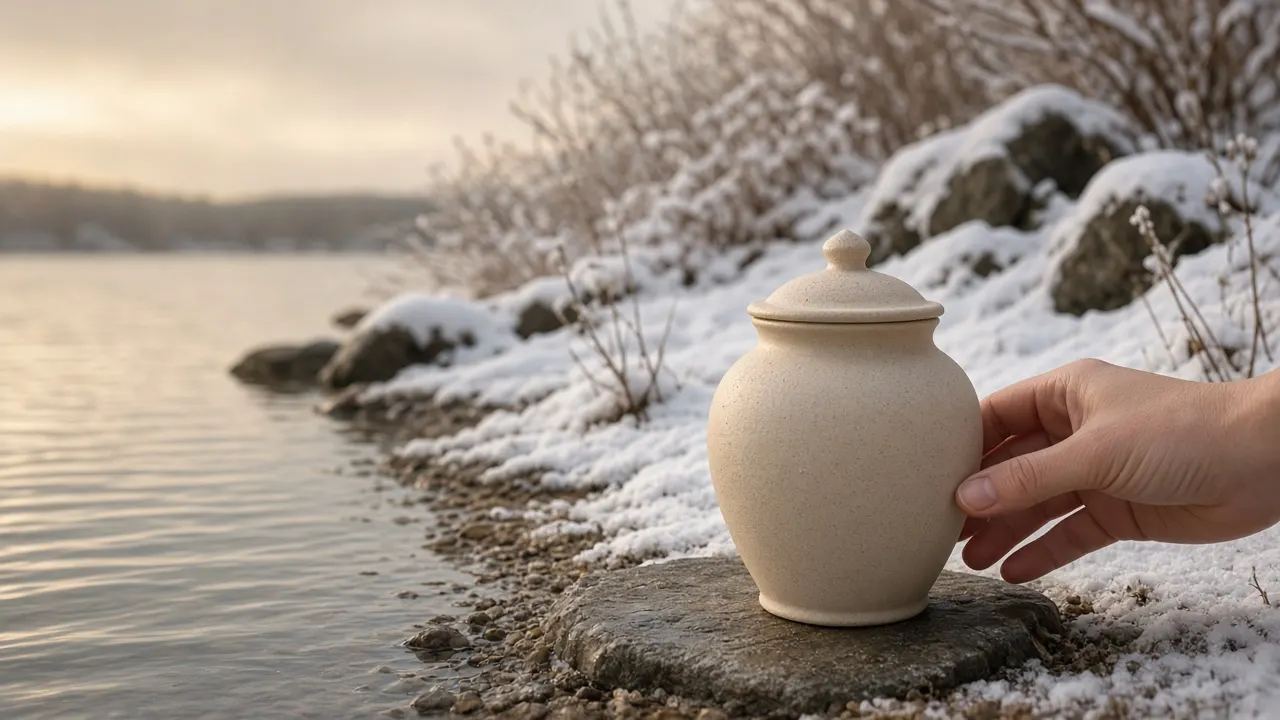
Water releases need open water, and in Kingston lakes and ponds may ice over around January. Never walk out onto ice to release an urn. If a lake or river was your pet's place, plan the release for spring or summer, when the shoreline is safe and a water-soluble urn can float and dissolve as it's meant to. Keep the ashes at home until then.
What bio urns and aquamation cost in Kingston
Add up every part before you commit. Beyond the cremation, a living memorial in Kingston can include the bio urn, compost and bark, a pH kit, the tree or shrub, a guard against deer or rabbits, and perhaps a marker. Our memorial budget planner lists each line so nothing surprises you. Most families find the tree is the cheapest part and the cremation the most expensive.
The full price table by product is on our New York page, and the services page explains what each option includes.

Free tool
Memorial budget planner
Add up cremation, urn, keepsakes and a farewell so the total holds no surprises.
Who to ask before you plant or scatter in New York
Rules about ashes were mostly written for people, and pet ashes often sit in a grey area. That's a reason to ask, not a reason to assume. On land you own, planting or burying ashes is generally fine. Anywhere else in New York, from parks to beaches to a friend's field, the land manager or owner decides, so ask first.
Not sure which office covers Kingston? The New York local government directory is the official list.
Home burial and scattering are governed at the New York level first; our New York rules summary has the detail. Then check whether Kingston or your HOA adds anything.
Your next steps, whatever your situation
- If your pet dies while you're away from Kingston, ask a local vet near where it happened to arrange individual cremation there. Bringing a body home over a long distance is rarely practical.
- Ask how the ashes can reach you: collected in person, posted by a tracked courier service, or sent to your own vet.
- Flying home with the ashes? Keep them in your carry-on, inside a container security can scan, and pack the crematory's paperwork alongside them.
- Don't buy the bio urn on the road. Wait until you're home and know the spot, so the urn matches the place.
- Plant somewhere that links both places if you like: a tree from the region where your pet died, or one from your own garden, if it suits the climate in Kingston.
- Write down the date and place of your pet's death and the name of the crematory. Memories of those particulars slip away sooner than most people think.
Remembering your pet, in Kingston and wherever you go next
Bluestone has been quarried in this part of New York for well over a century, and it makes a hard-wearing outdoor marker. Granite also does well. Softer cast stone and resin tend to crack after a few winters of freezing and thawing. Anything made of glass, fabric or thin wood belongs indoors, somewhere dry, away from a damp cellar or drafty porch.
Compare every option on our services page, read our guides and latest articles, or look at how readers voted in our polls, run the numbers with the free planning tools. If you live between Kingston and Syracuse, Rochester, Yonkers and Albany, either page applies. Every other community in New York, and all of the United States, is listed too.

Reader polls
What would you choose?
Vote anonymously and see how other readers answered. The results are live counts from people who visit this site, so they show real opinions, not a scientific sample.
Would you consider releasing your pet's ashes in water?
Tap an answer to vote and see how others answered. Anonymous.
What kind of tree or plant would you choose?
Tap an answer to vote and see how others answered. Anonymous.
If you had to decide today, which aftercare would you choose for your pet?
Tap an answer to vote and see how others answered. Anonymous.

Free tools to help you plan
Memorial budget planner
Add up cremation, urn, keepsakes and a farewell so the total holds no surprises.

Memorial tree finder
Pick a tree for a planting urn that suits your climate, space and pet.

Aftercare options compared
Compare private, communal and water cremation with burial on cost, timing and what comes home.
Questions people ask
Will I have to travel to Yonkers to arrange things?
Not usually. Providers based in Yonkers (roughly 68 miles from Kingston) collect from here as a matter of routine, and the paperwork is done by email or phone. If you want to be present for a witnessed cremation, that is when the drive matters.
Roughly how many pets die in Kingston each year?
Our estimate is around 730. It comes from Kingston's population (about 23,942), the average household size, the share of homes with a dog or cat (about 8,800 households here) and the average lifespan. It is arithmetic, not a count, so read it as a rough floor.
How does Kingston's weather affect pet aftercare?
July is the hottest month in Kingston, with average highs around 83°F, so prompt collection matters most then. Average lows drop below freezing in January, February, March and December, which can make digging a grave hard until spring.
Which nearby towns can I compare with Kingston?
The closest communities we cover are Poughkeepsie (about 16 miles), Newburgh (about 29 miles) and Middletown (about 40 miles). Providers based in those places often serve Kingston too. Ask each one for a written total that includes collection, so the distance is priced in.
How many families in Kingston might want a planting memorial?
We don't know the exact number, but the scale is real: by our estimate, around 730 dogs and cats die in Kingston each year. Interest in greener goodbyes is growing too; 61.4%[8] of US consumers say they'd like to explore green funeral options. If you're one of them, you're far from alone.
How long can I keep pet ashes before planting them?
As long as you like. Cremated remains don't break down or spoil in a sealed container, so a planting can happen next month, next year or after a move to a house with a garden. What does break down is a biodegradable urn, so keep the ashes in their original container and only transfer them into the bio urn shortly before planting.


Sources and our estimates
- [1] 53% of US households own a dog, which is about 71 million households. American Pet Products Association (APPA) 2025 State of the Industry, 2025.
- [2] US dogs have an average life expectancy at birth of 12.69 years. Montoya et al. 2023, Frontiers in Veterinary Science - Banfield Pet Hospital life expectancy tables (13.3 million dogs, 2.4 million cats, 2013-2019), 2023.
- [3] 39% of US households own a cat, which is about 53 million households. American Pet Products Association (APPA) 2025 State of the Industry, 2025.
- [4] US cats seen at Banfield hospitals have an average life expectancy at birth of 11.18 years. Montoya et al. 2023, Frontiers in Veterinary Science - Banfield Pet Hospital life expectancy tables (13.3 million dogs, 2.4 million cats, 2013-2019), 2023.
- [5] The NFDA projected New York's cremation rate at 55.7% for 2024. NFDA 2024 Cremation & Burial Report state projections (via Occasional Sage), 2024.
- [6] Gardening Know How advises letting an ash/soil-amendment mixture sit for at least 90 to 120 days before planting. Gardening Know How — Planting With Cremains: Is There a Safe Way to Bury Ashes, 2024.
- [7] U.S. pet flame cremations emit on the order of 47,000 t CO2e a year. Our estimate: 1.5M pet cremations x 31.3 kg CO2e. How we calculate.
- [8] 61.4% of US consumers say they are interested in exploring green funeral options. NFDA 2025 Cremation & Burial Report (press release), 2025.
Tell us about your pet and your garden
Tell us what you need and where you are. We'll reply by email with clear options and prices so you can decide in your own time.