Planting your pet's ashes in Springfield
Roughly 1,900 Springfield families say goodbye to a dog or cat each year, by our count. A living memorial is one way to mark it. This guide explains how to make one that actually grows.
- Options for renters and apartments
- Water release rules in plain words
- No obligation, we reply by email

Springfield, Oregon
Living memorials in Springfield: the local picture
Springfield's mill-town heritage means wood still feels like a natural material here, and a turned or hand-joined box in Oregon myrtlewood, maple or fir makes a warm alternative to a metal urn. Wood is best kept indoors, away from damp exterior walls. For the garden, basalt or granite will outlast any timber through the valley's long wet season and needs little more than a yearly rinse.
Dorris Ranch, a historic filbert orchard now run as a park in Springfield, and the trails along the Willamette give many families a sense of place when thinking about a memorial. Some plant a tree or shrub in their own yard with a little of the ashes; others keep an urn indoors or wear a keepsake. Choose what fits your home and how you like to remember.
In a smaller place like Springfield, a living memorial often starts with more space than city families have: a larger yard, family land or a farm. That makes a memorial tree in the ground realistic. The services, though, may be further away. Pet water cremation is rarely based in small towns, so if it matters to you, ask your vet whether they work with a provider in a larger centre such as Springfield, and how the ashes come back.
About 61,431 people live in Springfield, which makes it the 10th-largest of the 34 Oregon communities we cover.
Our pages for Eugene (5 miles, a larger centre), Lebanon (33 miles) and Corvallis (38 miles) describe the same choices from those towns' point of view, and the providers overlap, so a quote from one often covers Springfield as well.
Our estimate
22,500
Springfield: dog- or cat-owning households, our estimate
How we calculated this
61,431 ÷ 2.5 = 24,572 households; × 53% (dog) + 39% (cat) = 22,500. A household with several pets counts once.
Our estimate
1,900
Estimated dog and cat losses in Springfield each year
How we calculated this
22,500 dog/cat-owning homes ÷ average lifespan (dog: 12.69 yrs + cat: 11.18 yrs) ≈ 1,900 a year. A floor, not a ceiling.
53%[1]
53% of US households own a dog, which is about 71 million households.
12.69 years[2]
US dogs have an average life expectancy at birth of 12.69 years.
39%[3]
39% of US households own a cat, which is about 53 million households.
11.18 years[4]
US cats seen at Banfield hospitals have an average life expectancy at birth of 11.18 years.
Where these figures come from: Montoya et al. 2023, Frontiers in Veterinary Science and American Pet Products Association (APPA) 2025 State of the Industry.

The local attitude to ashes and memorials
Cremation is the usual choice for people in Oregon: about 77.7%[5] of those who die there are cremated. That figure is about people, not pets, but it tells you something useful. Where cremation is ordinary, families already think about what to do with ashes, and planting or scattering is a familiar next step. You're less likely to have to explain a bio urn to relatives, and more likely to find a crematory nearby that returns ashes promptly.
We take the Oregon rate from Direct Cremate (citing CANA) (2024). It is a human statistic; there is no equivalent pet figure for Springfield, and we would rather show a real number than invent one.
Springfield seasons and your memorial tree
Springfield's climate is kind to a new tree. Summers stay moderate and winter lows are mostly above freezing, so you can plant in most months. The best time is usually autumn or early spring, when soil is moist and roots can grow before any summer dry spell. Avoid planting into waterlogged ground, which can happen around December: wait for a few drier days so the soil crumbles in your hand.
Rain is your friend with a planting urn. In a place like Springfield, with regular rainfall and few hard frosts, water gradually carries salts from the ashes down and away from the root zone. You still need to mix the ashes through plenty of compost and soil first, but a mild, damp climate makes the soil chemistry more forgiving than in a desert or a cold, dry region.
What a greener goodbye costs in Springfield
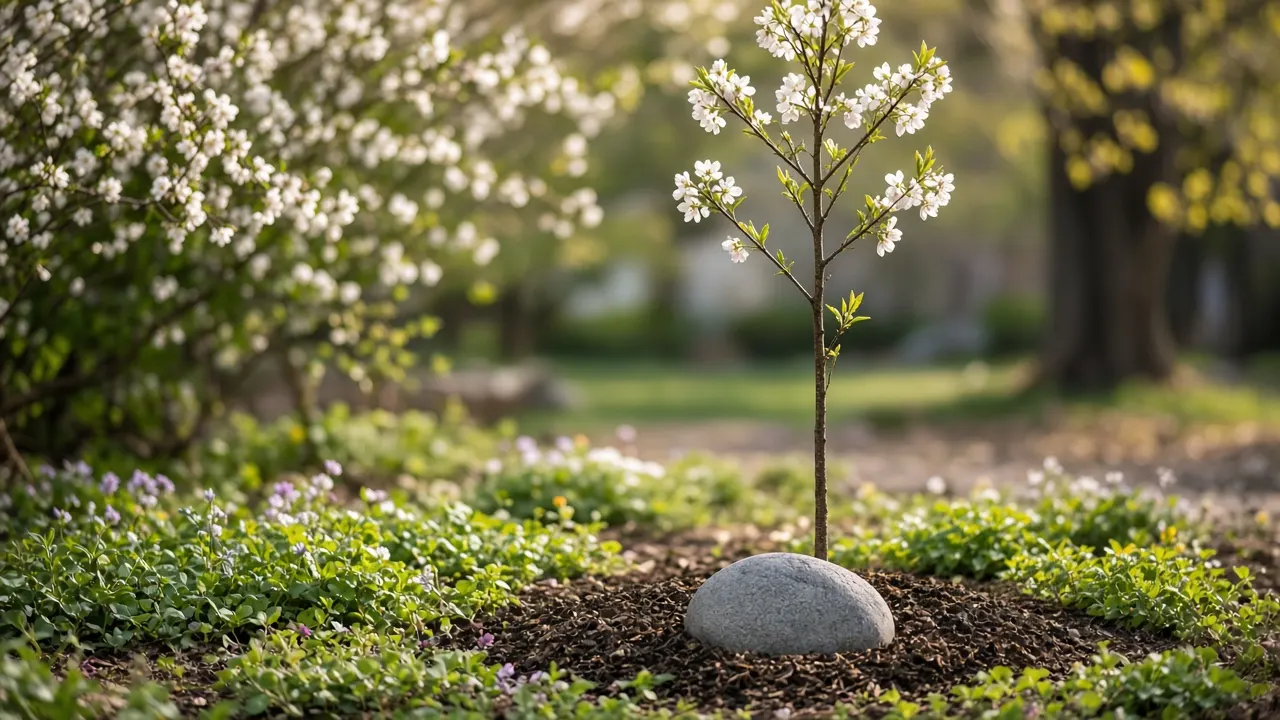
Here's how the pieces add up for a Springfield family. Private cremation of a dog averages about $260[6] nationally. A pet bio urn with a seed capsule is sold for about $99[7], and a planting system without the tree for $119[8]. Compost, pine bark and a pH kit add a few dollars more. Ask local providers for a written total before you choose.
Rather than repeat the price table on every city page, we keep one for Oregon: Oregon costs. What each service includes is on the services page.

Free tool
Memorial budget planner
Add up cremation, urn, keepsakes and a farewell so the total holds no surprises.
Land, water and permission in Oregon
If you live under a homeowners' association, a co-op board or a tenancy agreement in Oregon, its rules can matter more than any public law. Many restrict new trees, digging near shared pipes or heavy pots on balconies. A quick read of the rules, or one email to the manager, tells you whether a tree, a shrub bed or a container memorial is the right fit.
To find your county or city office in Oregon, start with the official Oregon local government directory.
For Oregon's rules on burying a pet at home or scattering ashes, see the Oregon guide. Local rules in Springfield can be stricter than the state's, especially in homeowners' associations and rentals.
Planting a memorial in Springfield, step by step
- Decide what the memorial is for. A place to visit, something growing, a return to water or a lower-impact goodbye each point to a different choice.
- If a greener cremation matters, ask about aquamation before anything else; it's the step with the biggest environmental difference.
- Keep a small portion back in a keepsake if there's any chance you'll move or want a second planting later.
- Buy the tree locally. A native sapling from a nursery near Springfield will usually outgrow a seed from a kit.
- Prepare the soil a season ahead where you can, and the mixture of compost and ash will have settled by the time you dig the hole.
- Plant with the people who loved your pet, and give each of them a job: mixing, filling, watering.
Ways to mark the spot and the date
Mount Pisgah, in the Howard Buford Recreation Area just south of Springfield, is a favorite climb with wide views over the valley, and some families think of places like it when choosing where to remember a pet. County park rules apply to scattering, so check before you go. Leaving the larger share on a shelf indoors and carrying only a pinch to a favorite spot is a common compromise.
the planning tools turn your pet's details into figures, or compare your instinct with the poll results, go deeper with the guides or catch up on recent articles, Our services overview lays out every option side by side. More local pages: Bend, Gresham, Portland and Salem, the Oregon overview and every city in the United States.

Reader polls
What would you choose?
Vote anonymously and see how other readers answered. The results are live counts from people who visit this site, so they show real opinions, not a scientific sample.
If you rent or might move, how would you handle a memorial planting?
Tap an answer to vote and see how others answered. Anonymous.
If water cremation (aquamation) were offered near you, would you choose it?
Tap an answer to vote and see how others answered. Anonymous.
If you had to decide today, which aftercare would you choose for your pet?
Tap an answer to vote and see how others answered. Anonymous.

Free tools to help you plan
Memorial budget planner
Add up cremation, urn, keepsakes and a farewell so the total holds no surprises.

Memorial tree finder
Pick a tree for a planting urn that suits your climate, space and pet.

Aftercare options compared
Compare private, communal and water cremation with burial on cost, timing and what comes home.
Questions people ask
Does the Springfield climate change what I should do first?
Only the timing. In August, with highs near 84°F, cool the body and book collection the same day. Winters here are mild enough that burial or scattering is possible in any month.
Roughly how many pets die in Springfield each year?
Our estimate is around 1,900. It comes from Springfield's population (about 61,431), the average household size, the share of homes with a dog or cat (about 22,500 households here) and the average lifespan. It is arithmetic, not a count, so read it as a rough floor.
Can a provider from a neighbouring town collect from Springfield?
Usually yes. Eugene is about 5 miles away, Lebanon is about 33 miles away and Corvallis is about 38 miles away, all inside a normal collection radius. Get the mileage written into the quote so there is no surprise on the day.
How do Oregon attitudes to cremation compare?
Direct Cremate (citing CANA) (2024) puts the Oregon human cremation rate at about 77.7%[5]. We show it on the Springfield page because pet aftercare choices tend to track it: where cremation is normal for people, communal and private pet cremation are both easy to find.
How do I stop my other dog digging up the memorial?
Fresh soil with bone ash in it is interesting to dogs. Lay a piece of wire mesh just under the mulch, surround the planting with flat stones, or put up a short temporary fence for the first few months. Walk your dog past the spot on a lead a few times so it becomes familiar. Interest usually fades once the soil settles.
How many families in Springfield might want a planting memorial?
We don't know the exact number, but the scale is real: by our estimate, around 1,900 dogs and cats die in Springfield each year. Interest in greener goodbyes is growing too; 61.4%[10] of US consumers say they'd like to explore green funeral options. If you're one of them, you're far from alone.


Sources and our estimates
- [1] 53% of US households own a dog, which is about 71 million households. American Pet Products Association (APPA) 2025 State of the Industry, 2025.
- [2] US dogs have an average life expectancy at birth of 12.69 years. Montoya et al. 2023, Frontiers in Veterinary Science - Banfield Pet Hospital life expectancy tables (13.3 million dogs, 2.4 million cats, 2013-2019), 2023.
- [3] 39% of US households own a cat, which is about 53 million households. American Pet Products Association (APPA) 2025 State of the Industry, 2025.
- [4] US cats seen at Banfield hospitals have an average life expectancy at birth of 11.18 years. Montoya et al. 2023, Frontiers in Veterinary Science - Banfield Pet Hospital life expectancy tables (13.3 million dogs, 2.4 million cats, 2013-2019), 2023.
- [5] Oregon had a 77.7% cremation rate in 2024, among the highest in the US. Direct Cremate (citing CANA), 2024.
- [6] CareCredit's 2025 cost study put the US national average for private dog cremation at $260 (range $206-$473). CareCredit (Synchrony) - How Much Does It Cost To Euthanize a Dog? (2025 ASQ360 procedural cost study), 2025.
- [7] The Bios Urn for pets, a biodegradable urn with a seed capsule, costs $99. Bios Urn – Pets, 2026.
- [8] The Living Urn's pet bio-urn planting system (without a tree) costs $119. The Living Urn – Pet tree urn, 2026.
- [9] Each shelter-animal flame cremation emits about 31 kg CO2e on average. Our estimate: 19,000 t CO2e / 607,000 animals. How we calculate.
- [10] 61.4% of US consumers say they are interested in exploring green funeral options. NFDA 2025 Cremation & Burial Report (press release), 2025.
Get eco memorial ideas by email
Tell us what you need and where you are. We'll reply by email with clear options and prices so you can decide in your own time.