Greener pet aftercare in Rutland, Vermont
About 470 dogs and cats are lost in Rutland each year, by our estimate. If you'd like your pet's ashes to grow into a tree or return to the water, this page covers the soil, the season and the cost.
- Planting, garden and water urns compared
- Honest notes on local rules
- Help choosing a native species

Rutland, Vermont
Living memorials in Rutland: the local picture
Marble is beautiful but softer than granite, and outdoors it slowly roughens and weathers over the decades. For a marker that stays crisp through Rutland's harsh winters, granite, slate or bronze are more durable; for one that ages gently into the garden, marble fits. Resin and painted concrete rarely survive many freeze-thaw cycles. Indoors, any sealed urn keeps the ashes safe.
Rutland grew up on marble, with quarries in nearby Proctor and West Rutland supplying stone for buildings and cemeteries across the country. A small marble marker engraved with a pet's name carries that local tradition forward. Others prefer a wooden urn, a ceramic piece from a Vermont potter or a small keepsake to wear. Any of these can honor a companion well.
Space is often generous around Rutland, so think about where you'll see the memorial every day. A tree framed in the kitchen window, beside the path to the barn or at the end of the drive becomes part of the daily routine. Planting it somewhere far from the house can mean it's only visited on anniversaries, which suits some families and not others.
With roughly 15,363 residents, Rutland is the 3rd-largest of the 12 Vermont communities we cover.
For a second opinion on price, Woodstock (23 miles), Hanover (35 miles) and Claremont (36 miles) are close enough that their providers cover Rutland routinely. Two written quotes tell you more than any price list.
Our estimate
5,650
Estimated dog- or cat-owning households in Rutland
How we calculated this
15,363 ÷ 2.5 = 6,145 households; × 53% (dog) + 39% (cat) = 5,650. Multi-pet homes count once.
Our estimate
470
dog and cat deaths per year in Rutland, our estimate
How we calculated this
5,650 dog/cat-owning homes ÷ average lifespan (dog: 12.69 yrs + cat: 11.18 yrs) ≈ 470 a year. A floor, not a ceiling.
53%[1]
53% of US households own a dog, which is about 71 million households.
12.69 years[2]
US dogs have an average life expectancy at birth of 12.69 years.
39%[3]
39% of US households own a cat, which is about 53 million households.
11.18 years[4]
US cats seen at Banfield hospitals have an average life expectancy at birth of 11.18 years.
Where these figures come from: Montoya et al. 2023, Frontiers in Veterinary Science and American Pet Products Association (APPA) 2025 State of the Industry.

What local attitudes to cremation mean in Vermont
Cremation is the usual choice for people in Vermont: about 78.1%[5] of those who die there are cremated. That figure is about people, not pets, but it tells you something useful. Where cremation is ordinary, families already think about what to do with ashes, and planting or scattering is a familiar next step. You're less likely to have to explain a bio urn to relatives, and more likely to find a crematory nearby that returns ashes promptly.
For the Vermont figure we rely on NFDA 2024 Cremation & Burial Report state projections (via Occasional Sage) (2024). Read it as a picture of local custom around death and remembrance in Rutland rather than as pet data.
Choosing the right month to plant in Rutland
A Rutland winter is a useful waiting room. With 6 months of freezing lows, you can mix the ashes with compost in a covered bin or tub in a garage or shed during the cold months and let the mix rest. One gardening guide suggests at least 90–120 days[6] before planting, which fits neatly between a winter loss and spring planting. Test the pH before the tree goes in.
Freezing and thawing through January, February, March, April, November and December can heave a newly planted tree out of the ground in Rutland. If you plant in autumn, mulch well after the first frost to keep the soil temperature steady, and check the base of the tree in spring. A spring planting avoids the problem entirely and gives roots a full growing season before the next winter.
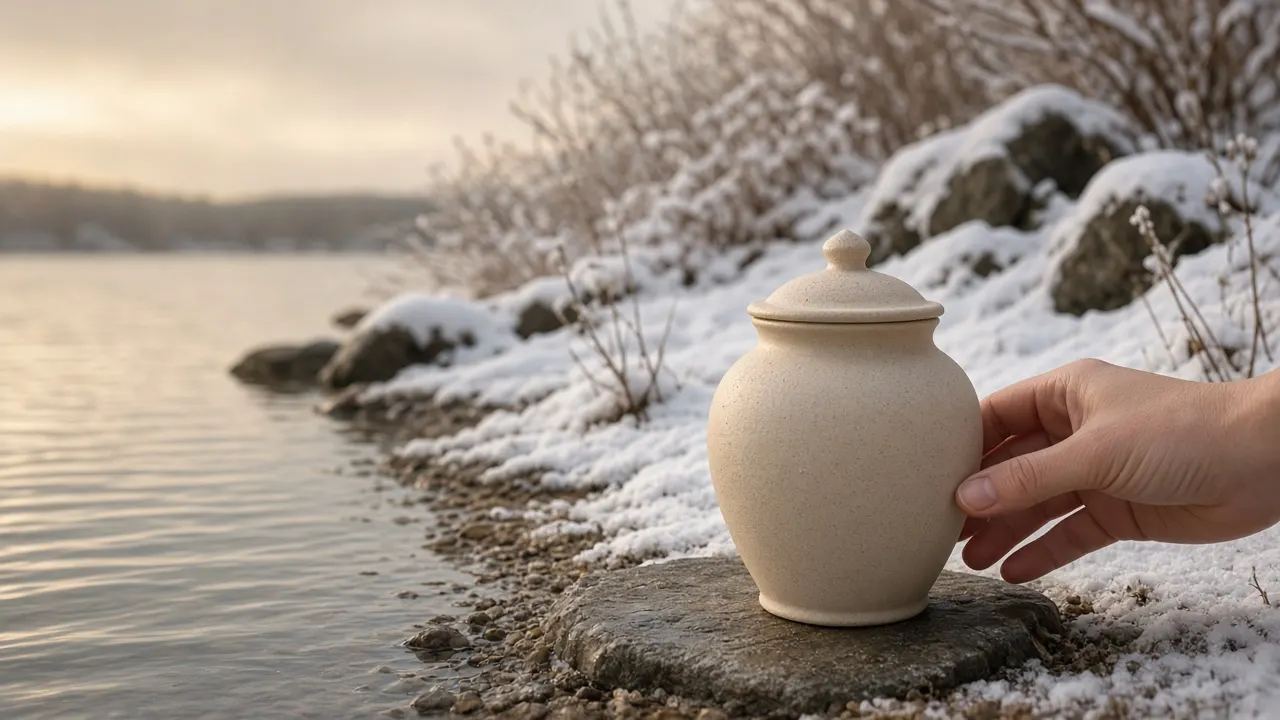
Eco memorial prices, from urn to tree
Water cremation prices overlap with flame cremation. One Delaware provider charges $150–$450[7] for private aquamation by weight, including a standard urn, and $50–$225[8] for communal. That makes private about 2.5 times the shared price[9]. Prices in Rutland depend on who offers it locally, so ask for a written quote that says whether the ashes come back and in what container.
For a line-by-line price table, see the Vermont overview; for what's included in each option, see our services.

Free tool
Memorial budget planner
Add up cremation, urn, keepsakes and a farewell so the total holds no surprises.
What Vermont allows for ashes, in general terms
If you live under a homeowners' association, a co-op board or a tenancy agreement in Vermont, its rules can matter more than any public law. Many restrict new trees, digging near shared pipes or heavy pots on balconies. A quick read of the rules, or one email to the manager, tells you whether a tree, a shrub bed or a container memorial is the right fit.
Not sure which office covers Rutland? The Vermont local government directory is the official list.
Start with the Vermont rules, which cover burial, scattering and oversight for the whole state, and treat Rutland's local ordinances as a possible extra layer.
Planting a memorial in Rutland, step by step
- If your pet dies while you're away from Rutland, have a vet close to where you are set up individual cremation locally. Transporting a body a long way home almost never works out.
- Ask how the ashes can reach you: collected in person, posted by a tracked courier service, or sent to your own vet.
- Flying home with the ashes? Carry them in your hand luggage in a container that can be X-rayed, with the crematory's certificate in the same bag.
- Don't buy the bio urn on the road. Wait until you're home and know the spot, so the urn matches the place.
- Plant somewhere that links both places if the idea appeals: perhaps a species native to the area your pet died in, or one already growing at home, provided it can cope with the climate in Rutland.
- Write down the date and place where your pet died and where it was cremated. Those details fade faster than you'd expect.
Keeping your pet's memory growing in Rutland
Many Rutland families have children and siblings who moved away to Burlington, Boston or farther, a common story in small Vermont cities. When several people hope to keep some of the ashes, say so at the first call so the crematory can return them in parts. One urn stays at the family home, while tiny marble boxes or pendants go to the ones who live away and visit at Christmas.
look through our guides and the blog, the planning tools turn your pet's details into figures, or see what other families chose in the poll results, See what each option includes on our services page. If you live between Rutland and Burlington, Barre, Montpelier and South Burlington, either page applies. Every other community in Vermont, and all of the United States, is listed too.

Reader polls
What would you choose?
Vote anonymously and see how other readers answered. The results are live counts from people who visit this site, so they show real opinions, not a scientific sample.
If you rent or might move, how would you handle a memorial planting?
Tap an answer to vote and see how others answered. Anonymous.
If water cremation (aquamation) were offered near you, would you choose it?
Tap an answer to vote and see how others answered. Anonymous.
If you had to decide today, which aftercare would you choose for your pet?
Tap an answer to vote and see how others answered. Anonymous.

Free tools to help you plan
Memorial budget planner
Add up cremation, urn, keepsakes and a farewell so the total holds no surprises.

Memorial tree finder
Pick a tree for a planting urn that suits your climate, space and pet.

Aftercare options compared
Compare private, communal and water cremation with burial on cost, timing and what comes home.
Questions people ask
Which nearby towns can I compare with Rutland?
The closest communities we cover are Woodstock (about 23 miles), Hanover (about 35 miles) and Claremont (about 36 miles). Providers based in those places often serve Rutland too. Ask each one for a written total that includes collection, so the distance is priced in.
How many pet owners live in Rutland?
By our estimate, about 5,650 households in Rutland have at least one dog or cat, and around 470 are lost each year. We calculate this from the city's population of about 15,363, the average household size and national ownership and lifespan figures, so treat it as a floor rather than an exact count.
How does Rutland's weather affect pet aftercare?
July is the hottest month in Rutland, with average highs around 80°F, so prompt collection matters most then. Average lows drop below freezing in January, February, March, April, November and December, which can make digging a grave hard until spring.
Is cremation common in Vermont?
For people, yes: about 78.1%[5] of Vermont deaths end in cremation, according to NFDA 2024 Cremation & Burial Report state projections (via Occasional Sage) (2024). Nobody publishes the same figure for pets, but in our experience pet choices in Rutland follow the human pattern closely, so cremation is the default most families here start from.
I rent in Rutland. Can I still have a living memorial?
Yes. Plant in a large container, such as a half-barrel or a big pot with a dwarf tree or flowering shrub, and it moves with you. Use only a small share of the ashes in the pot, well mixed with compost. If you'd like to plant in a rented yard, get the landlord's permission in writing, and remember the tree stays when you leave.
Can I plant a tree directly on my pet's ashes in Rutland?
It's better not to. Cremated remains have a very high pH, around 11.7[11], and they're high in sodium, so a solid layer of ash under the roots can yellow or kill a young tree. Mix the ashes through plenty of compost and soil across a wider area, test the pH, and plant once it has come down. There's no single mixing ratio that suits every pet and every soil.


Sources and our estimates
- [1] 53% of US households own a dog, which is about 71 million households. American Pet Products Association (APPA) 2025 State of the Industry, 2025.
- [2] US dogs have an average life expectancy at birth of 12.69 years. Montoya et al. 2023, Frontiers in Veterinary Science - Banfield Pet Hospital life expectancy tables (13.3 million dogs, 2.4 million cats, 2013-2019), 2023.
- [3] 39% of US households own a cat, which is about 53 million households. American Pet Products Association (APPA) 2025 State of the Industry, 2025.
- [4] US cats seen at Banfield hospitals have an average life expectancy at birth of 11.18 years. Montoya et al. 2023, Frontiers in Veterinary Science - Banfield Pet Hospital life expectancy tables (13.3 million dogs, 2.4 million cats, 2013-2019), 2023.
- [5] The NFDA projected Vermont's cremation rate at 78.1% for 2024. NFDA 2024 Cremation & Burial Report state projections (via Occasional Sage), 2024.
- [6] Gardening Know How advises letting an ash/soil-amendment mixture sit for at least 90 to 120 days before planting. Gardening Know How — Planting With Cremains: Is There a Safe Way to Bury Ashes, 2024.
- [7] Delaware Pet Aquamation charges $150–$450 for private aquamation by weight, from under 10 lb to 150 lb and over, including a standard urn. Delaware Pet Aquamation – Pricing, 2026.
- [8] Communal aquamation at the same Delaware provider costs $50–$225 by weight. Delaware Pet Aquamation – Pricing, 2026.
- [9] Private pet aquamation costs about 2.5 times communal aquamation at the same provider. Our estimate: mean of tier ratios 150/50, 200/75, 250/100, 350/150, 450/225. How we calculate.
- [10] U.S. pet flame cremations emit on the order of 47,000 t CO2e a year. Our estimate: 1.5M pet cremations x 31.3 kg CO2e. How we calculate.
- [11] Cremated remains have a very high pH of approximately 11.7, which is toxic to plants without amendment. Larkspur Conservation — Giving Cremated Remains a New Life Through Science, 2024.
Ask about aquamation near Rutland
Tell us what you need and where you are. We'll reply by email with clear options and prices so you can decide in your own time.