Planting your pet's ashes in Charleston
Roughly 1,400 Charleston families say goodbye to a dog or cat each year, by our count. A living memorial is one way to mark it. This guide explains how to make one that actually grows.
- A memorial that moves with you
- Why pure ashes harm young roots
- Written prices you can compare

Charleston, West Virginia
Your living memorial options around Charleston
Small family cemeteries on hillsides are an old Appalachian tradition, and some Charleston-area families with land still lay a beloved animal down on the home place, marking the spot with a creek stone or a hand-cut wooden cross. Others in town prefer a brass urn on the mantelpiece, a pawprint framed next to wedding photos, or a small charm bearing the animal's name.
Steamy summers and repeated freeze-thaw cycles work hard on anything outside in the Kanawha Valley. Granite and bronze hold their inscriptions; sandstone flakes and wood rots. A marker on a hillside should be bedded deep and level so it won't creep downhill after heavy rain. Photographs, fabric collars and other fragile keepsakes last far longer in a dry room indoors.
Space is often generous around Charleston, so think about where you'll see the memorial every day. A tree framed in the kitchen window, beside the path to the barn or at the end of the drive becomes part of the daily routine. Planting it somewhere far from the house can mean it's only visited on anniversaries, which suits some families and not others.
Charleston is home to about 46,117 people, the largest of the 10 West Virginia communities we cover.
Families in Charleston often end up using a provider from Huntington (44 miles), Beckley (47 miles) and Ashland (55 miles). That is normal: crematories serve a radius, not a single town, and the drive is priced into collection.
Our estimate
17,000
Estimated dog- or cat-owning households in Charleston
How we calculated this
46,117 ÷ 2.5 = 18,447 households; × 53% (dog) + 39% (cat) = 17,000. Multi-pet homes count once.
Our estimate
1,400
dog and cat deaths per year in Charleston, our estimate
How we calculated this
17,000 dog/cat-owning homes ÷ average lifespan (dog: 12.69 yrs + cat: 11.18 yrs) ≈ 1,400 a year. Treat it as a minimum.
53%[1]
53% of US households own a dog, which is about 71 million households.
12.69 years[2]
US dogs have an average life expectancy at birth of 12.69 years.
39%[3]
39% of US households own a cat, which is about 53 million households.
11.18 years[4]
US cats seen at Banfield hospitals have an average life expectancy at birth of 11.18 years.
The numbers above come from American Pet Products Association (APPA) 2025 State of the Industry and Montoya et al. 2023, Frontiers in Veterinary Science, if you'd like to read the original sources.

How West Virginia feels about cremation
The human cremation rate in West Virginia sits around 51.6%[5], so many families have a foot in both camps, and generations can disagree. Grandparents may expect a grave in the yard; younger relatives may want ashes they can take with them. Talking it through before the vet asks you to choose saves a hard conversation on a hard day. A tree over buried ashes often satisfies both sides.
For the West Virginia figure we rely on NFDA 2024 Cremation & Burial Report state projections (via Occasional Sage) (2024). Read it as a picture of local custom around death and remembrance in Charleston rather than as pet data.
Choosing the right month to plant in Charleston
Water releases need open water, and in Charleston lakes and ponds may ice over around January. Never walk out onto ice to release an urn. If a lake or river was your pet's place, plan the release for spring or summer, when the shoreline is safe and a water-soluble urn can float and dissolve as it's meant to. Keep the ashes at home until then.
Freezing and thawing through January, February and December can heave a newly planted tree out of the ground in Charleston. If you plant in autumn, mulch well after the first frost to keep the soil temperature steady, and check the base of the tree in spring. A spring planting avoids the problem entirely and gives roots a full growing season before the next winter.
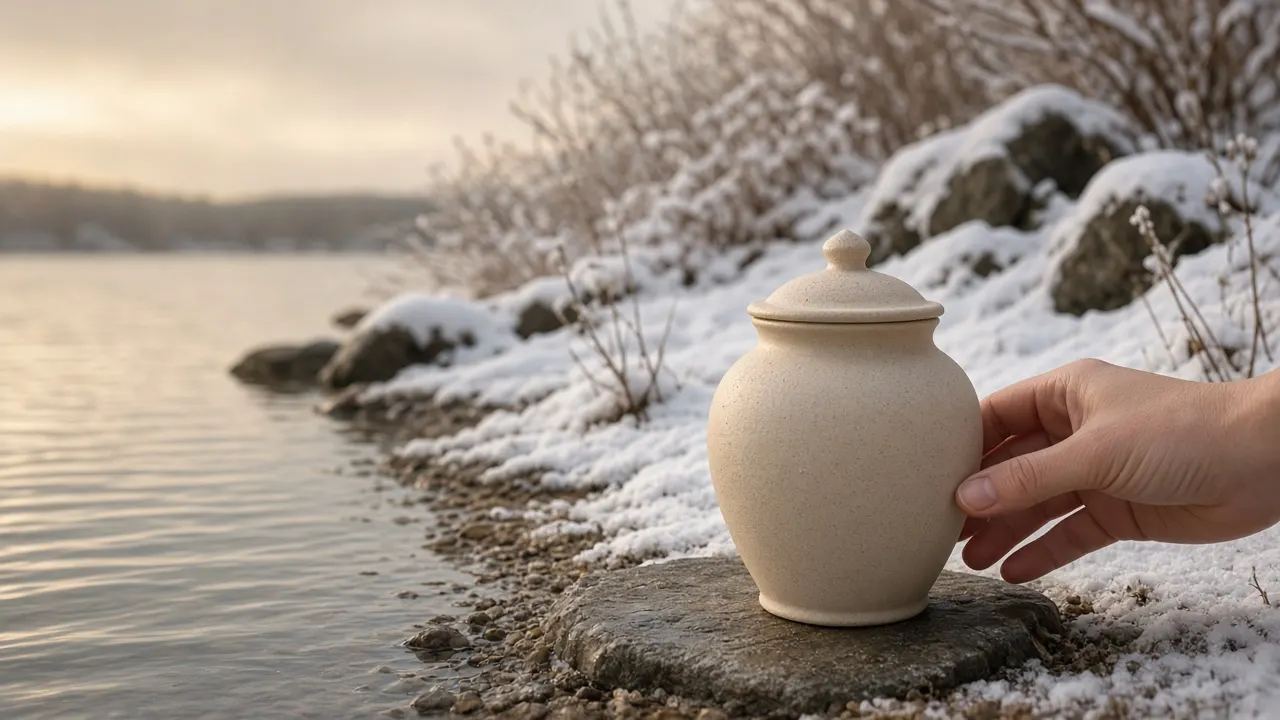
Adding up the cost of a bio urn memorial in Charleston
For a medium-size dog, published private aquamation prices at two US providers sit around $200–$259[6], and one Arizona provider's individual aquamation price of $75–$349[7] includes an urn, nameplate and ink paw print. Whether a Charleston provider bundles extras like that makes a real difference when you compare. Add the bio urn or tree separately, and use the planner below to see the total.
We keep the detailed West Virginia price table on one page so it stays current: see West Virginia prices.

Free tool
Memorial budget planner
Add up cremation, urn, keepsakes and a farewell so the total holds no surprises.
Where you can plant or release ashes in West Virginia
Rules about ashes were mostly written for people, and pet ashes often sit in a grey area. That's a reason to ask, not a reason to assume. On land you own, planting or burying ashes is generally fine. Anywhere else in West Virginia, from parks to beaches to a friend's field, the land manager or owner decides, so ask first.
West Virginia keeps an official directory of local governments; use it to reach the county or city office that covers Charleston.
Start with the West Virginia rules, which cover burial, scattering and oversight for the whole state, and treat Charleston's local ordinances as a possible extra layer.
What to do first, and what can wait for the right season
- If you're remembering more than one animal, decide early whether the ashes will be planted together or apart. Both are fine, but mixed ashes can't be separated later.
- Label each container clearly the moment it arrives, name and date on the lid, which matters most when the sets come home a long way apart.
- Choose a bigger planting area when there are several sets of ashes; a long hedge, a cluster of shrubs or a few fruit trees gives the minerals more ground to disperse into.
- Keep a spoonful of each in its own keepsake, so a family member who was closest to one particular pet has something just for them.
- Plan for the pets still living with you. A new planting that smells of bone attracts diggers, so protect it for the first few months.
- Add a marker for each name, or a single stone carrying all of them, so anyone visiting understands who is remembered there.
Keeping your pet's memory growing in Charleston
Only around half of West Virginia funerals involve cremation, below much of the country, so keeping ashes may feel unfamiliar to some Charleston families. The options are wide: an urn at home, a portion scattered in a favorite hollow, a biodegradable urn tucked under a young redbud. Nothing needs settling in the first week, and relatives are welcome to weigh in before anything happens.
Every option Charleston families choose between is on the services page, read our guides and latest articles, run the numbers with the free planning tools, or look at how readers voted in our polls. Close to Charleston we also cover Wheeling, Huntington, Morgantown and Martinsburg; the full list for West Virginia and for the United States is a click away.

Reader polls
What would you choose?
Vote anonymously and see how other readers answered. The results are live counts from people who visit this site, so they show real opinions, not a scientific sample.
If you rent or might move, how would you handle a memorial planting?
Tap an answer to vote and see how others answered. Anonymous.
Would you consider releasing your pet's ashes in water?
Tap an answer to vote and see how others answered. Anonymous.
If you had to decide today, which aftercare would you choose for your pet?
Tap an answer to vote and see how others answered. Anonymous.

Free tools to help you plan
Memorial budget planner
Add up cremation, urn, keepsakes and a farewell so the total holds no surprises.

Memorial tree finder
Pick a tree for a planting urn that suits your climate, space and pet.

Aftercare options compared
Compare private, communal and water cremation with burial on cost, timing and what comes home.
Questions people ask
Does the Charleston climate change what I should do first?
Only the timing. In July, with highs near 86°F, cool the body and book collection the same day. In January, February and December, when lows sit below freezing, a home burial may have to wait for a thaw, so cremation with ashes returned keeps your options open.
Which nearby towns can I compare with Charleston?
The closest communities we cover are Huntington (about 44 miles), Beckley (about 47 miles) and Ashland (about 55 miles). Providers based in those places often serve Charleston too. Ask each one for a written total that includes collection, so the distance is priced in.
How do West Virginia attitudes to cremation compare?
NFDA 2024 Cremation & Burial Report state projections (via Occasional Sage) (2024) puts the West Virginia human cremation rate at about 51.6%[5]. We show it on the Charleston page because pet aftercare choices tend to track it: where cremation is normal for people, communal and private pet cremation are both easy to find.
How many pet owners live in Charleston?
By our estimate, about 17,000 households in Charleston have at least one dog or cat, and around 1,400 are lost each year. We calculate this from the city's population of about 46,117, the average household size and national ownership and lifespan figures, so treat it as a floor rather than an exact count.
Is it legal to release pet ashes in the sea or a river?
Rules differ by place and by who manages the water, and many were written for human remains. In general, avoid drinking-water reservoirs, busy swimming areas and places where anglers gather, use a water-soluble urn or loose ashes only, and let nothing plastic float away. Ask the relevant agency or landowner before the day.
Is it safe to plant a fruit tree with my pet's ashes?
Cremated remains are mostly bone minerals, and once they're thoroughly blended into plenty of compost and garden soil, many gardeners grow fruit trees over them. The high pH and salt are the real concern for the tree, so dilute generously and test the pH. If eating fruit from the memorial feels wrong to anyone in your family, choose an ornamental tree instead.


Sources and our estimates
- [1] 53% of US households own a dog, which is about 71 million households. American Pet Products Association (APPA) 2025 State of the Industry, 2025.
- [2] US dogs have an average life expectancy at birth of 12.69 years. Montoya et al. 2023, Frontiers in Veterinary Science - Banfield Pet Hospital life expectancy tables (13.3 million dogs, 2.4 million cats, 2013-2019), 2023.
- [3] 39% of US households own a cat, which is about 53 million households. American Pet Products Association (APPA) 2025 State of the Industry, 2025.
- [4] US cats seen at Banfield hospitals have an average life expectancy at birth of 11.18 years. Montoya et al. 2023, Frontiers in Veterinary Science - Banfield Pet Hospital life expectancy tables (13.3 million dogs, 2.4 million cats, 2013-2019), 2023.
- [5] The NFDA projected West Virginia's cremation rate at 51.6% for 2024. NFDA 2024 Cremation & Burial Report state projections (via Occasional Sage), 2024.
- [6] Private aquamation for a 21–50 lb dog costs about $200–$259 at two posted US price lists. Our estimate: Delaware 10–49 lb $200; A Greener Place 21–50 lb $259. How we calculate.
- [7] A Greener Place in Mesa, Arizona, charges $75–$349 for individual pet aquamation by weight, including an urn, nameplate and ink paw print. A Greener Place Pet Aquamation – Pricing, 2026.
- [8] U.S. pet flame cremations emit on the order of 47,000 t CO2e a year. Our estimate: 1.5M pet cremations x 31.3 kg CO2e. How we calculate.
Tell us about your pet and your garden
Tell us what you need and where you are. We'll reply by email with clear options and prices so you can decide in your own time.