Greener pet aftercare in Bellflower, California
Bellflower has an estimated 27,500 dog- or cat-owning households. When a planting or water memorial feels right for yours, here's what works in the local climate and what to ask before you buy.
- Trees matched to Bellflower's climate
- Soil-safe planting method for ashes
- Real prices for bio urns and aquamation

Bellflower, California
Bio urns, trees and water in Bellflower
With the coast only a short drive away, some Bellflower families take a portion of a pet's ashes to the beach or the harbor for a quiet goodbye. Ask what is allowed at the spot you choose. Holding back most of the ashes in a small urn or keepsake keeps the memory at home once the trip to the water is over.
Many Bellflower families come from Latin American, Filipino and other traditions where home altars with photos, candles and flowers are part of remembering loved ones. A small corner for a pet fits naturally alongside that. A framed picture, a keepsake box of ashes or a collar laid beside a candle can make a warm, personal space. Marigolds, a favorite toy or a small bowl can all find a place there too.
Getting a bio urn in Bellflower is mostly a matter of ordering online, but getting the soil right is a local job. Ask a nursery or your county extension office whether the ground is chalky, clay or sandy. Clay holds salts near the roots and drains poorly, so dig a wider hole and mix in more compost. Sandy soil drains well but holds little, so water the young tree more often in its first summers.
With roughly 74,719 residents, Bellflower is the 112th-largest of the 307 California communities we cover. Long Beach, roughly 9 miles off, is the closest larger centre, and a share of the providers who cover Bellflower run from there.
For a second opinion on price, Paramount (2 miles), Lakewood (3 miles) and Norwalk (3 miles) are close enough that their providers cover Bellflower routinely. Two written quotes tell you more than any price list.
Our estimate
27,500
Estimated dog- or cat-owning households in Bellflower
How we calculated this
74,719 ÷ 2.5 = 29,888 households; × 53% (dog) + 39% (cat) = 27,500. Homes are counted once however many pets they keep.
Our estimate
2,300
dog and cat deaths per year in Bellflower, our estimate
How we calculated this
27,500 dog/cat-owning homes ÷ average lifespan (dog: 12.69 yrs + cat: 11.18 yrs) ≈ 2,300 a year. The real figure is unlikely to be lower.
53%[1]
53% of US households own a dog, which is about 71 million households.
12.69 years[2]
US dogs have an average life expectancy at birth of 12.69 years.
39%[3]
39% of US households own a cat, which is about 53 million households.
11.18 years[4]
US cats seen at Banfield hospitals have an average life expectancy at birth of 11.18 years.
If a number here surprises you, the primary material is Montoya et al. 2023, Frontiers in Veterinary Science and American Pet Products Association (APPA) 2025 State of the Industry; we only apply it to this.

The local attitude to ashes and memorials
With a human cremation rate near 70.5%[5], California has plenty of crematories competing for families, and that tends to show in the choice on offer. Ask more than one pet provider what they include. Some return ashes in a simple cardboard or paper tube, some add a wooden urn you may not want, and a few can quote for water cremation. The cheapest honest quote is usually the one you can plant from.
The California figure comes from NFDA 2024 Cremation & Burial Report state projections (via Occasional Sage) (2024). It describes people, not pets, so read it as a sign of local attitudes rather than a pet statistic.
Choosing the right month to plant in Bellflower
A mild climate like Bellflower's gives you a wide choice of trees and shrubs, and that's where the risk lies: it's tempting to choose something that looks lovely but is short-lived or grows too big. Think about the spot in twenty years. A small flowering tree, a fruit tree on a dwarfing rootstock or a native shrub suits most yards far better than a forest tree planted beside the house.
In Bellflower, winters are gentle, with December lows around 48°F, and summers are warm rather than scorching. That opens up evergreen choices, such as a native evergreen shrub or a small conifer, which give you a green memorial all year. Whatever you choose, water through the first summer, keep grass away from the base and replace mulch each spring.
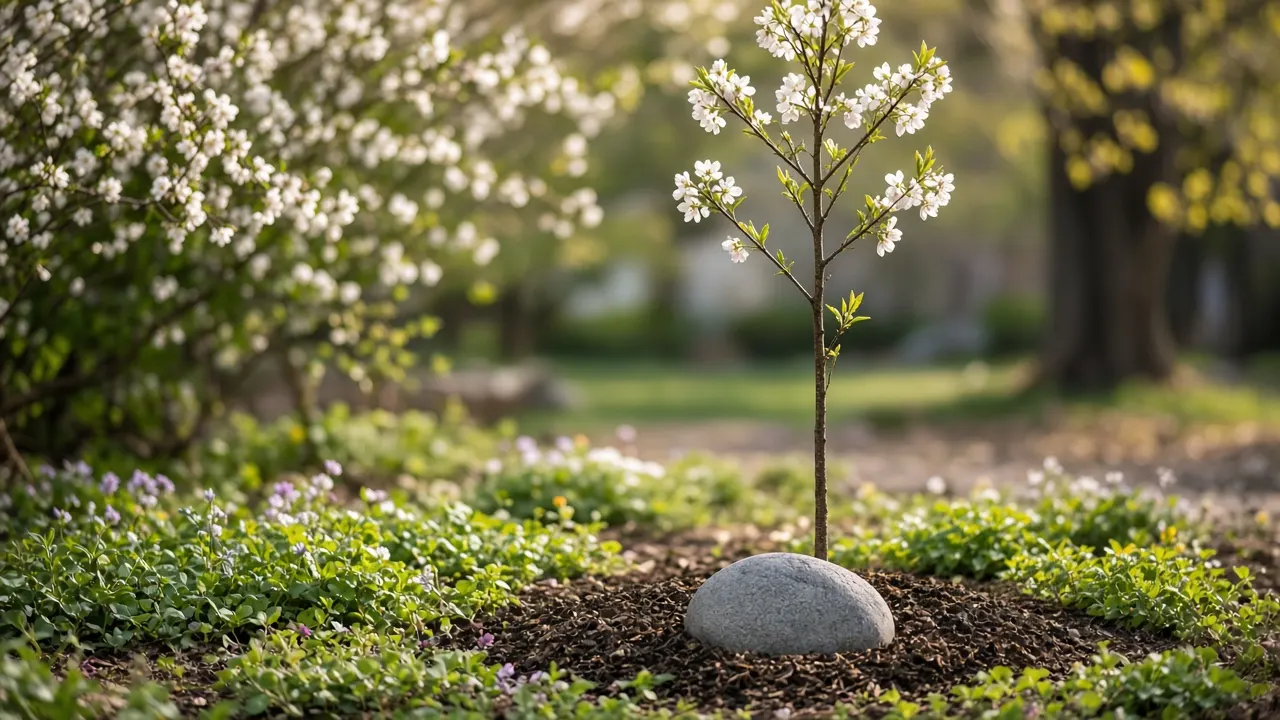
Budgeting for a living memorial in Bellflower
For a medium-size dog, published private aquamation prices at two US providers sit around $200–$259[6], and one Arizona provider's individual aquamation price of $75–$349[7] includes an urn, nameplate and ink paw print. Whether a Bellflower provider bundles extras like that makes a real difference when you compare. Add the bio urn or tree separately, and use the planner below to see the total.
Rather than repeat the price table on every city page, we keep one for California: California costs. What each service includes is on the services page.

Free tool
Memorial budget planner
Add up cremation, urn, keepsakes and a farewell so the total holds no surprises.
Where you can plant or release ashes in California
Rules about ashes were mostly written for people, and pet ashes often sit in a grey area. That's a reason to ask, not a reason to assume. On land you own, planting or burying ashes is generally fine. Anywhere else in California, from parks to beaches to a friend's field, the land manager or owner decides, so ask first.
California keeps an official directory of local governments; use it to reach the county or city office that covers Bellflower.
Home burial and scattering are governed at the California level first; our California rules summary has the detail. Then check whether Bellflower or your HOA adds anything.
Planting a memorial in Bellflower, step by step
- Talk it through with your household before deciding anything, since someone may quietly prefer the ashes to stay indoors.
- Measure your space. A tree needs room to grow; a shrub, a pot or a flower bed may suit your garden better.
- Test the soil at the planting site. Ground that already reads alkaline calls for a species that tolerates lime, plus more compost or composted bark than usual.
- Spread the ashes through a wide planting area, never as a single layer under the roots.
- Water well for two summers. Most memorial trees that fail do so in their first dry season, not their first winter.
- Keep a record of the species, the date and what went into the soil, so you can care for it or move a cutting later.
Remembering your pet in Bellflower
Bellflower yards tend to be small, so garden memorials here are usually modest: a flat engraved stone in a flower bed, a potted plant in your pet's name, a small marker by the back step. In an apartment, a shelf or windowsill piece may suit better. Pick something sized to the space you actually have, not the one you wish you had.
For a plain comparison of the choices, open services, or see what other families chose in the poll results, browse in-depth guides or recent articles, try the free planning tools. More local pages: San Jose, Sacramento, San Diego and Fresno, the California overview and every city in the United States.

Reader polls
What would you choose?
Vote anonymously and see how other readers answered. The results are live counts from people who visit this site, so they show real opinions, not a scientific sample.
If water cremation (aquamation) were offered near you, would you choose it?
Tap an answer to vote and see how others answered. Anonymous.
Would you consider releasing your pet's ashes in water?
Tap an answer to vote and see how others answered. Anonymous.
If you had to decide today, which aftercare would you choose for your pet?
Tap an answer to vote and see how others answered. Anonymous.

Free tools to help you plan
Memorial budget planner
Add up cremation, urn, keepsakes and a farewell so the total holds no surprises.

Memorial tree finder
Pick a tree for a planting urn that suits your climate, space and pet.

Aftercare options compared
Compare private, communal and water cremation with burial on cost, timing and what comes home.
Questions people ask
Which nearby towns can I compare with Bellflower?
The closest communities we cover are Paramount (about 2 miles), Lakewood (about 3 miles) and Norwalk (about 3 miles). Providers based in those places often serve Bellflower too. Ask each one for a written total that includes collection, so the distance is priced in.
How does Bellflower's weather affect pet aftercare?
August is the hottest month in Bellflower, with average highs around 84°F, so prompt collection matters most then. Winters are mild, with average lows staying above freezing, so outdoor burial or scattering is usually possible year round.
Is Bellflower big enough to have several pet aftercare providers?
Probably, on the numbers. By our estimate about 27,500 Bellflower households keep a dog or cat and around 2,300 lose one each year, which is enough steady demand to support more than one provider. We derive that from population (about 74,719), household size and national ownership and lifespan figures.
Is cremation common in California?
For people, yes: about 70.5%[5] of California deaths end in cremation, according to NFDA 2024 Cremation & Burial Report state projections (via Occasional Sage) (2024). Nobody publishes the same figure for pets, but in our experience pet choices in Bellflower follow the human pattern closely, so cremation is the default most families here start from.
Do bio urns work with ashes from flame cremation?
Yes. A bio urn works with ashes from flame cremation or water cremation. Both leave mineral-rich, alkaline ash, so the soil advice is the same either way: dilute the ashes well through compost and soil, let the mix rest if you can, and test the pH before a young tree goes in.
What happens to the memorial tree if I move away from Bellflower?
It stays with the land, and ashes mixed into soil can't be recovered. If a move is possible, plant in a large container, plant at a relative's home, or keep a small portion of the ashes back for a future garden. Cuttings from many shrubs root easily, so you can take a piece of the plant with you.


Sources and our estimates
- [1] 53% of US households own a dog, which is about 71 million households. American Pet Products Association (APPA) 2025 State of the Industry, 2025.
- [2] US dogs have an average life expectancy at birth of 12.69 years. Montoya et al. 2023, Frontiers in Veterinary Science - Banfield Pet Hospital life expectancy tables (13.3 million dogs, 2.4 million cats, 2013-2019), 2023.
- [3] 39% of US households own a cat, which is about 53 million households. American Pet Products Association (APPA) 2025 State of the Industry, 2025.
- [4] US cats seen at Banfield hospitals have an average life expectancy at birth of 11.18 years. Montoya et al. 2023, Frontiers in Veterinary Science - Banfield Pet Hospital life expectancy tables (13.3 million dogs, 2.4 million cats, 2013-2019), 2023.
- [5] The NFDA projected California's cremation rate at 70.5% for 2024. NFDA 2024 Cremation & Burial Report state projections (via Occasional Sage), 2024.
- [6] Private aquamation for a 21–50 lb dog costs about $200–$259 at two posted US price lists. Our estimate: Delaware 10–49 lb $200; A Greener Place 21–50 lb $259. How we calculate.
- [7] A Greener Place in Mesa, Arizona, charges $75–$349 for individual pet aquamation by weight, including an urn, nameplate and ink paw print. A Greener Place Pet Aquamation – Pricing, 2026.
- [8] Switching one human-scale cremation to alkaline hydrolysis saves about 112 kg CO2e under TNO's accounting. Our estimate: 79.9 - (-31.8) kg CO2e. How we calculate.
Get bio urn options for Bellflower
Tell us what you need and where you are. We'll reply by email with clear options and prices so you can decide in your own time.