Planting your pet's ashes in Mill Valley
Roughly 420 Mill Valley families say goodbye to a dog or cat each year, by our count. A living memorial is one way to mark it. This guide explains how to make one that actually grows.
- Planting, garden and water urns compared
- Honest notes on local rules
- Help choosing a native species

Mill Valley, California
Where a living memorial fits in Mill Valley
Mill Valley has a strong arts community, and tributes here often end up personal and handmade: a ceramic vessel from a local potter, a small painting, a glass orb with a wisp of ash inside. If you want something custom, ask the cremation provider to send the ashes home in a simple sealed box and give yourself time. A keepsake commissioned weeks later means no less than one chosen the same afternoon.
Damp redwood canyons are hard on some outdoor memorials. Wood markers grow moss, soft stone stains, and printed photo plaques fade on the sunnier decks. Around Mill Valley, engraved granite, slate or bronze last far longer outside, and a biodegradable urn buried with a native plant does well in the wet winter months, when the soil is soft and the rain does the watering for you.
Small towns tend to have long memories, and a memorial tree in Mill Valley is often planted with a lot of history around it: the same yard for decades, a family farm, a favorite fishing spot. If the land is likely to stay in the family, a long-lived native tree is a lovely choice. If it might be sold, consider a shrub bed, a portion of ashes kept back, or a water release that doesn't depend on who owns the ground in twenty years.
Mill Valley's population is around 13,799, the 278th-largest of the 307 California communities we cover. Some of the providers who serve Mill Valley are based about 11 miles away in San Francisco, the nearest larger centre, so collection times reflect that drive.
Families in Mill Valley often end up using a provider from Corte Madera (2 miles), Larkspur (2 miles) and Kentfield (3 miles). That is normal: crematories serve a radius, not a single town, and the drive is priced into collection.
Our estimate
5,100
Estimated dog- or cat-owning households in Mill Valley
How we calculated this
13,799 ÷ 2.5 = 5,520 households; × 53% (dog) + 39% (cat) = 5,100. A household with several pets counts once.
Our estimate
420
Estimated dog and cat losses in Mill Valley each year
How we calculated this
5,100 dog/cat-owning homes ÷ average lifespan (dog: 12.69 yrs + cat: 11.18 yrs) ≈ 420 a year. The real figure is unlikely to be lower.
53%[1]
53% of US households own a dog, which is about 71 million households.
12.69 years[2]
US dogs have an average life expectancy at birth of 12.69 years.
39%[3]
39% of US households own a cat, which is about 53 million households.
11.18 years[4]
US cats seen at Banfield hospitals have an average life expectancy at birth of 11.18 years.
Sources for the statistics above: American Pet Products Association (APPA) 2025 State of the Industry and Montoya et al. 2023, Frontiers in Veterinary Science.

The local attitude to ashes and memorials
Cremation is the usual choice for people in California: about 70.5%[5] of those who die there are cremated. That figure is about people, not pets, but it tells you something useful. Where cremation is ordinary, families already think about what to do with ashes, and planting or scattering is a familiar next step. You're less likely to have to explain a bio urn to relatives, and more likely to find a crematory nearby that returns ashes promptly.
We take the California rate from NFDA 2024 Cremation & Burial Report state projections (via Occasional Sage) (2024). It is a human statistic; there is no equivalent pet figure for Mill Valley, and we would rather show a real number than invent one.
Seasons, soil and weather for a memorial in Mill Valley
Rain is your friend with a planting urn. In a place like Mill Valley, with regular rainfall and few hard frosts, water gradually carries salts from the ashes down and away from the root zone. You still need to mix the ashes through plenty of compost and soil first, but a mild, damp climate makes the soil chemistry more forgiving than in a desert or a cold, dry region.
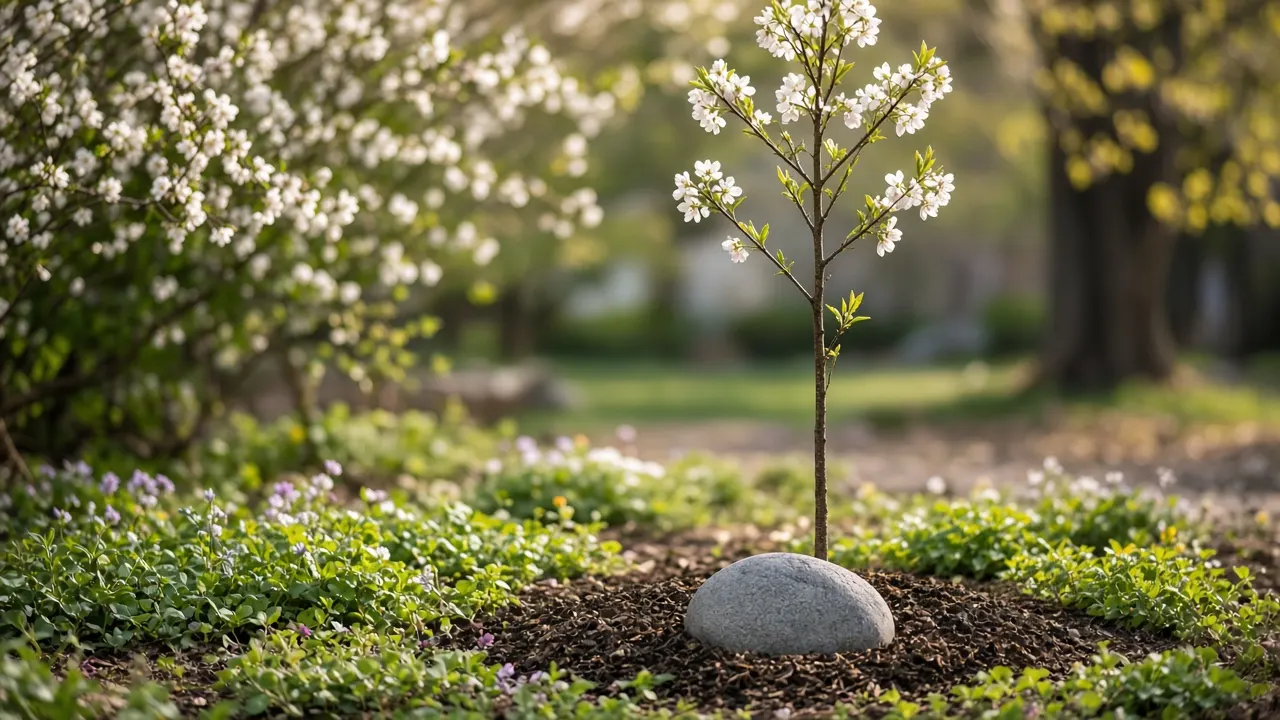
A mild climate like Mill Valley's gives you a wide choice of trees and shrubs, and that's where the risk lies: it's tempting to choose something that looks lovely but is short-lived or grows too big. Think about the spot in twenty years. A small flowering tree, a fruit tree on a dwarfing rootstock or a native shrub suits most yards far better than a forest tree planted beside the house.
What bio urns and aquamation cost in Mill Valley
Add up every part before you commit. Beyond the cremation, a living memorial in Mill Valley can include the bio urn, compost and bark, a pH kit, the tree or shrub, a guard against deer or rabbits, and perhaps a marker. Our memorial budget planner lists each line so nothing surprises you. Most families find the tree is the cheapest part and the cremation the most expensive.
We keep the detailed California price table on one page so it stays current: see California prices.

Free tool
Memorial budget planner
Add up cremation, urn, keepsakes and a farewell so the total holds no surprises.
Scattering and planting rules in California
Rules change more often than most people realise, and many local policies about ashes were never written down at all. Treat any general guide for California, including ours, as a starting point. Whoever looks after that particular field, park or shoreline is the one whose answer counts, so it's worth getting it by email where you can.
The official California local government directory lists every county and city office, which is the quickest way to find who to ask in Mill Valley.
Home burial and scattering are governed at the California level first; our California rules summary has the detail. Then check whether Mill Valley or your HOA adds anything.
What to do first, and what can wait for the right season
- Confirm the ashes will come back. Communal cremation usually means no ashes are returned, and you can't plant what you don't receive.
- Pick the type of bio urn: a planting urn for a tree, a plain burial urn for a garden corner, a water urn for a lake or the sea.
- Ask permission from the landowner, landlord or park manager for anywhere that isn't yours.
- Plan for the weather. In Mill Valley, avoid frozen, baked or waterlogged ground; a calm, mild day is best for planting or a release.
- Release gently on water. Rest the urn on the surface, leave it to drift and go under in its own time, and scatter only a few loose petals.
- Come back in a year. Top up the mulch, see how much the tree has put on, and photograph it to record the first anniversary.
Remembering your pet, in Mill Valley and wherever you go next
Mill Valley houses are often compact and built into slopes with little flat garden, which pushes many families toward small indoor tributes: a turned-wood urn, a pendant, a framed paw or nose print. Where there is a yard, a stone set among ferns suits the canyon light. Measure the shelf or niche before you choose, and ask the provider roughly how much ash will come back so the size matches.
there are guides for the big decisions and articles for the details, Compare every option on our services page, or see what other families chose in the poll results, run the numbers with the free planning tools. Close to Mill Valley we also cover Sacramento, Fresno, San Jose and San Diego; the full list for California and for the United States is a click away.

Reader polls
What would you choose?
Vote anonymously and see how other readers answered. The results are live counts from people who visit this site, so they show real opinions, not a scientific sample.
Would you consider releasing your pet's ashes in water?
Tap an answer to vote and see how others answered. Anonymous.
If you rent or might move, how would you handle a memorial planting?
Tap an answer to vote and see how others answered. Anonymous.
If you had to decide today, which aftercare would you choose for your pet?
Tap an answer to vote and see how others answered. Anonymous.

Free tools to help you plan
Memorial budget planner
Add up cremation, urn, keepsakes and a farewell so the total holds no surprises.

Memorial tree finder
Pick a tree for a planting urn that suits your climate, space and pet.

Aftercare options compared
Compare private, communal and water cremation with burial on cost, timing and what comes home.
Questions people ask
Will I have to travel to San Francisco to arrange things?
Not usually. Providers based in San Francisco (roughly 11 miles from Mill Valley) collect from here as a matter of routine, and the paperwork is done by email or phone. If you want to be present for a witnessed cremation, that is when the drive matters.
Is Mill Valley big enough to have several pet aftercare providers?
Probably, on the numbers. By our estimate about 5,100 Mill Valley households keep a dog or cat and around 420 lose one each year, which is enough steady demand to support more than one provider. We derive that from population (about 13,799), household size and national ownership and lifespan figures.
When is the hardest time of year to arrange a burial in Mill Valley?
There is no frozen-ground season here; average lows stay above freezing all year. The other pressure point is September, when highs around 70°F mean a body needs cooling and collecting quickly.
Which nearby towns can I compare with Mill Valley?
The closest communities we cover are Corte Madera (about 2 miles), Larkspur (about 2 miles) and Kentfield (about 3 miles). Providers based in those places often serve Mill Valley too. Ask each one for a written total that includes collection, so the distance is priced in.
Will the seed in a tree urn grow?
Not always. Seeds from kits can fail to sprout if they weren't stored or chilled correctly, and alkaline soil around them makes it harder. A young tree from a nursery near Mill Valley is far more reliable, and most planting urns work just as well with a sapling in the top chamber.
Can I bury pet ashes on a farm or rural land near Mill Valley?
On land you own, burying ashes is generally allowed. Keep the planting well away from wells, springs and streams, and away from ground where livestock graze or crops are grown. On someone else's land, including family land, ask the owner first and agree that the memorial can stay if the land changes hands.


Sources and our estimates
- [1] 53% of US households own a dog, which is about 71 million households. American Pet Products Association (APPA) 2025 State of the Industry, 2025.
- [2] US dogs have an average life expectancy at birth of 12.69 years. Montoya et al. 2023, Frontiers in Veterinary Science - Banfield Pet Hospital life expectancy tables (13.3 million dogs, 2.4 million cats, 2013-2019), 2023.
- [3] 39% of US households own a cat, which is about 53 million households. American Pet Products Association (APPA) 2025 State of the Industry, 2025.
- [4] US cats seen at Banfield hospitals have an average life expectancy at birth of 11.18 years. Montoya et al. 2023, Frontiers in Veterinary Science - Banfield Pet Hospital life expectancy tables (13.3 million dogs, 2.4 million cats, 2013-2019), 2023.
- [5] The NFDA projected California's cremation rate at 70.5% for 2024. NFDA 2024 Cremation & Burial Report state projections (via Occasional Sage), 2024.
- [6] About 59 million U.S. pet-owning households may be open to eco-friendly aftercare options. Our estimate: 86.9M pet households x 68% interested in green funeral options. How we calculate.
Get eco memorial ideas by email
Tell us what you need and where you are. We'll reply by email with clear options and prices so you can decide in your own time.