Growing something from the goodbye in Miami Lakes
Roughly 1,000 Miami Lakes families say goodbye to a dog or cat each year, by our count. A living memorial is one way to mark it. This guide explains how to make one that actually grows.
- Trees matched to Miami Lakes's climate
- Soil-safe planting method for ashes
- Real prices for bio urns and aquamation

Miami Lakes, Florida
Living memorials in Miami Lakes: the local picture
Many Miami Lakes families have relatives across Latin America and the Caribbean, and dividing ashes into small keepsakes or jewelry can help each person hold on to a piece. Ask for a cremation certificate if ashes will travel abroad, and check airline and destination rules before you go. Knowing the total weight in advance makes it easier to split fairly among relatives.
Humidity and strong sun rule out some memorial materials in Miami Lakes. Outdoors, choose something mineral or metal, like granite or bronze, and skip photo prints, painted wood and resin, which fade in a single summer. A flat stone set among the plantings or an engraved plate fixed to a planter both work on a small lot. Indoors, a sealed urn keeps ashes dry through the wet months.
Many homes around Miami Lakes rely on a septic system, and tree roots love the moist soil over a drain field. Keep a memorial tree well away from the tank and the leach lines, and choose a smaller shrub if space near the house is tight. Your septic contractor or the permit plan for the property will show where the lines run.
Miami Lakes's population is around 33,067, the 88th-largest of the 235 Florida communities we cover. Some of the providers who serve Miami Lakes are based about 4 miles away in Hialeah, the nearest larger centre, so collection times reflect that drive.
For a second opinion on price, Hialeah Gardens (3 miles), Hialeah (5 miles, a larger centre) and Miramar (5 miles, a larger centre) are close enough that their providers cover Miami Lakes routinely. Two written quotes tell you more than any price list.
Our estimate
12,000
Miami Lakes: dog- or cat-owning households, our estimate
How we calculated this
33,067 ÷ 2.5 = 13,227 households; × 53% (dog) + 39% (cat) = 12,000. A household with several pets counts once.
Our estimate
1,000
Estimated dog and cat losses in Miami Lakes each year
How we calculated this
12,000 dog/cat-owning homes ÷ average lifespan (dog: 12.69 yrs + cat: 11.18 yrs) ≈ 1,000 a year. Treat it as a minimum.
53%[1]
53% of US households own a dog, which is about 71 million households.
12.69 years[2]
US dogs have an average life expectancy at birth of 12.69 years.
39%[3]
39% of US households own a cat, which is about 53 million households.
11.18 years[4]
US cats seen at Banfield hospitals have an average life expectancy at birth of 11.18 years.
The numbers above come from American Pet Products Association (APPA) 2025 State of the Industry and Montoya et al. 2023, Frontiers in Veterinary Science, if you'd like to read the original sources.

The local attitude to ashes and memorials
With a human cremation rate near 72.5%[5], Florida has plenty of crematories competing for families, and that tends to show in the choice on offer. Ask more than one pet provider what they include. Some return ashes in a simple cardboard or paper tube, some add a wooden urn you may not want, and a few can quote for water cremation. The cheapest honest quote is usually the one you can plant from.
The Florida percentage above is from NFDA 2024 Cremation & Burial Report state projections (via Occasional Sage) (2024) and refers to human funerals. Treat it as context for Miami Lakes, not as a count of pets.
Choosing the right month to plant in Miami Lakes
Miami Lakes summers are hard on young trees: August averages highs around 91°F. Don't plant a memorial tree in the hottest months. Aim for the cooler part of the year, when roots can grow before the next summer arrives. Ashes don't need to go into the ground quickly, so keeping them safely at home for a few months is completely fine.
In a hot climate like Miami Lakes's, with highs of about 91°F in August, salt is a bigger problem than in wetter places. Rain is what washes sodium from ashes down past the roots, and dry heat lets it build up near the surface. Mix the ashes through a much larger volume of soil and compost than you'd think necessary, and water deeply and slowly after planting so salts move down, not up.
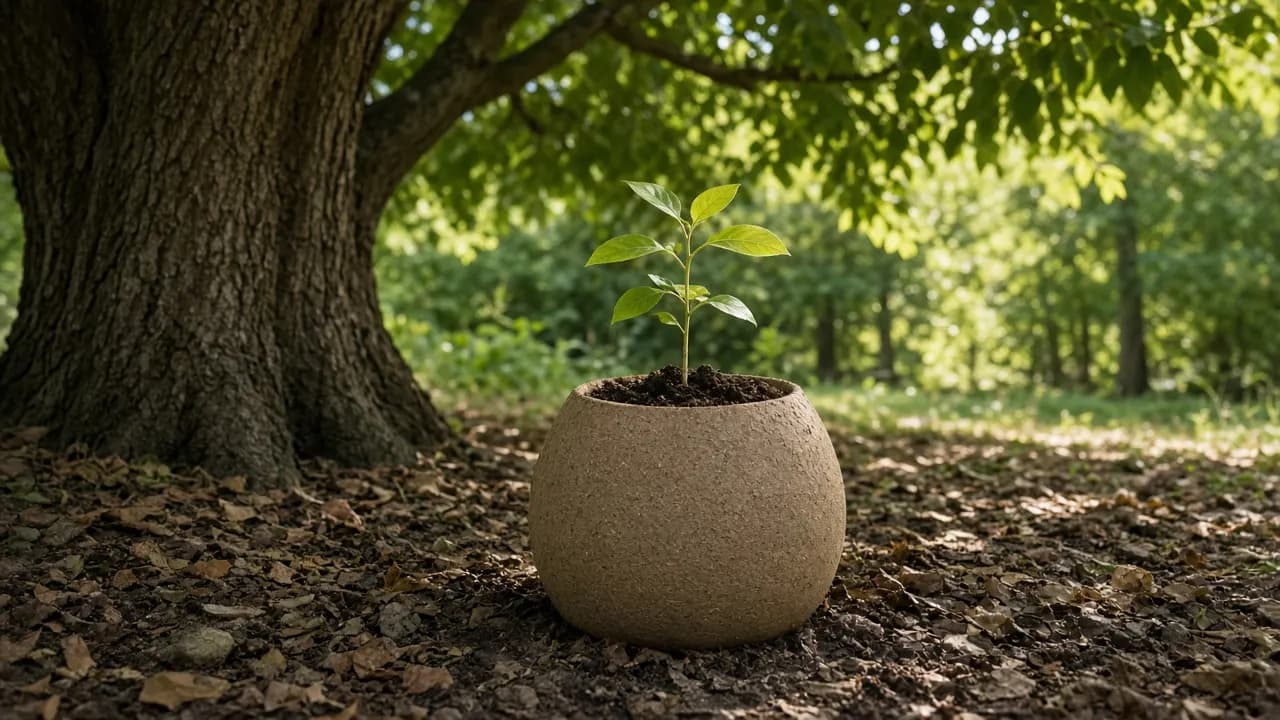
Budgeting for a living memorial in Miami Lakes
It helps to compare a planted memorial with the alternatives. A pet cemetery burial for a dog averages about $831[6] in the US, which by our estimate is around 3.2 times the national average for private cremation[7]. Private cremation plus a bio urn and a sapling in your own Miami Lakes garden usually comes in far below a cemetery plot, and there are no yearly maintenance fees.
We keep the detailed Florida price table on one page so it stays current: see Florida prices.

Free tool
Memorial budget planner
Add up cremation, urn, keepsakes and a farewell so the total holds no surprises.
Who to ask before you plant or scatter in Florida
Two questions cover most situations in Florida: who owns or manages this land or water, and have they said yes? For your own garden, the answer is you. For a rented home, it's your landlord, in writing. For parks and public water, it's the relevant agency. For a relative's garden, it's them, and it's worth agreeing that the tree stays even if the house is sold.
To find your county or city office in Florida, start with the official Florida local government directory.
We keep Florida's burial and scattering rules in one place: the Florida rules summary. Before a home burial in Miami Lakes, also ask the city whether local ordinances add anything.
Your next steps, whatever your situation
- Confirm the ashes will come back. With a communal cremation there's normally nothing to collect afterwards, which leaves you with nothing to put in an urn.
- Pick the type of bio urn: a planting urn for a tree, a plain burial urn for a garden corner, a water urn for a lake or the sea.
- Ask permission from the landowner, landlord or park manager for anywhere that isn't yours.
- Plan for the weather. Around Miami Lakes, skip days when the soil is rock-hard, frozen or sodden, and wait for still, gentle conditions to plant or release.
- Release gently on water. Set the urn on the surface, let it float and sink on its own, and add only loose petals.
- Come back in a year. Top up the mulch, see how much the tree has put on, and photograph it to record the first anniversary.
Ways to mark the spot and the date
Miami Lakes homes often have patios, lakeside yards or balconies, so memorials here tend to mix indoor and outdoor: an urn on a shelf, an engraved stone among potted palms, a framed paw print in the hallway. If you're unsure, leave the remains in their temporary box for now. Glass and jewelry artists can work from a small amount months later, so nothing is lost by waiting.
look through our guides and the blog, For a plain comparison of the choices, open services, use the free tools before you ring anyone, or compare your instinct with the poll results. More local pages: Port St. Lucie, Tampa, Orlando and Miami, the Florida overview and every city in the United States.

Reader polls
What would you choose?
Vote anonymously and see how other readers answered. The results are live counts from people who visit this site, so they show real opinions, not a scientific sample.
If you rent or might move, how would you handle a memorial planting?
Tap an answer to vote and see how others answered. Anonymous.
What kind of tree or plant would you choose?
Tap an answer to vote and see how others answered. Anonymous.
If you had to decide today, which aftercare would you choose for your pet?
Tap an answer to vote and see how others answered. Anonymous.

Free tools to help you plan
Memorial budget planner
Add up cremation, urn, keepsakes and a farewell so the total holds no surprises.

Memorial tree finder
Pick a tree for a planting urn that suits your climate, space and pet.

Aftercare options compared
Compare private, communal and water cremation with burial on cost, timing and what comes home.
Questions people ask
Is Miami Lakes big enough to have several pet aftercare providers?
Probably, on the numbers. By our estimate about 12,000 Miami Lakes households keep a dog or cat and around 1,000 lose one each year, which is enough steady demand to support more than one provider. We derive that from population (about 33,067), household size and national ownership and lifespan figures.
Where are the providers that serve Miami Lakes actually based?
Some are local, and some run from Hialeah, about 4 miles away. That is normal for a town this size. What matters is the collection time they quote for Miami Lakes and whether the drive is priced into the total, so ask both up front.
Is cremation common in Florida?
For people, yes: about 72.5%[5] of Florida deaths end in cremation, according to NFDA 2024 Cremation & Burial Report state projections (via Occasional Sage) (2024). Nobody publishes the same figure for pets, but in our experience pet choices in Miami Lakes follow the human pattern closely, so cremation is the default most families here start from.
Which nearby towns can I compare with Miami Lakes?
The closest communities we cover are Hialeah Gardens (about 3 miles), Hialeah (about 5 miles) and Miramar (about 5 miles). Providers based in those places often serve Miami Lakes too. Ask each one for a written total that includes collection, so the distance is priced in.
What happens to the memorial tree if I move away from Miami Lakes?
It stays with the land, and ashes mixed into soil can't be recovered. If a move is possible, plant in a large container, plant at a relative's home, or keep a small portion of the ashes back for a future garden. Cuttings from many shrubs root easily, so you can take a piece of the plant with you.
Where can I buy a native tree for a pet memorial in Miami Lakes?
A local nursery or garden center is the best place, because staff know what survives local heat, cold and soil. Some county extension offices and native plant societies run plant sales too. Ask for a two-year-old sapling of a species that tolerates slightly alkaline soil, and ask how much water it needs in its first summer.


Sources and our estimates
- [1] 53% of US households own a dog, which is about 71 million households. American Pet Products Association (APPA) 2025 State of the Industry, 2025.
- [2] US dogs have an average life expectancy at birth of 12.69 years. Montoya et al. 2023, Frontiers in Veterinary Science - Banfield Pet Hospital life expectancy tables (13.3 million dogs, 2.4 million cats, 2013-2019), 2023.
- [3] 39% of US households own a cat, which is about 53 million households. American Pet Products Association (APPA) 2025 State of the Industry, 2025.
- [4] US cats seen at Banfield hospitals have an average life expectancy at birth of 11.18 years. Montoya et al. 2023, Frontiers in Veterinary Science - Banfield Pet Hospital life expectancy tables (13.3 million dogs, 2.4 million cats, 2013-2019), 2023.
- [5] The NFDA projected Florida's cremation rate at 72.5% for 2024. NFDA 2024 Cremation & Burial Report state projections (via Occasional Sage), 2024.
- [6] CareCredit's 2025 cost study put the US national average for pet cemetery burial of a dog at $831 (range $659-$1,513). CareCredit (Synchrony) - How Much Does It Cost To Euthanize a Dog? (2025 ASQ360 procedural cost study), 2025.
- [7] US pet cemetery burial for a dog costs about 3.2x a private cremation ($831 vs $260 national averages). Our estimate: 831 / 260 = 3.20. How we calculate.
- [8] Switching one human-scale cremation to alkaline hydrolysis saves about 112 kg CO2e under TNO's accounting. Our estimate: 79.9 - (-31.8) kg CO2e. How we calculate.
Plan a living memorial in Miami Lakes
Tell us what you need and where you are. We'll reply by email with clear options and prices so you can decide in your own time.