Tree, garden and water memorials in Lewiston
About 1,050 dogs and cats are lost in Lewiston each year, by our estimate. If you'd like your pet's ashes to grow into a tree or return to the water, this page covers the soil, the season and the cost.
- Planting, garden and water urns compared
- Honest notes on local rules
- Help choosing a native species

Lewiston, Idaho
Bio urns, trees and water in Lewiston
In a town shaped by two rivers, memorials often have a water theme: a smooth river rock with a name painted on it, a small urn with a blue glaze, or a photo of a pet on a riverbank. The dry climate is kinder to outdoor markers than wetter places, though summer sun can fade some materials. Ask about UV-resistant finishes before placing a plaque in a sunny yard.
Lewiston families are often spread across the Lewis-Clark Valley, the Palouse and the rest of the Northwest. Dividing ashes lets everyone keep a piece: small keepsake urns for siblings, a charm on a necklace, or a paw or hoof print pressed in clay. Undecided is fine too. Ashes keep indefinitely, so the choice can wait for a family visit.
Most families in and around Lewiston arrange cremation through their local vet, who works with a regional crematory, and then do the memorial themselves. That's a good split. Bio urns ship by mail, and the local feed store, nursery or hardware store usually has the compost, pine bark and a pH kit you need. The one thing worth buying locally is the tree, because a nursery near you already knows what survives your winters and summers.
Lewiston is home to about 34,717 people, the 9th-largest of the 13 Idaho communities we cover.
The closest communities we cover are Moscow (23 miles), Pullman (25 miles) and Walla Walla (68 miles). Providers serving those towns often travel to Lewiston too, so it can be worth asking them for a quote.
Our estimate
13,000
How many dog- or cat-owning households Lewiston has (estimate)
How we calculated this
34,717 ÷ 2.5 = 13,887 households; × 53% (dog) + 39% (cat) = 13,000. A household with several pets counts once.
Our estimate
1,050
dog and cat deaths per year in Lewiston, our estimate
How we calculated this
13,000 dog/cat-owning homes ÷ average lifespan (dog: 12.69 yrs + cat: 11.18 yrs) ≈ 1,050 a year. Treat it as a minimum.
53%[1]
53% of US households own a dog, which is about 71 million households.
12.69 years[2]
US dogs have an average life expectancy at birth of 12.69 years.
39%[3]
39% of US households own a cat, which is about 53 million households.
11.18 years[4]
US cats seen at Banfield hospitals have an average life expectancy at birth of 11.18 years.
If a number here surprises you, the primary material is American Pet Products Association (APPA) 2025 State of the Industry and Montoya et al. 2023, Frontiers in Veterinary Science; we only apply it to this.

Why cremation culture in Idaho shapes your options
In Idaho, about 71.2%[5] of people are cremated, one of the higher rates around. When most human funerals end with ashes, the question "what shall we do with them?" comes up in nearly every family, and a tree, a garden bed or a lake release is a common answer. That familiarity carries over to pets. It also means more crematories to choose from, and more chance that one of them offers water cremation.
The Idaho figure comes from NFDA 2024 Cremation & Burial Report state projections (via Occasional Sage) (2024). It describes people, not pets, so read it as a sign of local attitudes rather than a pet statistic.
What Lewiston's climate means for a living memorial
Freezing and thawing through January, February and December can heave a newly planted tree out of the ground in Lewiston. If you plant in autumn, mulch well after the first frost to keep the soil temperature steady, and check the base of the tree in spring. A spring planting avoids the problem entirely and gives roots a full growing season before the next winter.
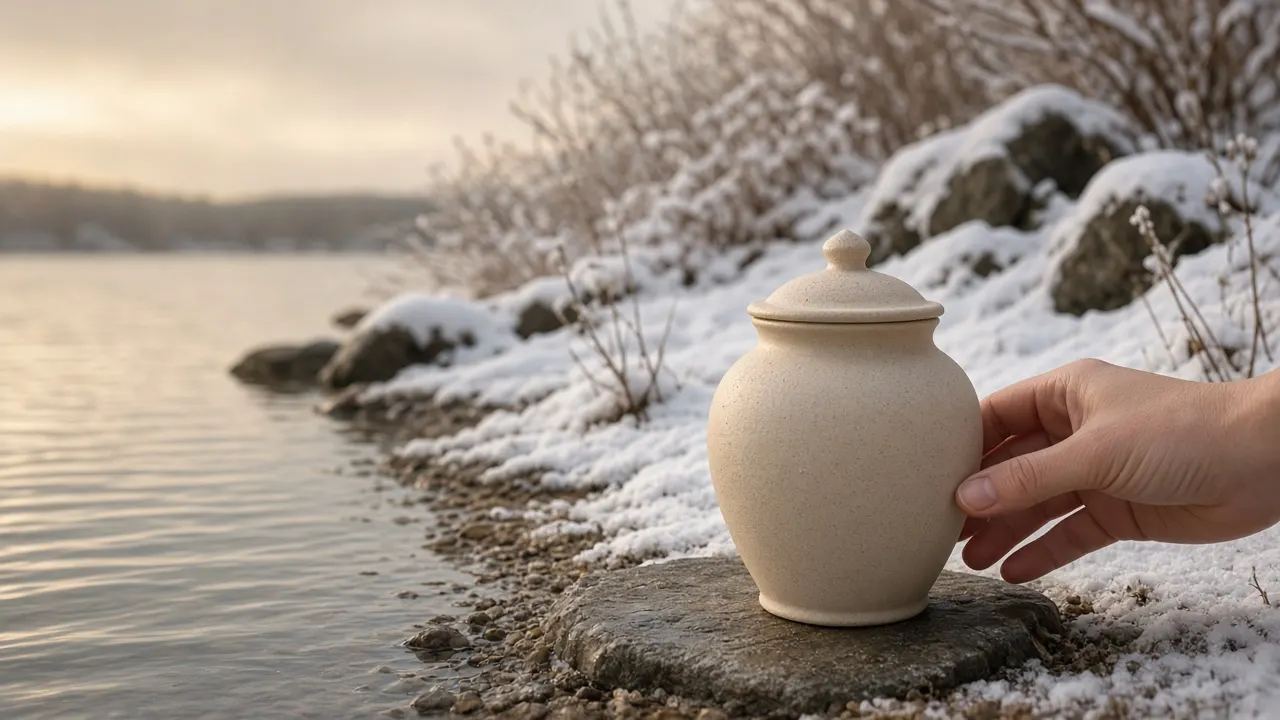
Water releases need open water, and in Lewiston lakes and ponds may ice over around December. Never walk out onto ice to release an urn. If a lake or river was your pet's place, plan the release for spring or summer, when the shoreline is safe and a water-soluble urn can float and dissolve as it's meant to. Keep the ashes at home until then.
Budgeting for a living memorial in Lewiston
Add up every part before you commit. Beyond the cremation, a living memorial in Lewiston can include the bio urn, compost and bark, a pH kit, the tree or shrub, a guard against deer or rabbits, and perhaps a marker. Our memorial budget planner lists each line so nothing surprises you. Most families find the tree is the cheapest part and the cremation the most expensive.
We keep the detailed Idaho price table on one page so it stays current: see Idaho prices.

Free tool
Memorial budget planner
Add up cremation, urn, keepsakes and a farewell so the total holds no surprises.
Scattering and planting rules in Idaho
Water releases need a little more care than a garden planting. Rivers, lakes, reservoirs and coastal waters in Idaho are managed by different bodies, and drinking-water sources are often off-limits. Wherever you release, use only a water-soluble urn or loose ashes, add nothing but loose flower petals, and let no plastic, ribbon or wreath wire float away.
To find your county or city office in Idaho, start with the official Idaho local government directory.
We keep Idaho's burial and scattering rules in one place: the Idaho rules summary. Before a home burial in Lewiston, also ask the city whether local ordinances add anything.
Planting a memorial in Lewiston, step by step
- If your pet dies while you're away from Lewiston, have a vet close to where you are set up individual cremation locally. Transporting a body a long way home almost never works out.
- Ask how the ashes can reach you: collected in person, posted by a tracked courier service, or sent to your own vet.
- Flying home with the ashes? Keep them in your carry-on, inside a container security can scan, and pack the crematory's paperwork alongside them.
- Don't buy the bio urn on the road. Hold off until you're back and have settled on a location, then choose an urn that suits it.
- Plant somewhere that links both places if the idea appeals: perhaps a species native to the area your pet died in, or one already growing at home, provided it can cope with the climate in Lewiston.
- Write down the date and place where your pet died and where it was cremated. Those details fade faster than you'd expect.
Ways to mark the spot and the date
About 71 percent of people in Idaho are cremated, and families here are used to the idea of keeping ashes or scattering them somewhere meaningful. If you want to scatter along the Snake or Clearwater, check the rules for that spot and choose a day with little wind. Keep back a portion in a small urn or pendant if you might want it later.
or compare your instinct with the poll results, run the numbers with the free planning tools, Compare every option on our services page, the guides answer the longer questions and the blog the newer ones. If you live between Lewiston and Pocatello, Boise, Idaho Falls and Nampa, either page applies. Every other community in Idaho, and all of the United States, is listed too.

Reader polls
What would you choose?
Vote anonymously and see how other readers answered. The results are live counts from people who visit this site, so they show real opinions, not a scientific sample.
Would you consider releasing your pet's ashes in water?
Tap an answer to vote and see how others answered. Anonymous.
If you rent or might move, how would you handle a memorial planting?
Tap an answer to vote and see how others answered. Anonymous.
If you had to decide today, which aftercare would you choose for your pet?
Tap an answer to vote and see how others answered. Anonymous.

Free tools to help you plan
Memorial budget planner
Add up cremation, urn, keepsakes and a farewell so the total holds no surprises.

Memorial tree finder
Pick a tree for a planting urn that suits your climate, space and pet.

Aftercare options compared
Compare private, communal and water cremation with burial on cost, timing and what comes home.
Questions people ask
When is the hardest time of year to arrange a burial in Lewiston?
January, February and December: average lows are below freezing then, and frozen ground makes a home grave slow or impossible until it thaws. The other pressure point is July, when highs around 91°F mean a body needs cooling and collecting quickly.
Is Lewiston big enough to have several pet aftercare providers?
Probably, on the numbers. By our estimate about 13,000 Lewiston households keep a dog or cat and around 1,050 lose one each year, which is enough steady demand to support more than one provider. We derive that from population (about 34,717), household size and national ownership and lifespan figures.
Can a provider from a neighbouring town collect from Lewiston?
Usually yes. Moscow is about 23 miles away, Pullman is about 25 miles away and Walla Walla is about 68 miles away, all inside a normal collection radius. Get the mileage written into the quote so there is no surprise on the day.
Why does the Lewiston page quote a human cremation rate?
Because it is the best local signal we have. NFDA 2024 Cremation & Burial Report state projections (via Occasional Sage) (2024) reports about 71.2%[5] of Idaho residents are cremated. There is no official pet equivalent, and inventing one would be worse than quoting a real, clearly labelled number.
What if my pet dies when it's too hot or cold to plant?
Wait. Ashes don't need to go into the ground quickly, and a tree planted in the wrong season is more likely to fail. Keep them in the container from the crematory, use the time to choose a species and prepare the soil mix, and plant when the weather in Lewiston is kind to young roots.
How do I prepare pet ashes for planting?
Spread the ashes through a large volume of compost and soil rather than pouring them into the hole in one layer. Many gardeners add acidic material such as composted pine bark or leaf mould. One gardening guide suggests letting the mix rest for 90–120 days[7] before planting. A garden-center pH kit tells you when the mix is ready.


Sources and our estimates
- [1] 53% of US households own a dog, which is about 71 million households. American Pet Products Association (APPA) 2025 State of the Industry, 2025.
- [2] US dogs have an average life expectancy at birth of 12.69 years. Montoya et al. 2023, Frontiers in Veterinary Science - Banfield Pet Hospital life expectancy tables (13.3 million dogs, 2.4 million cats, 2013-2019), 2023.
- [3] 39% of US households own a cat, which is about 53 million households. American Pet Products Association (APPA) 2025 State of the Industry, 2025.
- [4] US cats seen at Banfield hospitals have an average life expectancy at birth of 11.18 years. Montoya et al. 2023, Frontiers in Veterinary Science - Banfield Pet Hospital life expectancy tables (13.3 million dogs, 2.4 million cats, 2013-2019), 2023.
- [5] The NFDA projected Idaho's cremation rate at 71.2% for 2024. NFDA 2024 Cremation & Burial Report state projections (via Occasional Sage), 2024.
- [6] Switching one human-scale cremation to alkaline hydrolysis saves about 112 kg CO2e under TNO's accounting. Our estimate: 79.9 - (-31.8) kg CO2e. How we calculate.
- [7] Gardening Know How advises letting an ash/soil-amendment mixture sit for at least 90 to 120 days before planting. Gardening Know How — Planting With Cremains: Is There a Safe Way to Bury Ashes, 2024.
Tell us about your pet and your garden
Tell us what you need and where you are. We'll reply by email with clear options and prices so you can decide in your own time.