Planting your pet's ashes in Pullman
Roughly 1,050 Pullman families say goodbye to a dog or cat each year, by our count. A living memorial is one way to mark it. This guide explains how to make one that actually grows.
- When to plant in your season
- How much ash your urn must hold
- Aquamation providers in your area

Pullman, Washington
Planning a greener goodbye in Pullman
A big share of Pullman is students and early-career faculty who relocate after a few years, so a memorial that travels makes sense. A small urn, an inked paw print in a frame, or a tiny vial of ashes on a chain can follow you to the next job or degree. A heavy stone may not suit a rental you'll leave in June. Choose something you can pack in minutes.
Students often share an animal with roommates, a partner or family back home, and more than one person may want to keep something. A primary urn and a few mini urns or charms can be divided among them. Tell the provider before cremation, ask how portions are sealed for air travel, and put a clear label on each one. Include dates as well.
Many homes around Pullman rely on a septic system, and tree roots love the moist soil over a drain field. Keep a memorial tree well away from the tank and the leach lines, and choose a smaller shrub if space near the house is tight. Your septic contractor or the permit plan for the property will show where the lines run.
Pullman's population is around 33,756, the 39th-largest of the 67 Washington communities we cover. Spokane, roughly 65 miles off, is the closest larger centre, and a share of the providers who cover Pullman run from there.
Nearby, we also have local pages for Moscow (8 miles), Lewiston (25 miles) and Spokane Valley (64 miles, a larger centre), which can help if your vet or the provider you prefer is based there.
Our estimate
12,500
Pullman: dog- or cat-owning households, our estimate
How we calculated this
33,756 ÷ 2.5 = 13,502 households; × 53% (dog) + 39% (cat) = 12,500. Homes are counted once however many pets they keep.
Our estimate
1,050
dog and cat deaths per year in Pullman, our estimate
How we calculated this
12,500 dog/cat-owning homes ÷ average lifespan (dog: 12.69 yrs + cat: 11.18 yrs) ≈ 1,050 a year. The real figure is unlikely to be lower.
53%[1]
53% of US households own a dog, which is about 71 million households.
12.69 years[2]
US dogs have an average life expectancy at birth of 12.69 years.
39%[3]
39% of US households own a cat, which is about 53 million households.
11.18 years[4]
US cats seen at Banfield hospitals have an average life expectancy at birth of 11.18 years.
The numbers above come from Montoya et al. 2023, Frontiers in Veterinary Science and American Pet Products Association (APPA) 2025 State of the Industry, if you'd like to read the original sources.

Why cremation culture in Washington shapes your options
Cremation accounts for roughly 79.1%[5] of human deaths in Washington, and a lot of those ashes end up waiting on a shelf. That's true of pets as well. If you already have an urn at home from an earlier pet, a bio urn can be a way to finish that story: the older ashes and the new can go into one planting, or two trees side by side, whenever you feel ready.
For the Washington figure we rely on Direct Cremate (citing CANA) (2024). Read it as a picture of local custom around death and remembrance in Pullman rather than as pet data.
When to plant in Pullman's climate
A Pullman winter is a useful waiting room. With 6 months of freezing lows, you can mix the ashes with compost in a covered bin or tub in a garage or shed during the cold months and let the mix rest. One gardening guide suggests at least 90–120 days[6] before planting, which fits neatly between a winter loss and spring planting. Test the pH before the tree goes in.
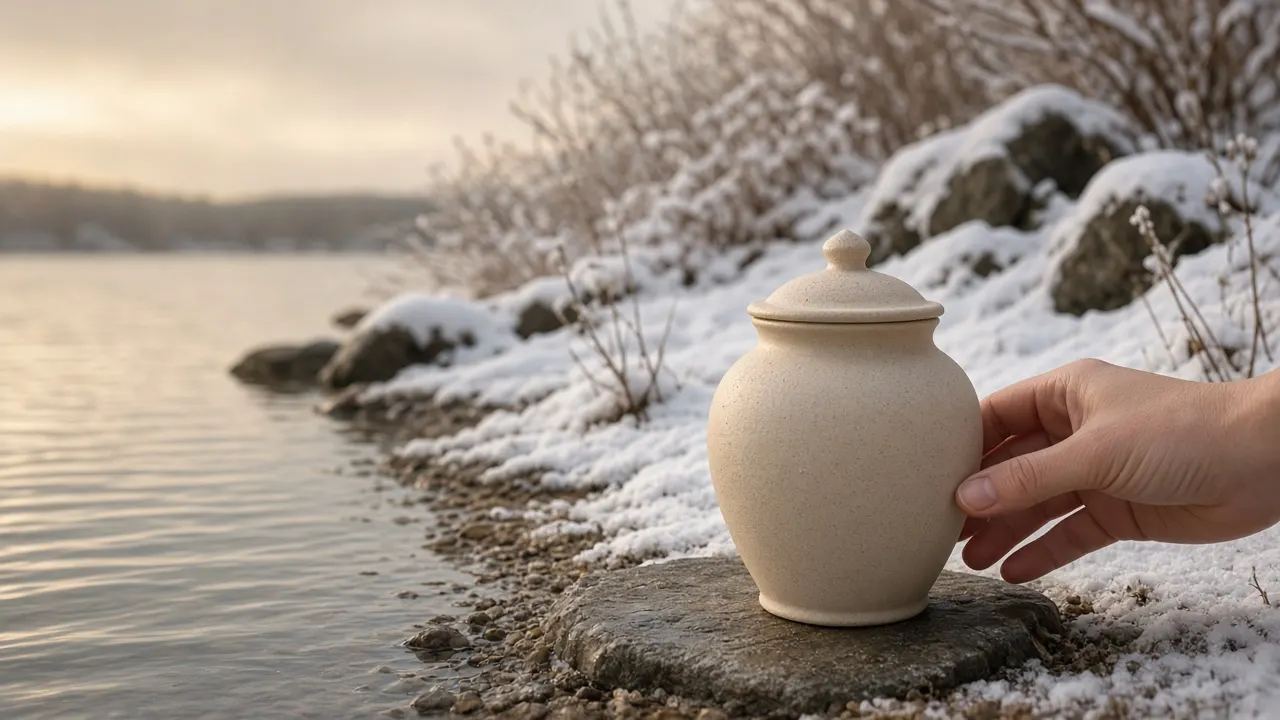
Water releases need open water, and in Pullman lakes and ponds may ice over around December. Never walk out onto ice to release an urn. If a lake or river was your pet's place, plan the release for spring or summer, when the shoreline is safe and a water-soluble urn can float and dissolve as it's meant to. Keep the ashes at home until then.
Budgeting for a living memorial in Pullman
The container the ashes come back in can quietly add to the bill. One Virginia crematory, for example, sells private cremation at $189 with a temporary container and $225 with a wooden urn[7]. If you're planting, the plain option is all you need. Wooden pet urns alone run about $30–$150[8] in one national guide, money that could buy a good tree for your Pullman garden instead.
Rather than repeat the price table on every city page, we keep one for Washington: Washington costs. What each service includes is on the services page.

Free tool
Memorial budget planner
Add up cremation, urn, keepsakes and a farewell so the total holds no surprises.
What Washington allows for ashes, in general terms
Water releases need a little more care than a garden planting. Rivers, lakes, reservoirs and coastal waters in Washington are managed by different bodies, and drinking-water sources are often off-limits. Wherever you release, use only a water-soluble urn or loose ashes, add nothing but loose flower petals, and let no plastic, ribbon or wreath wire float away.
Not sure which office covers Pullman? The Washington local government directory is the official list.
For Washington's rules on burying a pet at home or scattering ashes, see the Washington guide. Local rules in Pullman can be stricter than the state's, especially in homeowners' associations and rentals.
How to plan a living memorial, in order
- If you're remembering more than one animal, settle at the start on one shared planting or separate ones. Either works, but once the ashes are combined there's no undoing it.
- Label each container clearly with the name and date as it comes back, especially if the ashes return months or years apart.
- Choose a bigger planting area when there are several sets of ashes; a long hedge, a cluster of shrubs or a few fruit trees gives the minerals more ground to disperse into.
- Keep a spoonful of each in separate keepsakes if anyone in the family wants to remember one animal on its own.
- Plan for the pets still living with you. Fresh soil with the scent of bone in it invites digging, so fence or cover the spot until it has settled.
- Add a marker for each name, or one stone that lists them all, so visitors know who the planting is for.
Keeping your pet's memory growing in Pullman
Palouse winters bite and summers bake, and both punish anything left outside. Frost splits cheap concrete and resin, while high summer sun bleaches paint. For a garden on land you own, go with granite or bronze, bed it on gravel so frost heave doesn't tip it, and pick a spot with some afternoon shade. Wipe off dust after harvest season.
go deeper with the guides or catch up on recent articles, or compare your instinct with the poll results, the planning tools turn your pet's details into figures, For a plain comparison of the choices, open services. More local pages: Kent, Tacoma, Bellevue and Spokane, the Washington overview and every city in the United States.

Reader polls
What would you choose?
Vote anonymously and see how other readers answered. The results are live counts from people who visit this site, so they show real opinions, not a scientific sample.
If you rent or might move, how would you handle a memorial planting?
Tap an answer to vote and see how others answered. Anonymous.
If water cremation (aquamation) were offered near you, would you choose it?
Tap an answer to vote and see how others answered. Anonymous.
If you had to decide today, which aftercare would you choose for your pet?
Tap an answer to vote and see how others answered. Anonymous.

Free tools to help you plan
Memorial budget planner
Add up cremation, urn, keepsakes and a farewell so the total holds no surprises.

Memorial tree finder
Pick a tree for a planting urn that suits your climate, space and pet.

Aftercare options compared
Compare private, communal and water cremation with burial on cost, timing and what comes home.
Questions people ask
Which nearby towns can I compare with Pullman?
The closest communities we cover are Moscow (about 8 miles), Lewiston (about 25 miles) and Spokane Valley (about 64 miles). Providers based in those places often serve Pullman too. Ask each one for a written total that includes collection, so the distance is priced in.
Why does the Pullman page quote a human cremation rate?
Because it is the best local signal we have. Direct Cremate (citing CANA) (2024) reports about 79.1%[5] of Washington residents are cremated. There is no official pet equivalent, and inventing one would be worse than quoting a real, clearly labelled number.
Will I have to travel to Spokane to arrange things?
Not usually. Providers based in Spokane (roughly 65 miles from Pullman) collect from here as a matter of routine, and the paperwork is done by email or phone. If you want to be present for a witnessed cremation, that is when the drive matters.
How does Pullman's weather affect pet aftercare?
August is the hottest month in Pullman, with average highs around 86°F, so prompt collection matters most then. Average lows drop below freezing in January, February, March, April, November and December, which can make digging a grave hard until spring.
I rent in Pullman. Can I still have a living memorial?
Yes. Plant in a large container, such as a half-barrel or a big pot with a dwarf tree or flowering shrub, and it moves with you. Use only a small share of the ashes in the pot, well mixed with compost. If you'd like to plant in a rented yard, get the landlord's permission in writing, and remember the tree stays when you leave.
Can I plant my pet's ashes in winter in Pullman?
Not usually, if the ground is frozen. Keep the ashes indoors until spring, when the soil has thawed and drained, or plant in early autumn with several weeks of open ground before hard frosts. Winter is a good time to mix the ashes with compost in a covered tub and let the blend rest before planting.


Sources and our estimates
- [1] 53% of US households own a dog, which is about 71 million households. American Pet Products Association (APPA) 2025 State of the Industry, 2025.
- [2] US dogs have an average life expectancy at birth of 12.69 years. Montoya et al. 2023, Frontiers in Veterinary Science - Banfield Pet Hospital life expectancy tables (13.3 million dogs, 2.4 million cats, 2013-2019), 2023.
- [3] 39% of US households own a cat, which is about 53 million households. American Pet Products Association (APPA) 2025 State of the Industry, 2025.
- [4] US cats seen at Banfield hospitals have an average life expectancy at birth of 11.18 years. Montoya et al. 2023, Frontiers in Veterinary Science - Banfield Pet Hospital life expectancy tables (13.3 million dogs, 2.4 million cats, 2013-2019), 2023.
- [5] Washington had a 79.1% cremation rate in 2024, among the highest in the US. Direct Cremate (citing CANA), 2024.
- [6] Gardening Know How advises letting an ash/soil-amendment mixture sit for at least 90 to 120 days before planting. Gardening Know How — Planting With Cremains: Is There a Safe Way to Bury Ashes, 2024.
- [7] Heavenly Paws Cremations in Chantilly, Virginia, sells private cremation packages at $189 (temporary container), $225 (wooden urn) and $300 (wooden photo urn), each including a paw print and fur clipping. Heavenly Paws Cremations – Packages, 2026.
- [8] Memorials.com puts wooden pet urns at $30–$150. Memorials.com – Pet Urn Cost Guide, 2025.
- [9] About 59 million U.S. pet-owning households may be open to eco-friendly aftercare options. Our estimate: 86.9M pet households x 68% interested in green funeral options. How we calculate.
Ask about aquamation near Pullman
Tell us what you need and where you are. We'll reply by email with clear options and prices so you can decide in your own time.