Greener pet aftercare in Austin, Minnesota
Austin has an estimated 9,800 dog- or cat-owning households. When a planting or water memorial feels right for yours, here's what works in the local climate and what to ask before you buy.
- When to plant in your season
- How much ash your urn must hold
- Aquamation providers in your area

Austin, Minnesota
Where a living memorial fits in Austin
Some Austin families like to mark the loss in a way that helps other animals, such as a donation of food or blankets to a local shelter to honor their companion. Others want something small to keep: fur sealed in a locket, a nose impression in ink, or a charm carrying a little ash. Keepsakes taken from the body must be requested before cremation.
Austin's older neighborhoods are mostly modest frame houses on tree-lined streets, while the newer homes toward the edge of town sit on roomier lots. Memorials follow suit. A small hardwood urn on a bookshelf, a framed photo paired with a clay pawprint, or an engraved stone at the corner of a vegetable garden all fit different households. Taking weeks or months to decide is common and completely fine.
In rural areas around Austin, family pets are sometimes buried whole on the property rather than cremated. If you'd prefer that, check local rules on depth and distance from water. If you'd like a tree above the grave, plant it beside the grave, not directly on it, so the roots aren't disturbed and the ground can settle. For cremated pets, a planting urn gives you the tree without a large grave, and it can be placed exactly where you want.
With roughly 26,689 residents, Austin is the 40th-largest of the 67 Minnesota communities we cover.
Nearby, we also have local pages for Albert Lea (19 miles), Owatonna (32 miles) and Rochester (34 miles, a larger centre), which can help if your vet or the provider you prefer is based there.
Our estimate
9,800
Austin: dog- or cat-owning households, our estimate
How we calculated this
26,689 ÷ 2.5 = 10,676 households; × 53% (dog) + 39% (cat) = 9,800. A household with several pets counts once.
Our estimate
820
Estimated dog and cat losses in Austin each year
How we calculated this
9,800 dog/cat-owning homes ÷ average lifespan (dog: 12.69 yrs + cat: 11.18 yrs) ≈ 820 a year. A floor, not a ceiling.
53%[1]
53% of US households own a dog, which is about 71 million households.
12.69 years[2]
US dogs have an average life expectancy at birth of 12.69 years.
39%[3]
39% of US households own a cat, which is about 53 million households.
11.18 years[4]
US cats seen at Banfield hospitals have an average life expectancy at birth of 11.18 years.
The published sources behind those figures are American Pet Products Association (APPA) 2025 State of the Industry and Montoya et al. 2023, Frontiers in Veterinary Science.

What local attitudes to cremation mean in Minnesota
Cremation and burial are both familiar in Minnesota, where about 68.5%[5] of people are cremated. For many families that means a pet's aftercare starts with a question of tradition: bury in the yard as earlier generations did, or cremate and keep the ashes. A bio urn sits happily between the two. It returns the ashes to the earth like a burial, but without a large grave, and it can be planted in a spot you choose later.
For the Minnesota figure we rely on NFDA 2024 Cremation & Burial Report state projections (via Occasional Sage) (2024). Read it as a picture of local custom around death and remembrance in Austin rather than as pet data.
Choosing the right month to plant in Austin
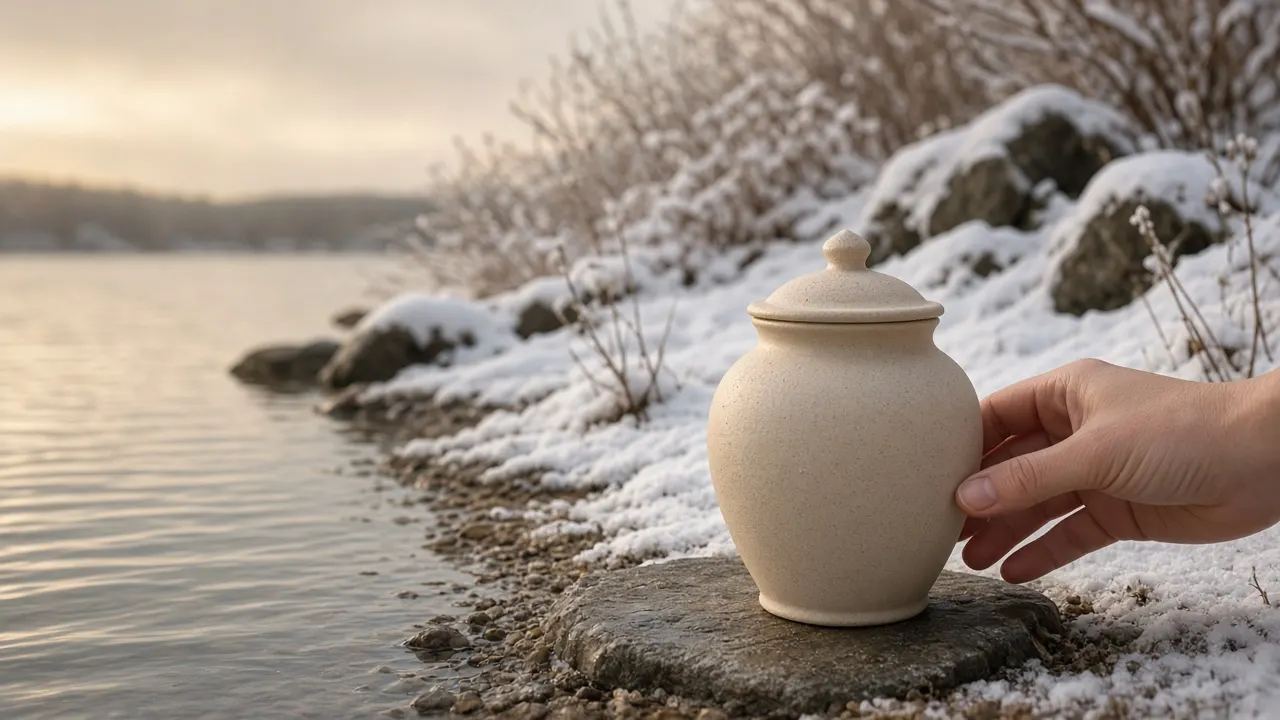
Water releases need open water, and in Austin lakes and ponds may ice over around January. Never walk out onto ice to release an urn. If a lake or river was your pet's place, plan the release for spring or summer, when the shoreline is safe and a water-soluble urn can float and dissolve as it's meant to. Keep the ashes at home until then.
In Austin, average lows fall below freezing in January, February, March, November and December, and frozen ground makes digging hard or impossible. That's no reason to rush. Ashes keep safely indoors for as long as you like, so many families wait for spring, once the soil has thawed and drained. Early autumn works too, as long as the tree has about six weeks of open ground to root in before the hard frosts.
Eco memorial prices, from urn to tree
Water cremation prices overlap with flame cremation. One Delaware provider charges $150–$450[6] for private aquamation by weight, including a standard urn, and $50–$225[7] for communal. That makes private about 2.5 times the shared price[8]. Prices in Austin depend on who offers it locally, so ask for a written quote that says whether the ashes come back and in what container.
The Minnesota price table breaks costs down by product; our services page explains what sits behind each line.

Free tool
Memorial budget planner
Add up cremation, urn, keepsakes and a farewell so the total holds no surprises.
Where you can plant or release ashes in Minnesota
Two questions cover most situations in Minnesota: who owns or manages this land or water, and have they said yes? For your own garden, the answer is you. For a rented home, it's your landlord, in writing. For parks and public water, it's the relevant agency. For a relative's garden, it's them, and it's worth agreeing that the tree stays even if the house is sold.
To find your county or city office in Minnesota, start with the official Minnesota local government directory.
The Minnesota page sets out who oversees pet cremation and what the state says about burial and scattering. Austin's own bylaws can sit on top of that, so ask before you dig.
What to do first, and what can wait for the right season
- Talk it through with your household before deciding anything, since someone may quietly prefer the ashes to stay indoors.
- Measure your space. Trees spread more than people expect; in a smaller garden a shrub, a big pot or a border may be the kinder fit.
- Test the soil at the planting site. Ground that already reads alkaline calls for a species that tolerates lime, plus more compost or composted bark than usual.
- Spread the ashes through a wide planting area, not in one band directly beneath the root ball.
- Water well for two summers. It's drought in the early years, not cold, that kills the majority of memorial trees that don't make it.
- Keep a record noting which species you planted, when, and how the soil was mixed, so future care or taking a cutting is straightforward.
Ways to mark the spot and the date
The heavy, fertile soil around Austin holds a lot of water, and when it freezes it pushes outdoor markers crooked. A granite or bronze memorial on a bed of crushed rock stays level far better than resin or molded cement. Choose a spot that doesn't flood when snowmelt runs off in March, and plan to reset the stone once or twice over the first few years.
the guides answer the longer questions and the blog the newer ones, See what each option includes on our services page, try the free planning tools, or look at how readers voted in our polls. You can also browse every city in the United States. Nearby, we also cover Rochester, Minneapolis, Brooklyn Park and Saint Paul, and every city in Minnesota.

Reader polls
What would you choose?
Vote anonymously and see how other readers answered. The results are live counts from people who visit this site, so they show real opinions, not a scientific sample.
If you rent or might move, how would you handle a memorial planting?
Tap an answer to vote and see how others answered. Anonymous.
If water cremation (aquamation) were offered near you, would you choose it?
Tap an answer to vote and see how others answered. Anonymous.
If you had to decide today, which aftercare would you choose for your pet?
Tap an answer to vote and see how others answered. Anonymous.

Free tools to help you plan
Memorial budget planner
Add up cremation, urn, keepsakes and a farewell so the total holds no surprises.

Memorial tree finder
Pick a tree for a planting urn that suits your climate, space and pet.

Aftercare options compared
Compare private, communal and water cremation with burial on cost, timing and what comes home.
Questions people ask
When is the hardest time of year to arrange a burial in Austin?
January, February, March, November and December: average lows are below freezing then, and frozen ground makes a home grave slow or impossible until it thaws. The other pressure point is July, when highs around 82°F mean a body needs cooling and collecting quickly.
Is Austin big enough to have several pet aftercare providers?
Probably, on the numbers. By our estimate about 9,800 Austin households keep a dog or cat and around 820 lose one each year, which is enough steady demand to support more than one provider. We derive that from population (about 26,689), household size and national ownership and lifespan figures.
How do Minnesota attitudes to cremation compare?
NFDA 2024 Cremation & Burial Report state projections (via Occasional Sage) (2024) puts the Minnesota human cremation rate at about 68.5%[5]. We show it on the Austin page because pet aftercare choices tend to track it: where cremation is normal for people, communal and private pet cremation are both easy to find.
Can a provider from a neighbouring town collect from Austin?
Usually yes. Albert Lea is about 19 miles away, Owatonna is about 32 miles away and Rochester is about 34 miles away, all inside a normal collection radius. Get the mileage written into the quote so there is no surprise on the day.
Which memorial plants are dangerous to cats and dogs?
Lilies are highly toxic to cats, even the pollen. Sago palm, oleander, yew, azalea and foxglove can poison dogs, and several of them harm cats and horses too. If you have pets at home in Austin, ask a vet or nursery to confirm a plant is safe before you buy it. Grasses, many herbs and most fruit trees are safer choices, though large amounts of fallen fruit can still upset a dog's stomach.
Can I plant my pet's ashes in winter in Austin?
Not usually, if the ground is frozen. Keep the ashes indoors until spring, when the soil has thawed and drained, or plant in early autumn with several weeks of open ground before hard frosts. Winter is a good time to mix the ashes with compost in a covered tub and let the blend rest before planting.


Sources and our estimates
- [1] 53% of US households own a dog, which is about 71 million households. American Pet Products Association (APPA) 2025 State of the Industry, 2025.
- [2] US dogs have an average life expectancy at birth of 12.69 years. Montoya et al. 2023, Frontiers in Veterinary Science - Banfield Pet Hospital life expectancy tables (13.3 million dogs, 2.4 million cats, 2013-2019), 2023.
- [3] 39% of US households own a cat, which is about 53 million households. American Pet Products Association (APPA) 2025 State of the Industry, 2025.
- [4] US cats seen at Banfield hospitals have an average life expectancy at birth of 11.18 years. Montoya et al. 2023, Frontiers in Veterinary Science - Banfield Pet Hospital life expectancy tables (13.3 million dogs, 2.4 million cats, 2013-2019), 2023.
- [5] The NFDA projected Minnesota's cremation rate at 68.5% for 2024. NFDA 2024 Cremation & Burial Report state projections (via Occasional Sage), 2024.
- [6] Delaware Pet Aquamation charges $150–$450 for private aquamation by weight, from under 10 lb to 150 lb and over, including a standard urn. Delaware Pet Aquamation – Pricing, 2026.
- [7] Communal aquamation at the same Delaware provider costs $50–$225 by weight. Delaware Pet Aquamation – Pricing, 2026.
- [8] Private pet aquamation costs about 2.5 times communal aquamation at the same provider. Our estimate: mean of tier ratios 150/50, 200/75, 250/100, 350/150, 450/225. How we calculate.
- [9] If just 10% of U.S. pet cremations moved to aquamation, about 4,200 t CO2e a year would be avoided. Our estimate: 1.5M x 10% x 31.3 kg x 90% reduction. How we calculate.
Tell us about your pet and your garden
Tell us what you need and where you are. We'll reply by email with clear options and prices so you can decide in your own time.