Tree, garden and water memorials in Chaska
Chaska has an estimated 11,000 dog- or cat-owning households. When a planting or water memorial feels right for yours, here's what works in the local climate and what to ask before you buy.
- Trees matched to Chaska's climate
- Soil-safe planting method for ashes
- Real prices for bio urns and aquamation

Chaska, Minnesota
Where a living memorial fits in Chaska
The clay soils around Chaska hold moisture, and when that water freezes it lifts anything set in the ground. A granite or bronze marker on a gravel footing stays level much longer than resin, cast stone or painted concrete. Keep it away from downspouts and low spots where meltwater pools in March, and give it a quick look once the frost has gone out each spring.
Walking the Arboretum's collections is an easy way to see which trees and shrubs handle Minnesota winters before planting one over a biodegradable urn. Some families would rather have a portable keepsake, such as a clay impression of a paw, a sealed clipping of fur, or a glass charm holding a little ash. Prints and fur can only be taken before cremation, so ask at the start.
Getting a bio urn in Chaska is mostly a matter of ordering online, but getting the soil right is a local job. Ask a nursery or your county extension office whether the ground is chalky, clay or sandy. Clay holds salts near the roots and drains poorly, so dig a wider hole and mix in more compost. Sandy soil drains well but holds little, so water the young tree more often in its first summers.
Chaska is home to about 30,513 people, the 35th-largest of the 67 Minnesota communities we cover. The nearest larger centre is Minneapolis, about 20 miles (33 km) away, which is where some providers serving Chaska are based.
Our pages for Chanhassen (4 miles), Shakopee (7 miles) and Eden Prairie (8 miles, a larger centre) describe the same choices from those towns' point of view, and the providers overlap, so a quote from one often covers Chaska as well.
Our estimate
11,000
Estimated dog- or cat-owning households in Chaska
How we calculated this
30,513 ÷ 2.5 = 12,205 households; × 53% (dog) + 39% (cat) = 11,000. A household with several pets counts once.
Our estimate
940
dog and cat deaths per year in Chaska, our estimate
How we calculated this
11,000 dog/cat-owning homes ÷ average lifespan (dog: 12.69 yrs + cat: 11.18 yrs) ≈ 940 a year. A floor, not a ceiling.
53%[1]
53% of US households own a dog, which is about 71 million households.
12.69 years[2]
US dogs have an average life expectancy at birth of 12.69 years.
39%[3]
39% of US households own a cat, which is about 53 million households.
11.18 years[4]
US cats seen at Banfield hospitals have an average life expectancy at birth of 11.18 years.
To check the figures yourself, see American Pet Products Association (APPA) 2025 State of the Industry and Montoya et al. 2023, Frontiers in Veterinary Science.

Cremation, burial and green choices in Minnesota
About 68.5%[5] of people who die in Minnesota are cremated. That's a human statistic, but it shapes local services: in places where cremation is common but not dominant, there are usually enough crematories to compare, while greener options like water cremation may be less widespread. It's worth asking any provider directly whether they offer aquamation, and whether the ashes come back in a simple container you can plant from.
The Minnesota percentage above is from NFDA 2024 Cremation & Burial Report state projections (via Occasional Sage) (2024) and refers to human funerals. Treat it as context for Chaska, not as a count of pets.
Chaska seasons and your memorial tree
In Chaska, average lows fall below freezing in January, February, March, November and December, and frozen ground makes digging hard or impossible. That's no reason to rush. Ashes keep safely indoors for as long as you like, so many families wait for spring, once the soil has thawed and drained. Early autumn works too, as long as the tree has about six weeks of open ground to root in before the hard frosts.
Snow can hide a young memorial tree and the damage done around it. In Chaska, where lows average about 7°F in January, voles and rabbits chew bark under the snow line, and snowplows or shovels can snap a sapling. Put a tall stake beside the planting so you can find it, and fit a loose guard around the trunk before the first snow.
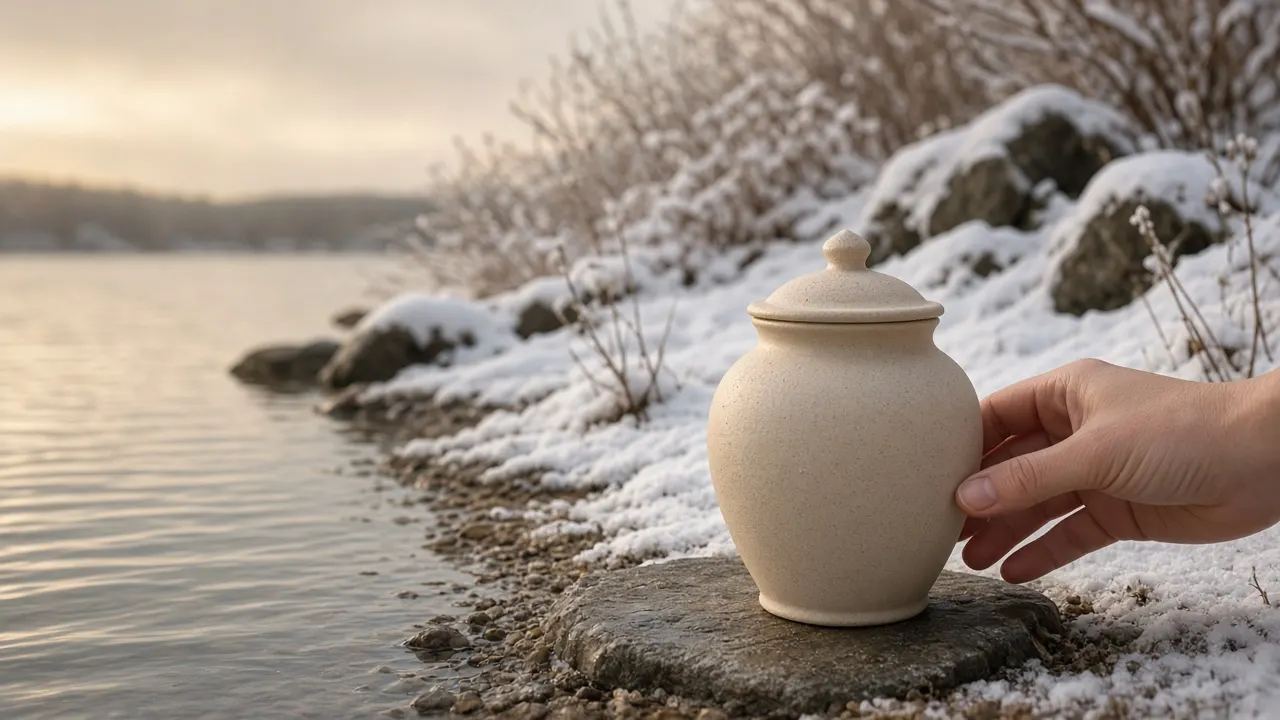
Adding up the cost of a bio urn memorial in Chaska
Here's how the pieces add up for a Chaska family. Private cremation of a dog averages about $260[6] nationally. A pet bio urn with a seed capsule is sold for about $99[7], and a planting system without the tree for $119[8]. Compost, pine bark and a pH kit add a few dollars more. Ask local providers for a written total before you choose.
The full price table by product is on our Minnesota page, and the services page explains what each option includes.

Free tool
Memorial budget planner
Add up cremation, urn, keepsakes and a farewell so the total holds no surprises.
Scattering and planting rules in Minnesota
Water releases need a little more care than a garden planting. Rivers, lakes, reservoirs and coastal waters in Minnesota are managed by different bodies, and drinking-water sources are often off-limits. Wherever you release, use only a water-soluble urn or loose ashes, add nothing but loose flower petals, and let no plastic, ribbon or wreath wire float away.
Not sure which office covers Chaska? The Minnesota local government directory is the official list.
We keep Minnesota's burial and scattering rules in one place: the Minnesota rules summary. Before a home burial in Chaska, also ask the city whether local ordinances add anything.
What to do first, and what can wait for the right season
- If you're remembering more than one animal, decide early whether the ashes will be planted together or apart. Both are fine, but mixed ashes can't be separated later.
- Label each container clearly the moment it arrives, name and date on the lid, which matters most when the sets come home a long way apart.
- Choose a bigger planting area for several sets of ashes: a hedge, a group of shrubs or a small orchard spreads the mineral load across more soil.
- Keep a spoonful of each in its own keepsake, so a family member who was closest to one particular pet has something just for them.
- Plan for the pets still living with you. Fresh soil with the scent of bone in it invites digging, so fence or cover the spot until it has settled.
- Add a marker for each name, or one stone that lists them all, so visitors know who the planting is for.
Living memorials beyond the backyard
Downtown Chaska's brick storefronts and older houses sit close together, while the newer neighborhoods up on the bluffs have wider yards. That range shapes what people choose. In a historic home, a small urn on a windowsill or a framed pawprint beside the stairs fits the scale of the rooms, while a hillside backyard can take a garden stone beneath a young tree. There is no deadline for deciding.
or see how other readers answered in our polls, run the numbers with the free planning tools, For a plain comparison of the choices, open services, the guides answer the longer questions and the blog the newer ones. You can also browse every city in the United States. Nearby, we also cover Minneapolis, Duluth, Brooklyn Park and Saint Paul, and every city in Minnesota.

Reader polls
What would you choose?
Vote anonymously and see how other readers answered. The results are live counts from people who visit this site, so they show real opinions, not a scientific sample.
If water cremation (aquamation) were offered near you, would you choose it?
Tap an answer to vote and see how others answered. Anonymous.
What kind of tree or plant would you choose?
Tap an answer to vote and see how others answered. Anonymous.
If you had to decide today, which aftercare would you choose for your pet?
Tap an answer to vote and see how others answered. Anonymous.

Free tools to help you plan
Memorial budget planner
Add up cremation, urn, keepsakes and a farewell so the total holds no surprises.

Memorial tree finder
Pick a tree for a planting urn that suits your climate, space and pet.

Aftercare options compared
Compare private, communal and water cremation with burial on cost, timing and what comes home.
Questions people ask
Roughly how many pets die in Chaska each year?
Our estimate is around 940. It comes from Chaska's population (about 30,513), the average household size, the share of homes with a dog or cat (about 11,000 households here) and the average lifespan. It is arithmetic, not a count, so read it as a rough floor.
Does the Chaska climate change what I should do first?
Only the timing. In July, with highs near 82°F, cool the body and book collection the same day. In January, February, March, November and December, when lows sit below freezing, a home burial may have to wait for a thaw, so cremation with ashes returned keeps your options open.
How do Minnesota attitudes to cremation compare?
NFDA 2024 Cremation & Burial Report state projections (via Occasional Sage) (2024) puts the Minnesota human cremation rate at about 68.5%[5]. We show it on the Chaska page because pet aftercare choices tend to track it: where cremation is normal for people, communal and private pet cremation are both easy to find.
Which nearby towns can I compare with Chaska?
The closest communities we cover are Chanhassen (about 4 miles), Shakopee (about 7 miles) and Eden Prairie (about 8 miles). Providers based in those places often serve Chaska too. Ask each one for a written total that includes collection, so the distance is priced in.
Can I scatter my pet's ashes in a park in Chaska?
Usually only with permission, and some parks don't allow it at all. Parks are managed by a city, county, state or national agency, each with its own policy, and many were written for human ashes. Contact the park office, explain it's a small amount of pet ash, and ask whether there's a preferred spot.
Will the seed in a tree urn grow?
Not always. Seeds from kits can fail to sprout if they weren't stored or chilled correctly, and alkaline soil around them makes it harder. A young tree from a nursery near Chaska is far more reliable, and most planting urns work just as well with a sapling in the top chamber.


Sources and our estimates
- [1] 53% of US households own a dog, which is about 71 million households. American Pet Products Association (APPA) 2025 State of the Industry, 2025.
- [2] US dogs have an average life expectancy at birth of 12.69 years. Montoya et al. 2023, Frontiers in Veterinary Science - Banfield Pet Hospital life expectancy tables (13.3 million dogs, 2.4 million cats, 2013-2019), 2023.
- [3] 39% of US households own a cat, which is about 53 million households. American Pet Products Association (APPA) 2025 State of the Industry, 2025.
- [4] US cats seen at Banfield hospitals have an average life expectancy at birth of 11.18 years. Montoya et al. 2023, Frontiers in Veterinary Science - Banfield Pet Hospital life expectancy tables (13.3 million dogs, 2.4 million cats, 2013-2019), 2023.
- [5] The NFDA projected Minnesota's cremation rate at 68.5% for 2024. NFDA 2024 Cremation & Burial Report state projections (via Occasional Sage), 2024.
- [6] CareCredit's 2025 cost study put the US national average for private dog cremation at $260 (range $206-$473). CareCredit (Synchrony) - How Much Does It Cost To Euthanize a Dog? (2025 ASQ360 procedural cost study), 2025.
- [7] The Bios Urn for pets, a biodegradable urn with a seed capsule, costs $99. Bios Urn – Pets, 2026.
- [8] The Living Urn's pet bio-urn planting system (without a tree) costs $119. The Living Urn – Pet tree urn, 2026.
- [9] If just 10% of U.S. pet cremations moved to aquamation, about 4,200 t CO2e a year would be avoided. Our estimate: 1.5M x 10% x 31.3 kg x 90% reduction. How we calculate.
Plan a living memorial in Chaska
Tell us what you need and where you are. We'll reply by email with clear options and prices so you can decide in your own time.