Tree, garden and water memorials in Forest Lake
Roughly 640 Forest Lake families say goodbye to a dog or cat each year, by our count. A living memorial is one way to mark it. This guide explains how to make one that actually grows.
- Planting, garden and water urns compared
- Honest notes on local rules
- Help choosing a native species

Forest Lake, Minnesota
Where a living memorial fits in Forest Lake
Lakeside memorials in Forest Lake take a beating from frost heave, spring ice push and high water after snowmelt. Granite or bronze bedded over crushed rock lasts longest, sited well back from the waterline where ice shoves can't reach. Tree urns take hold best after the ground thaws, usually in May. Indoor memorials skip the weather problem entirely and move with you if the cabin is ever sold.
With lake homes and acreage common around Forest Lake, outdoor memorials are popular: a granite stone above the shoreline, a white pine planted on the property, or a cedar bench facing the water. Others lean toward indoor urns, pendants or framed paw impressions. You needn't rush any of it, since cremated remains keep indefinitely in the crematory's plain container while the family talks things through.
Many homes around Forest Lake rely on a septic system, and tree roots love the moist soil over a drain field. Keep a memorial tree well away from the tank and the leach lines, and choose a smaller shrub if space near the house is tight. Your septic contractor or the permit plan for the property will show where the lines run.
Forest Lake is home to about 20,952 people, the 59th-largest of the 67 Minnesota communities we cover. Some of the providers who serve Forest Lake are based about 21 miles away in Saint Paul, the nearest larger centre, so collection times reflect that drive.
Nearby, we also have local pages for Lino Lakes (9 miles), Blaine (13 miles, a larger centre) and White Bear Lake (13 miles), which can help if your vet or the provider you prefer is based there.
Our estimate
7,700
Estimated dog- or cat-owning households in Forest Lake
How we calculated this
20,952 ÷ 2.5 = 8,381 households; × 53% (dog) + 39% (cat) = 7,700. Homes are counted once however many pets they keep.
Our estimate
640
dog and cat deaths per year in Forest Lake, our estimate
How we calculated this
7,700 dog/cat-owning homes ÷ average lifespan (dog: 12.69 yrs + cat: 11.18 yrs) ≈ 640 a year. Treat it as a minimum.
53%[1]
53% of US households own a dog, which is about 71 million households.
12.69 years[2]
US dogs have an average life expectancy at birth of 12.69 years.
39%[3]
39% of US households own a cat, which is about 53 million households.
11.18 years[4]
US cats seen at Banfield hospitals have an average life expectancy at birth of 11.18 years.
None of the figures on this this page are ours alone: they rest on Montoya et al. 2023, Frontiers in Veterinary Science and American Pet Products Association (APPA) 2025 State of the Industry.

What local attitudes to cremation mean in Minnesota
About 68.5%[5] of people in Minnesota are cremated, which puts it in the middle: cremation is common, but so is burial. For pets, that often means families weigh a planting urn against a whole-body burial in the yard. Both can grow a tree. The planting urn takes less space and can go almost anywhere; a whole-body grave needs more depth and distance from water, and the tree should go beside it rather than directly on top.
The Minnesota figure comes from NFDA 2024 Cremation & Burial Report state projections (via Occasional Sage) (2024). It describes people, not pets, so read it as a sign of local attitudes rather than a pet statistic.
When to plant in Forest Lake's climate
In Forest Lake, average lows fall below freezing in January, February, March, November and December, and frozen ground makes digging hard or impossible. That's no reason to rush. Ashes keep safely indoors for as long as you like, so many families wait for spring, once the soil has thawed and drained. Early autumn works too, as long as the tree has about six weeks of open ground to root in before the hard frosts.
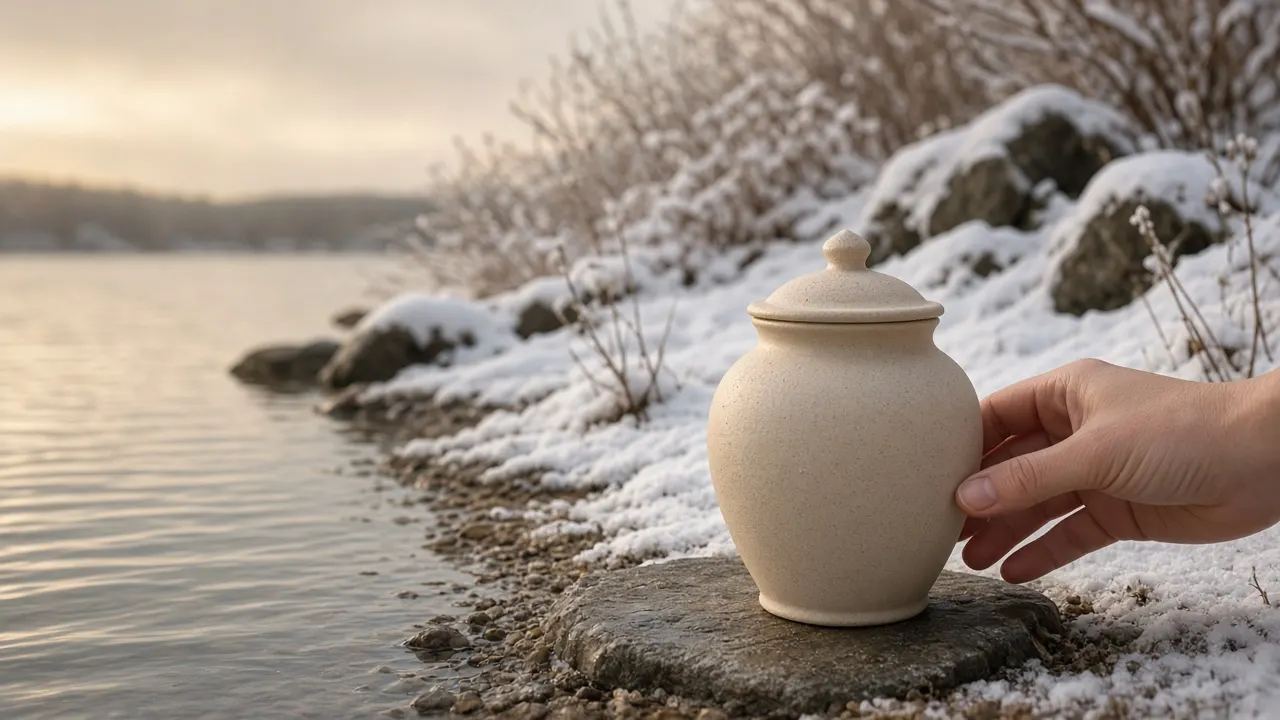
Water releases need open water, and in Forest Lake lakes and ponds may ice over around January. Never walk out onto ice to release an urn. If a lake or river was your pet's place, plan the release for spring or summer, when the shoreline is safe and a water-soluble urn can float and dissolve as it's meant to. Keep the ashes at home until then.
Budgeting for a living memorial in Forest Lake
Add up every part before you commit. Beyond the cremation, a living memorial in Forest Lake can include the bio urn, compost and bark, a pH kit, the tree or shrub, a guard against deer or rabbits, and perhaps a marker. Our memorial budget planner lists each line so nothing surprises you. Most families find the tree is the cheapest part and the cremation the most expensive.
The full price table by product is on our Minnesota page, and the services page explains what each option includes.

Free tool
Memorial budget planner
Add up cremation, urn, keepsakes and a farewell so the total holds no surprises.
Land, water and permission in Minnesota
Rules about ashes were mostly written for people, and pet ashes often sit in a grey area. That's a reason to ask, not a reason to assume. On land you own, planting or burying ashes is generally fine. Anywhere else in Minnesota, from parks to beaches to a friend's field, the land manager or owner decides, so ask first.
To find your county or city office in Minnesota, start with the official Minnesota local government directory.
For Minnesota's rules on burying a pet at home or scattering ashes, see the Minnesota guide. Local rules in Forest Lake can be stricter than the state's, especially in homeowners' associations and rentals.
A simple plan for your pet's eco memorial
- Decide what the memorial is for. A place to visit, something growing, a return to water or a lower-impact goodbye each point to a different choice.
- If a greener cremation matters, ask about aquamation before anything else; it's the step with the biggest environmental difference.
- Keep a small portion back in a keepsake in case a house move or a second memorial is on the cards down the line.
- Buy the tree locally. A young native tree from a grower around Forest Lake tends to outgrow anything sprouted from a packet seed.
- Prepare the soil a season ahead where you can, and the mixture of compost and ash will have settled by the time you dig the hole.
- Plant with the people who loved your pet, and give each of them a job: mixing, filling, watering.
Remembering your pet in Forest Lake
Forest Lake families often divide ashes, with a little kept in a keepsake vial, some scattered from a boat at a favorite cabin with the owner's blessing, and the rest planted beneath a tree near the house. Request additional containers when booking, and ask about a clay paw impression right away; the provider has to make it before cremation, not after.
the planning tools turn your pet's details into figures, or see how other readers answered in our polls, Our services overview lays out every option side by side, the guides answer the longer questions and the blog the newer ones. You can also browse every city in the United States. Nearby, we also cover Minneapolis, Duluth, Saint Paul and Bloomington, and every city in Minnesota.

Reader polls
What would you choose?
Vote anonymously and see how other readers answered. The results are live counts from people who visit this site, so they show real opinions, not a scientific sample.
If you rent or might move, how would you handle a memorial planting?
Tap an answer to vote and see how others answered. Anonymous.
If water cremation (aquamation) were offered near you, would you choose it?
Tap an answer to vote and see how others answered. Anonymous.
If you had to decide today, which aftercare would you choose for your pet?
Tap an answer to vote and see how others answered. Anonymous.

Free tools to help you plan
Memorial budget planner
Add up cremation, urn, keepsakes and a farewell so the total holds no surprises.

Memorial tree finder
Pick a tree for a planting urn that suits your climate, space and pet.

Aftercare options compared
Compare private, communal and water cremation with burial on cost, timing and what comes home.
Questions people ask
Can a provider from a neighbouring town collect from Forest Lake?
Usually yes. Lino Lakes is about 9 miles away, Blaine is about 13 miles away and White Bear Lake is about 13 miles away, all inside a normal collection radius. Get the mileage written into the quote so there is no surprise on the day.
Does the Forest Lake climate change what I should do first?
Only the timing. In July, with highs near 81°F, cool the body and book collection the same day. In January, February, March, November and December, when lows sit below freezing, a home burial may have to wait for a thaw, so cremation with ashes returned keeps your options open.
Where are the providers that serve Forest Lake actually based?
Some are local, and some run from Saint Paul, about 21 miles away. That is normal for a town this size. What matters is the collection time they quote for Forest Lake and whether the drive is priced into the total, so ask both up front.
How do Minnesota attitudes to cremation compare?
NFDA 2024 Cremation & Burial Report state projections (via Occasional Sage) (2024) puts the Minnesota human cremation rate at about 68.5%[5]. We show it on the Forest Lake page because pet aftercare choices tend to track it: where cremation is normal for people, communal and private pet cremation are both easy to find.
Is there water cremation for pets near Forest Lake?
It depends on whether a provider nearby has invested in the equipment. Smaller places rarely have their own, but some aquamation providers in larger centres such as Saint Paul collect from vets across a wide area. Ask your vet whether they work with one. If not, a flame cremation followed by a bio urn still gives you a living memorial.
Where can I buy a native tree for a pet memorial in Forest Lake?
A local nursery or garden center is the best place, because staff know what survives local heat, cold and soil. Some county extension offices and native plant societies run plant sales too. Ask for a two-year-old sapling of a species that tolerates slightly alkaline soil, and ask how much water it needs in its first summer.


Sources and our estimates
- [1] 53% of US households own a dog, which is about 71 million households. American Pet Products Association (APPA) 2025 State of the Industry, 2025.
- [2] US dogs have an average life expectancy at birth of 12.69 years. Montoya et al. 2023, Frontiers in Veterinary Science - Banfield Pet Hospital life expectancy tables (13.3 million dogs, 2.4 million cats, 2013-2019), 2023.
- [3] 39% of US households own a cat, which is about 53 million households. American Pet Products Association (APPA) 2025 State of the Industry, 2025.
- [4] US cats seen at Banfield hospitals have an average life expectancy at birth of 11.18 years. Montoya et al. 2023, Frontiers in Veterinary Science - Banfield Pet Hospital life expectancy tables (13.3 million dogs, 2.4 million cats, 2013-2019), 2023.
- [5] The NFDA projected Minnesota's cremation rate at 68.5% for 2024. NFDA 2024 Cremation & Burial Report state projections (via Occasional Sage), 2024.
- [6] If just 10% of U.S. pet cremations moved to aquamation, about 4,200 t CO2e a year would be avoided. Our estimate: 1.5M x 10% x 31.3 kg x 90% reduction. How we calculate.
Ask about aquamation near Forest Lake
Tell us what you need and where you are. We'll reply by email with clear options and prices so you can decide in your own time.