Greener pet aftercare in Winona, Minnesota
Winona has an estimated 9,750 dog- or cat-owning households. When a planting or water memorial feels right for yours, here's what works in the local climate and what to ask before you buy.
- Options for renters and apartments
- Water release rules in plain words
- No obligation, we reply by email

Winona, Minnesota
Planning a greener goodbye in Winona
Limestone is the stone of the Driftless region, and some Winona families like the idea of a local limestone marker. It's softer than granite, though, and river-valley freeze-thaw cycles can wear lettering over time, so granite or bronze remain the most durable choices. Set any marker on compacted stone and check it after the spring thaw. A small solar light nearby can help during the short December days.
River towns tend to hold onto stories, and some Winona families mark a loss with a painting or photograph of a favorite spot along the water rather than an object that holds ashes. Others want a keepsake close by: a pendant carrying a trace of ash, fur sealed in a glass vial, or a feather saved from a pet bird. Paw and nose impressions have to be requested before the cremation is carried out.
Most families in and around Winona arrange cremation through their local vet, who works with a regional crematory, and then do the memorial themselves. That's a good split. Bio urns ship by mail, and the local feed store, nursery or hardware store usually has the compost, pine bark and a pH kit you need. The one thing worth buying locally is the tree, because a nursery near you already knows what survives your winters and summers.
Winona is home to about 26,530 people, the 42nd-largest of the 67 Minnesota communities we cover.
If you want to compare providers, look at Onalaska (26 miles), La Crosse (27 miles) and Rochester (40 miles, a larger centre). Distance matters because pickup fees and the time until the ashes come back both grow with the drive.
Our estimate
9,750
How many dog- or cat-owning households Winona has (estimate)
How we calculated this
26,530 ÷ 2.5 = 10,612 households; × 53% (dog) + 39% (cat) = 9,750. A household with several pets counts once.
Our estimate
810
Estimated dog and cat losses in Winona each year
How we calculated this
9,750 dog/cat-owning homes ÷ average lifespan (dog: 12.69 yrs + cat: 11.18 yrs) ≈ 810 a year. Treat it as a minimum.
53%[1]
53% of US households own a dog, which is about 71 million households.
12.69 years[2]
US dogs have an average life expectancy at birth of 12.69 years.
39%[3]
39% of US households own a cat, which is about 53 million households.
11.18 years[4]
US cats seen at Banfield hospitals have an average life expectancy at birth of 11.18 years.
If a number here surprises you, the primary material is Montoya et al. 2023, Frontiers in Veterinary Science and American Pet Products Association (APPA) 2025 State of the Industry; we only apply it to this.

Why cremation culture in Minnesota shapes your options
In Minnesota, with a human cremation rate of roughly 68.5%[5], you'll often find pet cemeteries and pet crematories operating side by side. Some cemeteries now offer small plots for ashes, occasionally with a tree or shrub above them. That's worth comparing with a garden planting at home: a cemetery plot stays put if you move, while your own garden costs nothing and stays private.
NFDA 2024 Cremation & Burial Report state projections (via Occasional Sage) (2024) is where the Minnesota figure comes from. It counts people; we use it because attitudes to cremating a pet in Winona tend to follow attitudes to cremation generally.
Seasons, soil and weather for a memorial in Winona
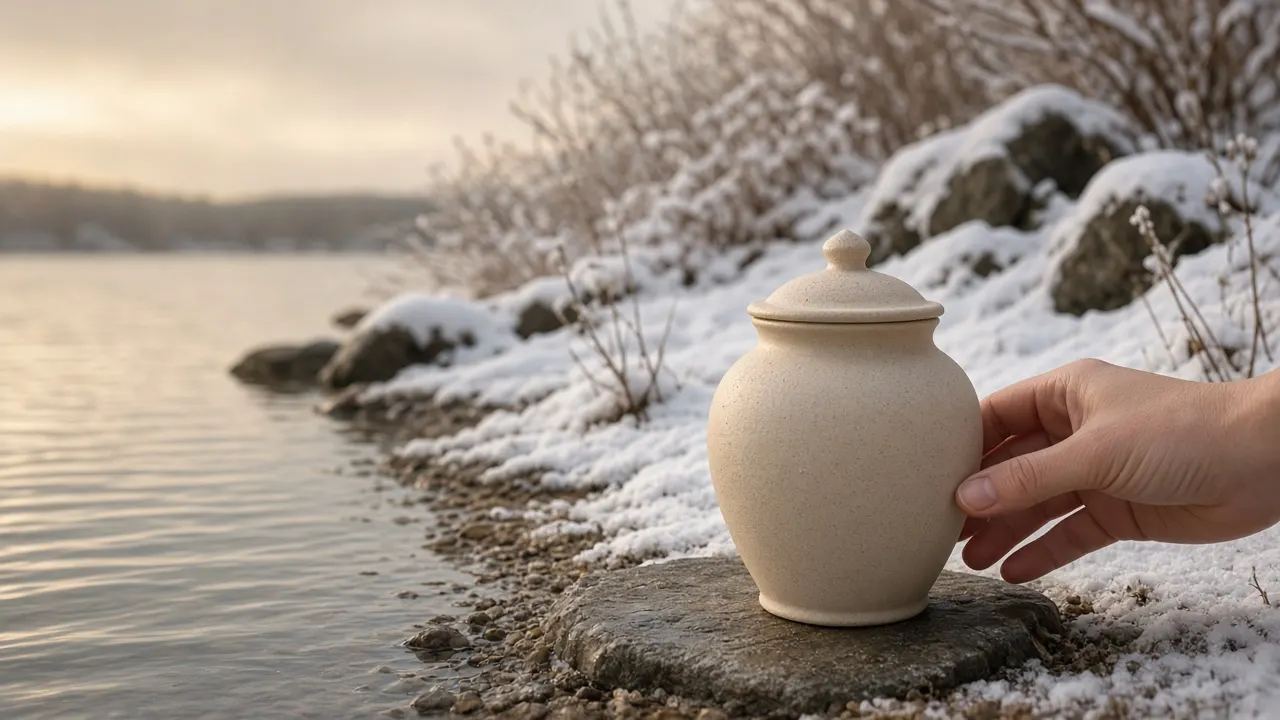
Water releases need open water, and in Winona lakes and ponds may ice over around January. Never walk out onto ice to release an urn. If a lake or river was your pet's place, plan the release for spring or summer, when the shoreline is safe and a water-soluble urn can float and dissolve as it's meant to. Keep the ashes at home until then.
In places like Winona, driveways and sidewalks are often salted in January, February, March, November and December. Ashes already add sodium to the soil, and road salt splashed onto the same bed doubles the load. Keep a memorial planting well back from salted paths and the edge of the road, and away from where snow gets piled. A spot uphill from the drive is better than one downhill of it.
What bio urns and aquamation cost in Winona
For a medium-size dog, published private aquamation prices at two US providers sit around $200–$259[6], and one Arizona provider's individual aquamation price of $75–$349[7] includes an urn, nameplate and ink paw print. Whether a Winona provider bundles extras like that makes a real difference when you compare. Add the bio urn or tree separately, and use the planner below to see the total.
We keep the detailed Minnesota price table on one page so it stays current: see Minnesota prices.

Free tool
Memorial budget planner
Add up cremation, urn, keepsakes and a farewell so the total holds no surprises.
Where you can plant or release ashes in Minnesota
Water releases need a little more care than a garden planting. Rivers, lakes, reservoirs and coastal waters in Minnesota are managed by different bodies, and drinking-water sources are often off-limits. Wherever you release, use only a water-soluble urn or loose ashes, add nothing but loose flower petals, and let no plastic, ribbon or wreath wire float away.
Not sure which office covers Winona? The Minnesota local government directory is the official list.
We keep Minnesota's burial and scattering rules in one place: the Minnesota rules summary. Before a home burial in Winona, also ask the city whether local ordinances add anything.
Planting a memorial in Winona, step by step
- If you're remembering more than one animal, settle at the start on one shared planting or separate ones. Either works, but once the ashes are combined there's no undoing it.
- Label each container clearly the moment it arrives, name and date on the lid, which matters most when the sets come home a long way apart.
- Choose a bigger planting area when there are several sets of ashes; a long hedge, a cluster of shrubs or a few fruit trees gives the minerals more ground to disperse into.
- Keep a spoonful of each in separate keepsakes if anyone in the family wants to remember one animal on its own.
- Plan for the pets still living with you. Fresh soil with the scent of bone in it invites digging, so fence or cover the spot until it has settled.
- Add a marker for each name, or a single stone carrying all of them, so anyone visiting understands who is remembered there.
Ways to mark the spot and the date
Many of Winona's older houses, especially near the universities and downtown, sit on narrow lots with little yard to spare. A memorial here might be a small urn on the mantel, a framed photograph of your companion with the bluffs behind, or a garden stone tucked beside the back steps. Students and renters who expect to move often choose something portable. Nothing about the choice has to be settled quickly.
or see how other readers answered in our polls, look through our guides and the blog, use the free tools before you ring anyone, For a plain comparison of the choices, open services. If you live between Winona and Duluth, Minneapolis, Brooklyn Park and Saint Paul, either page applies. Every other community in Minnesota, and all of the United States, is listed too.

Reader polls
What would you choose?
Vote anonymously and see how other readers answered. The results are live counts from people who visit this site, so they show real opinions, not a scientific sample.
Would you consider releasing your pet's ashes in water?
Tap an answer to vote and see how others answered. Anonymous.
If you rent or might move, how would you handle a memorial planting?
Tap an answer to vote and see how others answered. Anonymous.
If you had to decide today, which aftercare would you choose for your pet?
Tap an answer to vote and see how others answered. Anonymous.

Free tools to help you plan
Memorial budget planner
Add up cremation, urn, keepsakes and a farewell so the total holds no surprises.

Memorial tree finder
Pick a tree for a planting urn that suits your climate, space and pet.

Aftercare options compared
Compare private, communal and water cremation with burial on cost, timing and what comes home.
Questions people ask
How does Winona's weather affect pet aftercare?
July is the hottest month in Winona, with average highs around 83°F, so prompt collection matters most then. Average lows drop below freezing in January, February, March, November and December, which can make digging a grave hard until spring.
Roughly how many pets die in Winona each year?
Our estimate is around 810. It comes from Winona's population (about 26,530), the average household size, the share of homes with a dog or cat (about 9,750 households here) and the average lifespan. It is arithmetic, not a count, so read it as a rough floor.
Can a provider from a neighbouring town collect from Winona?
Usually yes. Onalaska is about 26 miles away, La Crosse is about 27 miles away and Rochester is about 40 miles away, all inside a normal collection radius. Get the mileage written into the quote so there is no surprise on the day.
How do Minnesota attitudes to cremation compare?
NFDA 2024 Cremation & Burial Report state projections (via Occasional Sage) (2024) puts the Minnesota human cremation rate at about 68.5%[5]. We show it on the Winona page because pet aftercare choices tend to track it: where cremation is normal for people, communal and private pet cremation are both easy to find.
Will the seed in a tree urn grow?
Not always. Seeds from kits can fail to sprout if they weren't stored or chilled correctly, and alkaline soil around them makes it harder. A young tree from a nursery near Winona is far more reliable, and most planting urns work just as well with a sapling in the top chamber.
Which memorial plants are dangerous to cats and dogs?
Lilies are highly toxic to cats, even the pollen. Sago palm, oleander, yew, azalea and foxglove can poison dogs, and several of them harm cats and horses too. If you have pets at home in Winona, ask a vet or nursery to confirm a plant is safe before you buy it. Grasses, many herbs and most fruit trees are safer choices, though large amounts of fallen fruit can still upset a dog's stomach.


Sources and our estimates
- [1] 53% of US households own a dog, which is about 71 million households. American Pet Products Association (APPA) 2025 State of the Industry, 2025.
- [2] US dogs have an average life expectancy at birth of 12.69 years. Montoya et al. 2023, Frontiers in Veterinary Science - Banfield Pet Hospital life expectancy tables (13.3 million dogs, 2.4 million cats, 2013-2019), 2023.
- [3] 39% of US households own a cat, which is about 53 million households. American Pet Products Association (APPA) 2025 State of the Industry, 2025.
- [4] US cats seen at Banfield hospitals have an average life expectancy at birth of 11.18 years. Montoya et al. 2023, Frontiers in Veterinary Science - Banfield Pet Hospital life expectancy tables (13.3 million dogs, 2.4 million cats, 2013-2019), 2023.
- [5] The NFDA projected Minnesota's cremation rate at 68.5% for 2024. NFDA 2024 Cremation & Burial Report state projections (via Occasional Sage), 2024.
- [6] Private aquamation for a 21–50 lb dog costs about $200–$259 at two posted US price lists. Our estimate: Delaware 10–49 lb $200; A Greener Place 21–50 lb $259. How we calculate.
- [7] A Greener Place in Mesa, Arizona, charges $75–$349 for individual pet aquamation by weight, including an urn, nameplate and ink paw print. A Greener Place Pet Aquamation – Pricing, 2026.
- [8] U.S. pet flame cremations emit on the order of 47,000 t CO2e a year. Our estimate: 1.5M pet cremations x 31.3 kg CO2e. How we calculate.
Plan a living memorial in Winona
Tell us what you need and where you are. We'll reply by email with clear options and prices so you can decide in your own time.