Planting your pet's ashes in Ozark
Roughly 720 Ozark families say goodbye to a dog or cat each year, by our count. A living memorial is one way to mark it. This guide explains how to make one that actually grows.
- When to plant in your season
- How much ash your urn must hold
- Aquamation providers in your area

Ozark, Missouri
Your living memorial options around Ozark
Southwest Missouri's humid summers and frequent spring storms weather outdoor memorials faster than people expect, leaving algae on porous stone and hairline cracks in cast concrete. Granite, bronze and dense native rock last far longer. If your house sits near the Finley River or one of its creeks, choose a spot well above any high water you have seen. Pieces kept indoors avoid all of this.
Ozark's riverside setting leads many families toward memorials made from natural materials: a creek stone engraved with a name, a cedar box for ashes, or a planter of native wildflowers by the porch. Polished urns, pendants and framed prints work just as well indoors. Take the time you need; the container from the crematory is a safe place to keep ashes meanwhile.
Small towns tend to have long memories, and a memorial tree in Ozark is often planted with a lot of history around it: the same yard for decades, a family farm, a favorite fishing spot. If the land is likely to stay in the family, a long-lived native tree is a lovely choice. If it might be sold, consider a shrub bed, a portion of ashes kept back, or a water release that doesn't depend on who owns the ground in twenty years.
About 23,544 people live in Ozark, which makes it the 31st-largest of the 43 Missouri communities we cover.
If you want to compare providers, look at Nixa (4 miles), Springfield (13 miles, a larger centre) and Republic (14 miles). Distance matters because pickup fees and the time until the ashes come back both grow with the drive.
Our estimate
8,650
Estimated dog- or cat-owning households in Ozark
How we calculated this
23,544 ÷ 2.5 = 9,418 households; × 53% (dog) + 39% (cat) = 8,650. Multi-pet homes count once.
Our estimate
720
Estimated dog and cat losses in Ozark each year
How we calculated this
8,650 dog/cat-owning homes ÷ average lifespan (dog: 12.69 yrs + cat: 11.18 yrs) ≈ 720 a year. Treat it as a minimum.
53%[1]
53% of US households own a dog, which is about 71 million households.
12.69 years[2]
US dogs have an average life expectancy at birth of 12.69 years.
39%[3]
39% of US households own a cat, which is about 53 million households.
11.18 years[4]
US cats seen at Banfield hospitals have an average life expectancy at birth of 11.18 years.
None of the figures on this this page are ours alone: they rest on American Pet Products Association (APPA) 2025 State of the Industry and Montoya et al. 2023, Frontiers in Veterinary Science.

How Missouri feels about cremation
The share of people cremated in Missouri, now about 59.8%[5], keeps inching up. For pet owners, that shift has brought more questions about what to do once the ashes come home. There's no need to decide on the day. Many families keep the ashes for a season, talk about what their pet loved, and only then settle on a tree, a pot or a lake.
Source for the Missouri number: NFDA 2024 Cremation & Burial Report state projections (via Occasional Sage) (2024). Nobody publishes a pet cremation rate for Ozark, so the human figure is the best local signal available.
What Ozark's climate means for a living memorial
Trees in Ozark have to survive hot summers and freezing winters, which rules out many species sold in planting kits. Ask a local nursery for trees proven in both conditions; natives are usually the safest choice. Plant a sapling rather than a seed, mulch a wide ring to keep the roots cooler in June, July and August and steadier through the freeze, and water deeply during dry spells for two summers.
A potted memorial in Ozark has a hard time: roots in a container feel both the 90°F heat of July and the freeze of January, February and December more sharply than roots in the ground. Choose a species rated for a colder zone than yours, move the pot into shade in summer, and into an unheated garage or against a sheltered wall in winter.
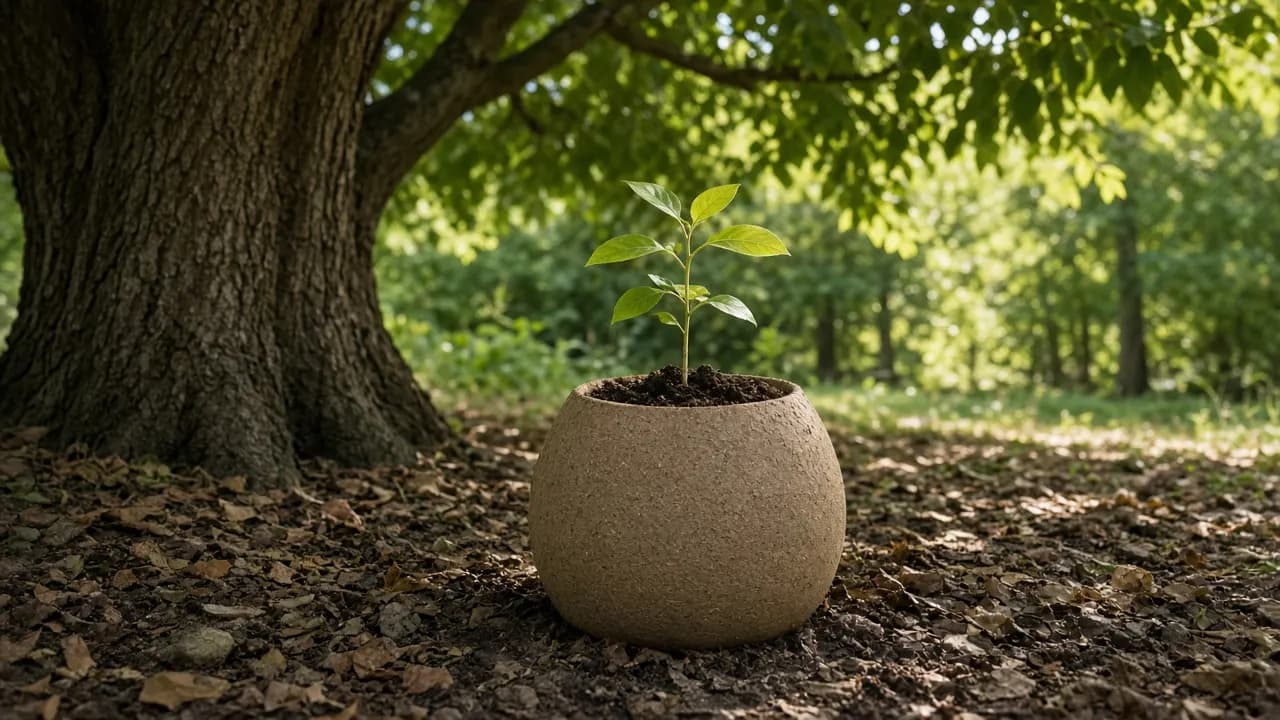
Adding up the cost of a bio urn memorial in Ozark
A living memorial in Ozark has two costs: the cremation and the urn. Biodegradable pet urns are among the cheaper urns you can buy, listed at about $15–$80[6] in one national price guide, and a sapling from a local nursery often costs less than a decorative display urn. If you'd like water cremation, one pet insurer's guide lists aquamation at $80 to $450 depending on size[7]. The table shows published examples.
The full price table by product is on our Missouri page, and the services page explains what each option includes.

Free tool
Memorial budget planner
Add up cremation, urn, keepsakes and a farewell so the total holds no surprises.
Rules worth knowing in Missouri before you scatter
Water releases need a little more care than a garden planting. Rivers, lakes, reservoirs and coastal waters in Missouri are managed by different bodies, and drinking-water sources are often off-limits. Wherever you release, use only a water-soluble urn or loose ashes, add nothing but loose flower petals, and let no plastic, ribbon or wreath wire float away.
The official Missouri local government directory lists every county and city office, which is the quickest way to find who to ask in Ozark.
The rules that apply across Missouri (home burial, scattering and who oversees pet cremation) are summarized on our Missouri page. Ozark may add its own conditions, so check with the city or county before digging.
Your next steps, whatever your situation
- Talk it through with your household first, especially if anyone would rather keep the ashes at home.
- Measure your space. Trees spread more than people expect; in a smaller garden a shrub, a big pot or a border may be the kinder fit.
- Test the soil at the planting site. Ground that already reads alkaline calls for a species that tolerates lime, plus more compost or composted bark than usual.
- Spread the ashes through a wide planting area, not in one band directly beneath the root ball.
- Water well for two summers. It's drought in the early years, not cold, that kills the majority of memorial trees that don't make it.
- Keep a record noting which species you planted, when, and how the soil was mixed, so future care or taking a cutting is straightforward.
Living memorials beyond the backyard
Some Ozark families divide the ashes, sealing a spoonful in a keepsake or pendant and placing the remainder in a garden bed or on family land with the owner's okay. Others choose a tree-planting urn, which suits the wooded hills and leaves a living marker to visit in every season. A redbud or a native serviceberry, both spring bloomers, is a popular pick in this part of the state.
go deeper with the guides or catch up on recent articles, or look at how readers voted in our polls, See what each option includes on our services page, try the free planning tools. You can also browse every city in the United States. Nearby, we also cover Columbia, Independence, Springfield and St. Louis, and every city in Missouri.

Reader polls
What would you choose?
Vote anonymously and see how other readers answered. The results are live counts from people who visit this site, so they show real opinions, not a scientific sample.
If water cremation (aquamation) were offered near you, would you choose it?
Tap an answer to vote and see how others answered. Anonymous.
Would you consider releasing your pet's ashes in water?
Tap an answer to vote and see how others answered. Anonymous.
If you had to decide today, which aftercare would you choose for your pet?
Tap an answer to vote and see how others answered. Anonymous.

Free tools to help you plan
Memorial budget planner
Add up cremation, urn, keepsakes and a farewell so the total holds no surprises.

Memorial tree finder
Pick a tree for a planting urn that suits your climate, space and pet.

Aftercare options compared
Compare private, communal and water cremation with burial on cost, timing and what comes home.
Questions people ask
Is Ozark big enough to have several pet aftercare providers?
Probably, on the numbers. By our estimate about 8,650 Ozark households keep a dog or cat and around 720 lose one each year, which is enough steady demand to support more than one provider. We derive that from population (about 23,544), household size and national ownership and lifespan figures.
How does Ozark's weather affect pet aftercare?
July is the hottest month in Ozark, with average highs around 90°F, so prompt collection matters most then. Average lows drop below freezing in January, February and December, which can make digging a grave hard until spring.
How do Missouri attitudes to cremation compare?
NFDA 2024 Cremation & Burial Report state projections (via Occasional Sage) (2024) puts the Missouri human cremation rate at about 59.8%[5]. We show it on the Ozark page because pet aftercare choices tend to track it: where cremation is normal for people, communal and private pet cremation are both easy to find.
Can a provider from a neighbouring town collect from Ozark?
Usually yes. Nixa is about 4 miles away, Springfield is about 13 miles away and Republic is about 14 miles away, all inside a normal collection radius. Get the mileage written into the quote so there is no surprise on the day.
Where can I buy a native tree for a pet memorial in Ozark?
A local nursery or garden center is the best place, because staff know what survives local heat, cold and soil. Some county extension offices and native plant societies run plant sales too. Ask for a two-year-old sapling of a species that tolerates slightly alkaline soil, and ask how much water it needs in its first summer.
I rent in Ozark. Can I still have a living memorial?
Yes. Plant in a large container, such as a half-barrel or a big pot with a dwarf tree or flowering shrub, and it moves with you. Use only a small share of the ashes in the pot, well mixed with compost. If you'd like to plant in a rented yard, get the landlord's permission in writing, and remember the tree stays when you leave.


Sources and our estimates
- [1] 53% of US households own a dog, which is about 71 million households. American Pet Products Association (APPA) 2025 State of the Industry, 2025.
- [2] US dogs have an average life expectancy at birth of 12.69 years. Montoya et al. 2023, Frontiers in Veterinary Science - Banfield Pet Hospital life expectancy tables (13.3 million dogs, 2.4 million cats, 2013-2019), 2023.
- [3] 39% of US households own a cat, which is about 53 million households. American Pet Products Association (APPA) 2025 State of the Industry, 2025.
- [4] US cats seen at Banfield hospitals have an average life expectancy at birth of 11.18 years. Montoya et al. 2023, Frontiers in Veterinary Science - Banfield Pet Hospital life expectancy tables (13.3 million dogs, 2.4 million cats, 2013-2019), 2023.
- [5] The NFDA projected Missouri's cremation rate at 59.8% for 2024. NFDA 2024 Cremation & Burial Report state projections (via Occasional Sage), 2024.
- [6] Memorials.com's pet urn cost guide puts biodegradable pet urns at $15–$80. Memorials.com – Pet Urn Cost Guide, 2025.
- [7] Embrace Pet Insurance lists US communal cremation at $30-$200, partitioned at $50-$250, private at $100-$500+ and aquamation at $80-$450. Embrace Pet Insurance - Bury or Cremate Your Dog? Costs, Pros & Cons, 2025.
- [8] Each shelter-animal flame cremation emits about 31 kg CO2e on average. Our estimate: 19,000 t CO2e / 607,000 animals. How we calculate.
Get bio urn options for Ozark
Tell us what you need and where you are. We'll reply by email with clear options and prices so you can decide in your own time.