Greener pet aftercare in Cincinnati, Ohio
By our estimate, around 115,000 households in Cincinnati share their home with a dog or cat, and roughly 9,650 of those pets die each year. More of those families now ask about planting or water memorials. Here's how to do it well.
- Trees matched to Cincinnati's climate
- Soil-safe planting method for ashes
- Real prices for bio urns and aquamation
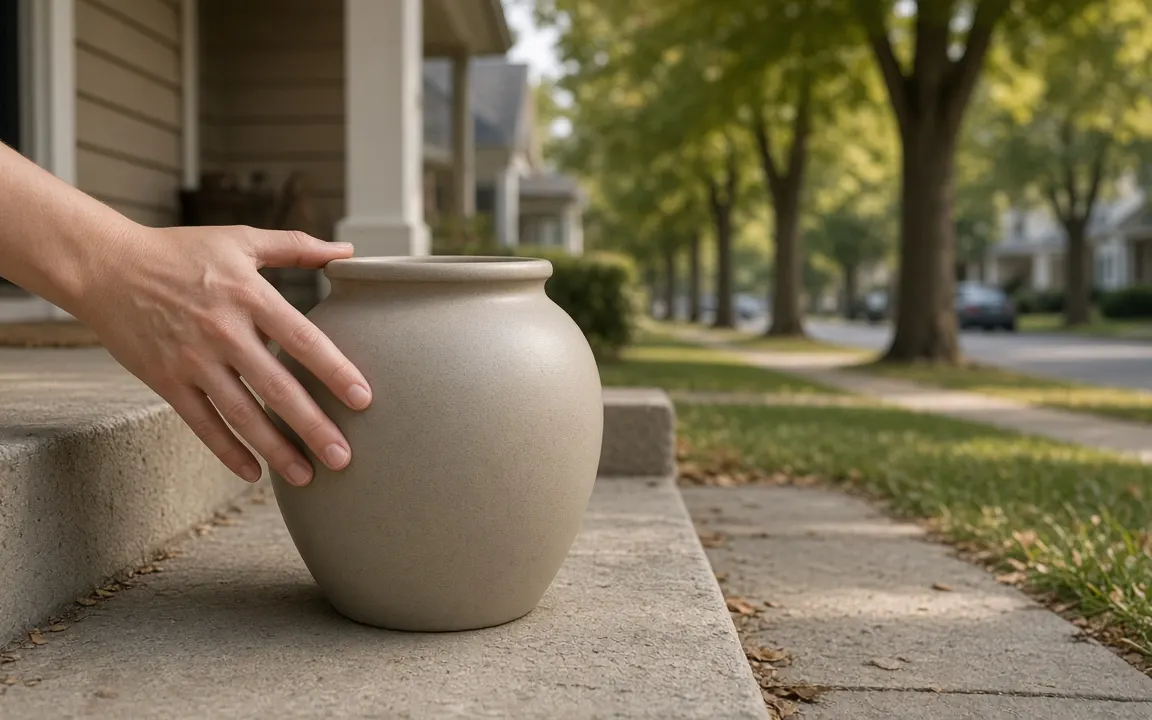
Cincinnati, Ohio
Planning a greener goodbye in Cincinnati
Many Cincinnati families keep a pet's ashes at home in an urn, share them in keepsake containers, or choose jewelry holding a pinch of ashes. Paw print plaques and engraved garden markers are other familiar choices. If you'd like a paw print or fur clipping, ask before cremation, since it has to be taken first. A small keepsake also travels well if you move.
Cincinnati's parks and river views are places many families link with their pets, from Eden Park and Mount Airy Forest to the riverfront parks along the Ohio. Some families leave a little of the ashes at an overlook and keep the remainder at home. Check park rules first, and consider a quiet overlook where you can return on the anniversary. A spoonful or two is plenty for that.
Suburban yards around Cincinnati often hide sprinkler lines, cables and gas pipes just below the grass. Before you dig a wide planting hole, use the free call-before-you-dig service where you live, and check where any irrigation runs. A tree planted over a sprinkler line will eventually find it. Marking the spot a week before the ceremony avoids a last-minute scramble.
About 314,367 people live in Cincinnati, which makes it the 3rd-largest of the 106 Ohio communities we cover.
Cincinnati sits within easy reach of Covington (1 miles), Norwood (5 miles) and Erlanger (6 miles). A provider based in any of them will usually collect from Cincinnati; ask what the mileage adds to the bill.
Our estimate
115,000
How many dog- or cat-owning households Cincinnati has (estimate)
How we calculated this
314,367 ÷ 2.5 = 125,747 households; × 53% (dog) + 39% (cat) = 115,000. Multi-pet homes count once.
Our estimate
9,650
dog and cat deaths per year in Cincinnati, our estimate
How we calculated this
115,000 dog/cat-owning homes ÷ average lifespan (dog: 12.69 yrs + cat: 11.18 yrs) ≈ 9,650 a year. A floor, not a ceiling.
53%[1]
53% of US households own a dog, which is about 71 million households.
12.69 years[2]
US dogs have an average life expectancy at birth of 12.69 years.
39%[3]
39% of US households own a cat, which is about 53 million households.
11.18 years[4]
US cats seen at Banfield hospitals have an average life expectancy at birth of 11.18 years.
To check the figures yourself, see Montoya et al. 2023, Frontiers in Veterinary Science and American Pet Products Association (APPA) 2025 State of the Industry.

Cremation habits in Ohio, and what they mean for a bio urn
Faith shapes these choices in Ohio, where cremation covers about 59.1%[5] of deaths and burial much of the rest. Some traditions that prefer burial for people have no view on pets; others do. If this matters to anyone in your household, ask a faith leader you trust. A planting urn puts the ashes back into the ground, which many people find sits comfortably with a burial tradition.
For the Ohio figure we rely on NFDA 2024 Cremation & Burial Report state projections (via Occasional Sage) (2024). Read it as a picture of local custom around death and remembrance in Cincinnati rather than as pet data.
Seasons, soil and weather for a memorial in Cincinnati
Early spring in Cincinnati is when nurseries sell bare-root trees, often at a lower price than trees in pots. They need planting quickly, as soon as the ground can be dug after January, February and December, which fits well with ashes that have waited through the winter. Have the soil blend ready beforehand, soak the roots for an hour, and plant on a calm, overcast day.
Snow can hide a young memorial tree and the damage done around it. In Cincinnati, where lows average about 24°F in January, voles and rabbits chew bark under the snow line, and snowplows or shovels can snap a sapling. Put a tall stake beside the planting so you can find it, and fit a loose guard around the trunk before the first snow.

Eco memorial prices, from urn to tree
A living memorial in Cincinnati has two costs: the cremation and the urn. Biodegradable pet urns are among the cheaper urns you can buy, listed at about $15–$80[6] in one national price guide, and a sapling from a local nursery often costs less than a decorative display urn. If you'd like water cremation, one pet insurer's guide lists aquamation at $80 to $450 depending on size[7]. The table shows published examples.
Rather than repeat the price table on every city page, we keep one for Ohio: Ohio costs. What each service includes is on the services page.

Free tool
Memorial budget planner
Add up cremation, urn, keepsakes and a farewell so the total holds no surprises.
Rules worth knowing in Ohio before you scatter
Burying ashes, scattering them loose and releasing them on water are often treated as three different things. In Ohio, a place that welcomes a scattering may forbid digging, and a lake that allows a release may not allow a gathering on the shore. When you ask permission, say exactly which one you have in mind.
Cincinnati's own guidance is published by City of Cincinnati 311; it covers public collection, which is separate from arranging a private cremation. The official Ohio local government directory lists every county and city office, which is the quickest way to find who to ask in Cincinnati.
Home burial and scattering are governed at the Ohio level first; our Ohio rules summary has the detail. Then check whether Cincinnati or your HOA adds anything.
What to do first, and what can wait for the right season
- If you're remembering more than one animal, decide early whether the ashes will be planted together or apart. Both are fine, but mixed ashes can't be separated later.
- Label each container clearly with the name and date as it comes back, especially if the ashes return months or years apart.
- Choose a bigger planting area when there are several sets of ashes; a long hedge, a cluster of shrubs or a few fruit trees gives the minerals more ground to disperse into.
- Keep a spoonful of each in separate keepsakes if anyone in the family wants to remember one animal on its own.
- Plan for the pets still living with you. Fresh soil with the scent of bone in it invites digging, so fence or cover the spot until it has settled.
- Add a marker for each name, or one stone that lists them all, so visitors know who the planting is for.
Remembering your pet in Cincinnati
Cincinnati has a long tradition of garden-style cemeteries and a strong German and Irish heritage, and many families like a memorial they can visit. For a pet, that might be an engraved stone under a tree, a memorial garden bed or a tree planted with a biodegradable urn. Choose natural stone or metal that handles freeze-thaw winters. Placing it where you'll see it often keeps it close.
Our services overview lays out every option side by side, the guides answer the longer questions and the blog the newer ones, try the free planning tools, or look at how readers voted in our polls. You can also browse every city in the United States. Nearby, we also cover Akron, Toledo, Columbus and Dayton, and every city in Ohio.

Reader polls
What would you choose?
Vote anonymously and see how other readers answered. The results are live counts from people who visit this site, so they show real opinions, not a scientific sample.
Would you consider releasing your pet's ashes in water?
Tap an answer to vote and see how others answered. Anonymous.
What kind of tree or plant would you choose?
Tap an answer to vote and see how others answered. Anonymous.
If you had to decide today, which aftercare would you choose for your pet?
Tap an answer to vote and see how others answered. Anonymous.

Free tools to help you plan
Memorial budget planner
Add up cremation, urn, keepsakes and a farewell so the total holds no surprises.

Memorial tree finder
Pick a tree for a planting urn that suits your climate, space and pet.

Aftercare options compared
Compare private, communal and water cremation with burial on cost, timing and what comes home.
Questions people ask
Can a provider from a neighbouring town collect from Cincinnati?
Usually yes. Covington is about 1 miles away, Norwood is about 5 miles away and Erlanger is about 6 miles away, all inside a normal collection radius. Get the mileage written into the quote so there is no surprise on the day.
How does Cincinnati's weather affect pet aftercare?
July is the hottest month in Cincinnati, with average highs around 87°F, so prompt collection matters most then. Average lows drop below freezing in January, February and December, which can make digging a grave hard until spring.
How many pet owners live in Cincinnati?
By our estimate, about 115,000 households in Cincinnati have at least one dog or cat, and around 9,650 are lost each year. We calculate this from the city's population of about 314,367, the average household size and national ownership and lifespan figures, so treat it as a floor rather than an exact count.
How do Ohio attitudes to cremation compare?
NFDA 2024 Cremation & Burial Report state projections (via Occasional Sage) (2024) puts the Ohio human cremation rate at about 59.1%[5]. We show it on the Cincinnati page because pet aftercare choices tend to track it: where cremation is normal for people, communal and private pet cremation are both easy to find.
What happens to the memorial tree if I move away from Cincinnati?
It stays with the land, and ashes mixed into soil can't be recovered. If a move is possible, plant in a large container, plant at a relative's home, or keep a small portion of the ashes back for a future garden. Cuttings from many shrubs root easily, so you can take a piece of the plant with you.
What if the soil in Cincinnati is already alkaline?
Then ashes push it further, so be generous with compost and composted bark, choose a lime-tolerant tree or shrub, and test the pH before planting. Chalky and limestone soils are common in many regions. Plants that dislike lime, such as azaleas and blueberries, are a poor choice for an ash planting anywhere.


Sources and our estimates
- [1] 53% of US households own a dog, which is about 71 million households. American Pet Products Association (APPA) 2025 State of the Industry, 2025.
- [2] US dogs have an average life expectancy at birth of 12.69 years. Montoya et al. 2023, Frontiers in Veterinary Science - Banfield Pet Hospital life expectancy tables (13.3 million dogs, 2.4 million cats, 2013-2019), 2023.
- [3] 39% of US households own a cat, which is about 53 million households. American Pet Products Association (APPA) 2025 State of the Industry, 2025.
- [4] US cats seen at Banfield hospitals have an average life expectancy at birth of 11.18 years. Montoya et al. 2023, Frontiers in Veterinary Science - Banfield Pet Hospital life expectancy tables (13.3 million dogs, 2.4 million cats, 2013-2019), 2023.
- [5] The NFDA projected Ohio's cremation rate at 59.1% for 2024. NFDA 2024 Cremation & Burial Report state projections (via Occasional Sage), 2024.
- [6] Memorials.com's pet urn cost guide puts biodegradable pet urns at $15–$80. Memorials.com – Pet Urn Cost Guide, 2025.
- [7] Embrace Pet Insurance lists US communal cremation at $30-$200, partitioned at $50-$250, private at $100-$500+ and aquamation at $80-$450. Embrace Pet Insurance - Bury or Cremate Your Dog? Costs, Pros & Cons, 2025.
- [8] About 59 million U.S. pet-owning households may be open to eco-friendly aftercare options. Our estimate: 86.9M pet households x 68% interested in green funeral options. How we calculate.
Get eco memorial ideas by email
Tell us what you need and where you are. We'll reply by email with clear options and prices so you can decide in your own time.