Greener pet aftercare in Livingston, Texas
About 170 dogs and cats are lost in Livingston each year, by our estimate. If you'd like your pet's ashes to grow into a tree or return to the water, this page covers the soil, the season and the cost.
- When to plant in your season
- How much ash your urn must hold
- Aquamation providers in your area

Livingston, Texas
Your living memorial options around Livingston
Lake Livingston and the surrounding forest give families plenty of peaceful settings for letting go of part of a pet's remains. Rules differ between public land, the lake itself and private shoreline, so check which applies before you go. Holding back a spoonful in a small keepsake lets the memory stay close even after the rest has been scattered across the water or among the pines.
Outdoor markers around Livingston contend with steamy summers, torrential rain and a constant fall of pine needles. Granite and bronze outlast almost anything the weather throws at them; untreated wood and painted resin break down quickly. Seating a stone on crushed rock in a bright, open spot keeps it drier, cleaner and far easier to read than one tucked into deep shade.
Many homes around Livingston rely on a septic system, and tree roots love the moist soil over a drain field. Keep a memorial tree well away from the tank and the leach lines, and choose a smaller shrub if space near the house is tight. Your septic contractor or the permit plan for the property will show where the lines run.
About 5,386 people live in Livingston, which makes it the 238th-largest of the 325 Texas communities we cover. Some of the providers who serve Livingston are based about 71 miles away in Houston, the nearest larger centre, so collection times reflect that drive.
If you want to compare providers, look at Onalaska (13 miles), Coldspring (14 miles) and Point Blank (17 miles). Distance matters because pickup fees and the time until the ashes come back both grow with the drive.
Our estimate
2,000
How many dog- or cat-owning households Livingston has (estimate)
How we calculated this
5,386 ÷ 2.5 = 2,154 households; × 53% (dog) + 39% (cat) = 2,000. A household with several pets counts once.
Our estimate
170
Livingston families who lose a dog or cat each year (estimate)
How we calculated this
2,000 dog/cat-owning homes ÷ average lifespan (dog: 12.69 yrs + cat: 11.18 yrs) ≈ 170 a year. Treat it as a minimum.
53%[1]
53% of US households own a dog, which is about 71 million households.
12.69 years[2]
US dogs have an average life expectancy at birth of 12.69 years.
39%[3]
39% of US households own a cat, which is about 53 million households.
11.18 years[4]
US cats seen at Banfield hospitals have an average life expectancy at birth of 11.18 years.
We built the this numbers from American Pet Products Association (APPA) 2025 State of the Industry and Montoya et al. 2023, Frontiers in Veterinary Science, and both are worth a look if you want the detail.

The local attitude to ashes and memorials
The human cremation rate in Texas sits around 55.7%[5], so many families have a foot in both camps, and generations can disagree. Grandparents may expect a grave in the yard; younger relatives may want ashes they can take with them. Talking it through before the vet asks you to choose saves a hard conversation on a hard day. A tree over buried ashes often satisfies both sides.
For the Texas figure we rely on NFDA 2024 Cremation & Burial Report state projections (via Occasional Sage) (2024). Read it as a picture of local custom around death and remembrance in Livingston rather than as pet data.
Livingston seasons and your memorial tree
The right tree for Livingston is one that already grows well in local gardens and parks. Walk around your neighborhood and note what looks healthy in older yards, then ask a nursery about those species. A native or well-established local tree will handle the weather far better than a seed from a kit made for another climate.
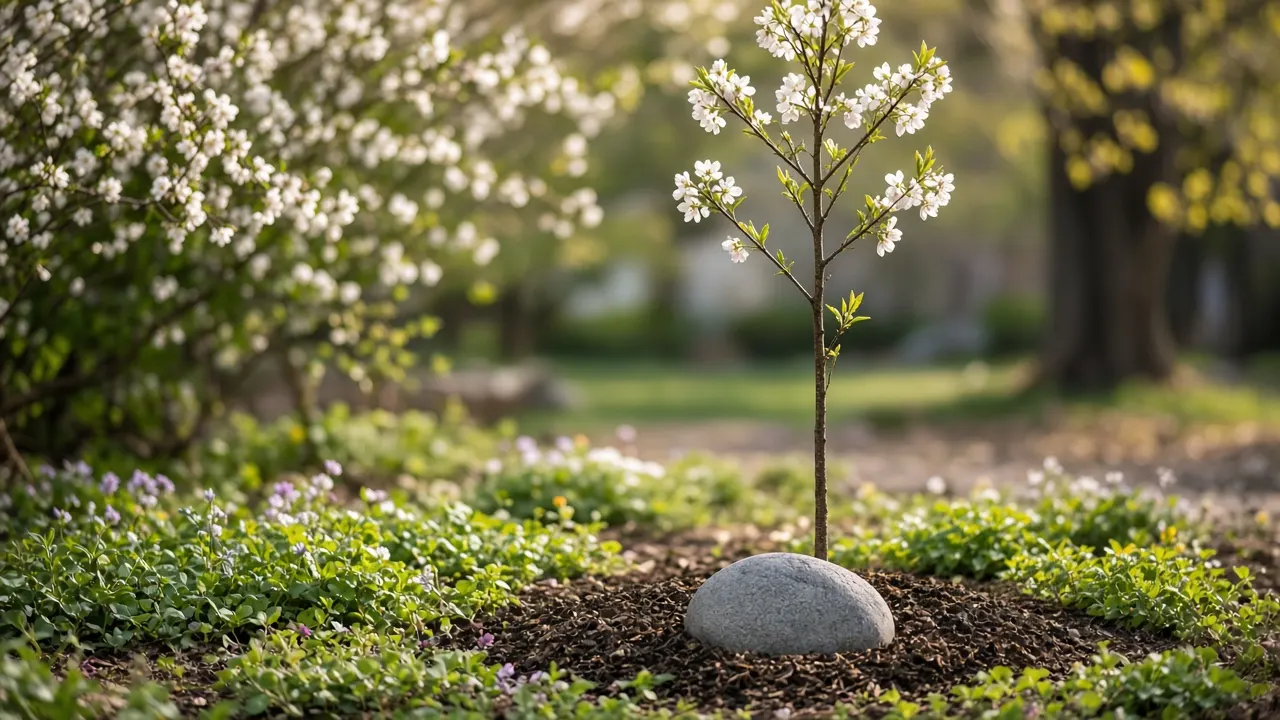
What a greener goodbye costs in Livingston
Add up every part before you commit. Beyond the cremation, a living memorial in Livingston can include the bio urn, compost and bark, a pH kit, the tree or shrub, a guard against deer or rabbits, and perhaps a marker. Our memorial budget planner lists each line so nothing surprises you. Most families find the tree is the cheapest part and the cremation the most expensive.
For a line-by-line price table, see the Texas overview; for what's included in each option, see our services.

Free tool
Memorial budget planner
Add up cremation, urn, keepsakes and a farewell so the total holds no surprises.
Rules worth knowing in Texas before you scatter
Two questions cover most situations in Texas: who owns or manages this land or water, and have they said yes? For your own garden, the answer is you. For a rented home, it's your landlord, in writing. For parks and public water, it's the relevant agency. For a relative's garden, it's them, and it's worth agreeing that the tree stays even if the house is sold.
To find your county or city office in Texas, start with the official Texas local government directory.
Start with the Texas rules, which cover burial, scattering and oversight for the whole state, and treat Livingston's local ordinances as a possible extra layer.
From ashes to a growing tree: the steps
- Take your time. There's no clock running on a bio urn. Sort out the cremation, bring the ashes home once they're released, and plant whenever you're ready, even months later.
- Ask for individual cremation, flame or water, so the ashes you plant are your pet's own. Ask for them in a plain container if you won't keep a display urn.
- Check how much ash you have. Many kits are sized for a set volume, and a large dog's ashes may not all fit.
- Choose the place and the tree together. Think about sun, space, underground pipes and whether you'll still live there in ten years.
- Mix, don't layer. Work the ashes evenly into plenty of soil and compost, give it a few weeks to settle where possible, and check the pH.
- Plant in the right season for Livingston, water deeply and mulch a wide ring around the base.
- Mark the spot with a small stone or plant label, and note the date somewhere you'll find it.
Remembering your pet, in Livingston and wherever you go next
For the many people who list Livingston as home but live on the road, a memorial has to travel well. A compact vessel with a threaded lid, a sturdy pendant or a small framed print rides safely in a motorhome cabinet over thousands of miles. Avoid fragile glass or loose lids, and consider a padded case for anything you plan to keep on display while moving.
run the numbers with the free planning tools, Every option Livingston families choose between is on the services page, or see what other families chose in the poll results, browse in-depth guides or recent articles. Close to Livingston we also cover El Paso, Fort Worth, Dallas and Austin; the full list for Texas and for the United States is a click away.

Reader polls
What would you choose?
Vote anonymously and see how other readers answered. The results are live counts from people who visit this site, so they show real opinions, not a scientific sample.
If water cremation (aquamation) were offered near you, would you choose it?
Tap an answer to vote and see how others answered. Anonymous.
If you rent or might move, how would you handle a memorial planting?
Tap an answer to vote and see how others answered. Anonymous.
If you had to decide today, which aftercare would you choose for your pet?
Tap an answer to vote and see how others answered. Anonymous.

Free tools to help you plan
Memorial budget planner
Add up cremation, urn, keepsakes and a farewell so the total holds no surprises.

Memorial tree finder
Pick a tree for a planting urn that suits your climate, space and pet.

Aftercare options compared
Compare private, communal and water cremation with burial on cost, timing and what comes home.
Questions people ask
Is cremation common in Texas?
For people, yes: about 55.7%[5] of Texas deaths end in cremation, according to NFDA 2024 Cremation & Burial Report state projections (via Occasional Sage) (2024). Nobody publishes the same figure for pets, but in our experience pet choices in Livingston follow the human pattern closely, so cremation is the default most families here start from.
Which nearby towns can I compare with Livingston?
The closest communities we cover are Onalaska (about 13 miles), Coldspring (about 14 miles) and Point Blank (about 17 miles). Providers based in those places often serve Livingston too. Ask each one for a written total that includes collection, so the distance is priced in.
How many pet owners live in Livingston?
By our estimate, about 2,000 households in Livingston have at least one dog or cat, and around 170 are lost each year. We calculate this from the city's population of about 5,386, the average household size and national ownership and lifespan figures, so treat it as a floor rather than an exact count.
Will I have to travel to Houston to arrange things?
Not usually. Providers based in Houston (roughly 71 miles from Livingston) collect from here as a matter of routine, and the paperwork is done by email or phone. If you want to be present for a witnessed cremation, that is when the drive matters.
How long can I keep pet ashes before planting them?
As long as you like. Cremated remains don't break down or spoil in a sealed container, so a planting can happen next month, next year or after a move to a house with a garden. What does break down is a biodegradable urn, so keep the ashes in their original container and only transfer them into the bio urn shortly before planting.
Which memorial plants are dangerous to cats and dogs?
Lilies are highly toxic to cats, even the pollen. Sago palm, oleander, yew, azalea and foxglove can poison dogs, and several of them harm cats and horses too. If you have pets at home in Livingston, ask a vet or nursery to confirm a plant is safe before you buy it. Grasses, many herbs and most fruit trees are safer choices, though large amounts of fallen fruit can still upset a dog's stomach.


Sources and our estimates
- [1] 53% of US households own a dog, which is about 71 million households. American Pet Products Association (APPA) 2025 State of the Industry, 2025.
- [2] US dogs have an average life expectancy at birth of 12.69 years. Montoya et al. 2023, Frontiers in Veterinary Science - Banfield Pet Hospital life expectancy tables (13.3 million dogs, 2.4 million cats, 2013-2019), 2023.
- [3] 39% of US households own a cat, which is about 53 million households. American Pet Products Association (APPA) 2025 State of the Industry, 2025.
- [4] US cats seen at Banfield hospitals have an average life expectancy at birth of 11.18 years. Montoya et al. 2023, Frontiers in Veterinary Science - Banfield Pet Hospital life expectancy tables (13.3 million dogs, 2.4 million cats, 2013-2019), 2023.
- [5] The NFDA projected Texas's cremation rate at 55.7% for 2024. NFDA 2024 Cremation & Burial Report state projections (via Occasional Sage), 2024.
- [6] U.S. pet flame cremations emit on the order of 47,000 t CO2e a year. Our estimate: 1.5M pet cremations x 31.3 kg CO2e. How we calculate.
Tell us about your pet and your garden
Tell us what you need and where you are. We'll reply by email with clear options and prices so you can decide in your own time.