Planting your pet's ashes in Manor
Manor has an estimated 8,500 dog- or cat-owning households. When a planting or water memorial feels right for yours, here's what works in the local climate and what to ask before you buy.
- A memorial that moves with you
- Why pure ashes harm young roots
- Written prices you can compare

Manor, Texas
Living memorials in Manor: the local picture
Plenty of people in Manor moved here recently and have parents or siblings in other parts of Texas or other states. Cremation allows ashes to be divided among relatives, kept at home, or held until you decide where they belong. If sharing is likely, mention it on the first call so the remains come back ready to be portioned out.
The heavy clay soil around Manor shifts between wet and dry seasons, so outdoor markers set directly in the ground can lean over time. A flat stone on a bed of gravel, or a memorial placed in a large planter, stays put. Intense sun also fades painted and resin pieces within a few years, so glass and other delicate items are better kept indoors.
In rural areas around Manor, family pets are sometimes buried whole on the property rather than cremated. If you'd prefer that, check local rules on depth and distance from water. If you'd like a tree above the grave, plant it beside the grave, not directly on it, so the roots aren't disturbed and the ground can settle. For cremated pets, a planting urn gives you the tree without a large grave, and it can be placed exactly where you want.
Manor's population is around 23,070, the 136th-largest of the 325 Texas communities we cover. Austin, roughly 12 miles off, is the closest larger centre, and a share of the providers who cover Manor run from there.
If you want to compare providers, look at Pflugerville (7 miles, a larger centre), Austin (13 miles, a larger centre) and Round Rock (13 miles, a larger centre). Distance matters because pickup fees and the time until the ashes come back both grow with the drive.
Our estimate
8,500
Estimated dog- or cat-owning households in Manor
How we calculated this
23,070 ÷ 2.5 = 9,228 households; × 53% (dog) + 39% (cat) = 8,500. Homes are counted once however many pets they keep.
Our estimate
710
dog and cat deaths per year in Manor, our estimate
How we calculated this
8,500 dog/cat-owning homes ÷ average lifespan (dog: 12.69 yrs + cat: 11.18 yrs) ≈ 710 a year. Treat it as a minimum.
53%[1]
53% of US households own a dog, which is about 71 million households.
12.69 years[2]
US dogs have an average life expectancy at birth of 12.69 years.
39%[3]
39% of US households own a cat, which is about 53 million households.
11.18 years[4]
US cats seen at Banfield hospitals have an average life expectancy at birth of 11.18 years.
Sources for the statistics above: American Pet Products Association (APPA) 2025 State of the Industry and Montoya et al. 2023, Frontiers in Veterinary Science.

Cremation, burial and green choices in Texas
The share of people cremated in Texas, now about 55.7%[5], keeps inching up. For pet owners, that shift has brought more questions about what to do once the ashes come home. There's no need to decide on the day. Many families keep the ashes for a season, talk about what their pet loved, and only then settle on a tree, a pot or a lake.
The Texas figure comes from NFDA 2024 Cremation & Burial Report state projections (via Occasional Sage) (2024). It describes people, not pets, so read it as a sign of local attitudes rather than a pet statistic.
When to plant in Manor's climate
Manor summers are hard on young trees: August averages highs around 96°F. Don't plant a memorial tree in the hottest months. Aim for the cooler part of the year, when roots can grow before the next summer arrives. Ashes don't need to go into the ground quickly, so keeping them safely at home for a few months is completely fine.
Heat narrows the tree list in Manor. Months like May, June, July, August and September bring sustained highs, so choose species that already cope locally: drought-tolerant natives, or trees a local nursery recommends for full sun. A seed from a planting kit, bred somewhere cooler, is a gamble here. Plant a sturdy nursery sapling instead, mulch a wide ring around it and plan to water it through its first two summers.
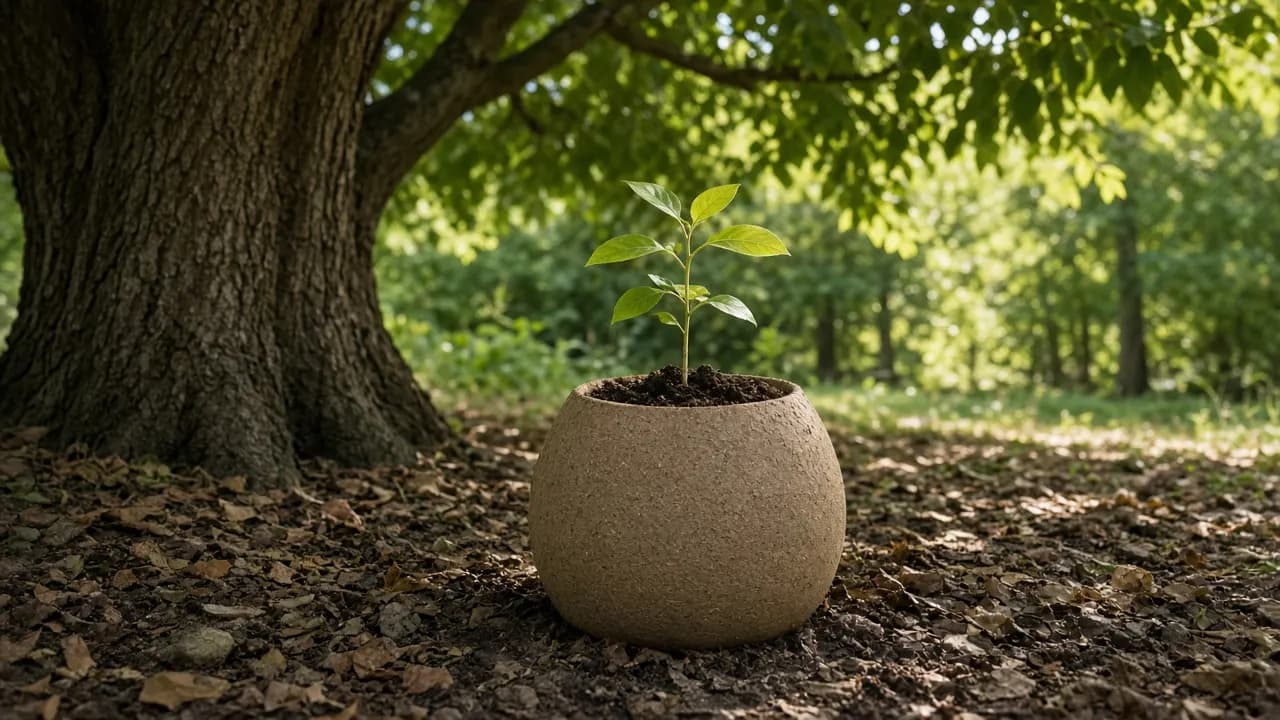
Eco memorial prices, from urn to tree
The container the ashes come back in can quietly add to the bill. One Virginia crematory, for example, sells private cremation at $189 with a temporary container and $225 with a wooden urn[6]. If you're planting, the plain option is all you need. Wooden pet urns alone run about $30–$150[7] in one national guide, money that could buy a good tree for your Manor garden instead.
For a line-by-line price table, see the Texas overview; for what's included in each option, see our services.

Free tool
Memorial budget planner
Add up cremation, urn, keepsakes and a farewell so the total holds no surprises.
What Texas allows for ashes, in general terms
Water releases need a little more care than a garden planting. Rivers, lakes, reservoirs and coastal waters in Texas are managed by different bodies, and drinking-water sources are often off-limits. Wherever you release, use only a water-soluble urn or loose ashes, add nothing but loose flower petals, and let no plastic, ribbon or wreath wire float away.
Not sure which office covers Manor? The Texas local government directory is the official list.
Home burial and scattering are governed at the Texas level first; our Texas rules summary has the detail. Then check whether Manor or your HOA adds anything.
Planting a memorial in Manor, step by step
- If you're remembering more than one animal, settle at the start on one shared planting or separate ones. Either works, but once the ashes are combined there's no undoing it.
- Label each container clearly the moment it arrives, name and date on the lid, which matters most when the sets come home a long way apart.
- Choose a bigger planting area for several sets of ashes: a hedge, a group of shrubs or a small orchard spreads the mineral load across more soil.
- Keep a spoonful of each in its own keepsake, so a family member who was closest to one particular pet has something just for them.
- Plan for the pets still living with you. A new planting that smells of bone attracts diggers, so protect it for the first few months.
- Add a marker for each name, or one stone that lists them all, so visitors know who the planting is for.
Keeping your pet's memory growing in Manor
Young families dominate many Manor streets, and memorials here often need to be child-friendly: a paw print keepsake a child can hold, a small painted stone, or a photo book they can page through. Adults may prefer an urn or a piece of jewelry. It is common to choose more than one item, so that different people in the house each have something personal.
the planning tools turn your pet's details into figures, The services page is the place to compare what is included, browse in-depth guides or recent articles, or look at how readers voted in our polls. You can also browse every city in the United States. Nearby, we also cover Houston, El Paso, San Antonio and Dallas, and every city in Texas.

Reader polls
What would you choose?
Vote anonymously and see how other readers answered. The results are live counts from people who visit this site, so they show real opinions, not a scientific sample.
What kind of tree or plant would you choose?
Tap an answer to vote and see how others answered. Anonymous.
Would you consider releasing your pet's ashes in water?
Tap an answer to vote and see how others answered. Anonymous.
If you had to decide today, which aftercare would you choose for your pet?
Tap an answer to vote and see how others answered. Anonymous.

Free tools to help you plan
Memorial budget planner
Add up cremation, urn, keepsakes and a farewell so the total holds no surprises.

Memorial tree finder
Pick a tree for a planting urn that suits your climate, space and pet.

Aftercare options compared
Compare private, communal and water cremation with burial on cost, timing and what comes home.
Questions people ask
Is cremation common in Texas?
For people, yes: about 55.7%[5] of Texas deaths end in cremation, according to NFDA 2024 Cremation & Burial Report state projections (via Occasional Sage) (2024). Nobody publishes the same figure for pets, but in our experience pet choices in Manor follow the human pattern closely, so cremation is the default most families here start from.
When is the hardest time of year to arrange a burial in Manor?
There is no frozen-ground season here; average lows stay above freezing all year. The other pressure point is August, when highs around 96°F mean a body needs cooling and collecting quickly.
Which nearby towns can I compare with Manor?
The closest communities we cover are Pflugerville (about 7 miles), Austin (about 13 miles) and Round Rock (about 13 miles). Providers based in those places often serve Manor too. Ask each one for a written total that includes collection, so the distance is priced in.
Roughly how many pets die in Manor each year?
Our estimate is around 710. It comes from Manor's population (about 23,070), the average household size, the share of homes with a dog or cat (about 8,500 households here) and the average lifespan. It is arithmetic, not a count, so read it as a rough floor.
Is water cremation better for the environment?
It uses much less energy: pet aquamation is claimed to use about 90%[9] less energy than flame cremation, and it uses about as much water as 1–3 pet baths[10] per pet. The strongest carbon figures come from studies of human funerals, not pets, so treat them as a direction rather than a promise. You still get ashes back for a bio urn.
Do bio urns work with ashes from flame cremation?
Yes. A bio urn works with ashes from flame cremation or water cremation. Both leave mineral-rich, alkaline ash, so the soil advice is the same either way: dilute the ashes well through compost and soil, let the mix rest if you can, and test the pH before a young tree goes in.


Sources and our estimates
- [1] 53% of US households own a dog, which is about 71 million households. American Pet Products Association (APPA) 2025 State of the Industry, 2025.
- [2] US dogs have an average life expectancy at birth of 12.69 years. Montoya et al. 2023, Frontiers in Veterinary Science - Banfield Pet Hospital life expectancy tables (13.3 million dogs, 2.4 million cats, 2013-2019), 2023.
- [3] 39% of US households own a cat, which is about 53 million households. American Pet Products Association (APPA) 2025 State of the Industry, 2025.
- [4] US cats seen at Banfield hospitals have an average life expectancy at birth of 11.18 years. Montoya et al. 2023, Frontiers in Veterinary Science - Banfield Pet Hospital life expectancy tables (13.3 million dogs, 2.4 million cats, 2013-2019), 2023.
- [5] The NFDA projected Texas's cremation rate at 55.7% for 2024. NFDA 2024 Cremation & Burial Report state projections (via Occasional Sage), 2024.
- [6] Heavenly Paws Cremations in Chantilly, Virginia, sells private cremation packages at $189 (temporary container), $225 (wooden urn) and $300 (wooden photo urn), each including a paw print and fur clipping. Heavenly Paws Cremations – Packages, 2026.
- [7] Memorials.com puts wooden pet urns at $30–$150. Memorials.com – Pet Urn Cost Guide, 2025.
- [8] Each shelter-animal flame cremation emits about 31 kg CO2e on average. Our estimate: 19,000 t CO2e / 607,000 animals. How we calculate.
- [9] Pet aquamation is described as available across all 50 US states, and is claimed to use about 90% less energy than flame cremation. Be a Tree Cremation pet aquamation guide, 2025.
- [10] Aquamation uses about the same water per pet as 1–3 pet baths. Veterinary Sustainability Alliance — Aquamation, 2024.
Get bio urn options for Manor
Tell us what you need and where you are. We'll reply by email with clear options and prices so you can decide in your own time.