Growing something from the goodbye in Mount Vernon
Mount Vernon has an estimated 960 dog- or cat-owning households. When a planting or water memorial feels right for yours, here's what works in the local climate and what to ask before you buy.
- Planting, garden and water urns compared
- Honest notes on local rules
- Help choosing a native species

Mount Vernon, Texas
Where a living memorial fits in Mount Vernon
Ice storms, heavy spring rain and summer heat all wear on outdoor memorials in Franklin County. Granite and bronze weather well and stay readable; painted resin tends to crack after a winter or two. If you would rather keep the memorial inside, choose a sealed urn or keepsake box and set it away from damp exterior walls and sunny windows that fade photos.
Some Mount Vernon families plant a small memorial garden with native flowers that attract butterflies and birds, such as purple coneflower, black-eyed Susan and salvia. Only a little ash should be worked into the bed, well mixed with plenty of soil, so the plants are not harmed. A simple engraved stone among the flowers marks the spot for years.
In a town the size of Mount Vernon, the nearest aquamation provider may be an hour or more away, and pet crematories often serve a wide rural area. That doesn't change what you can do with the ashes. A flame-cremated pet's ashes work just as well in a planting urn or water urn. If a lower-impact goodbye is the main reason you're here, the choice of cremation matters more than the urn, so ask about water cremation before you commit.
About 2,610 people live in Mount Vernon, which makes it the 279th-largest of the 325 Texas communities we cover.
For a second opinion on price, Mount Pleasant (15 miles, a larger centre), Winnsboro (16 miles) and Pittsburg (20 miles) are close enough that their providers cover Mount Vernon routinely. Two written quotes tell you more than any price list.
Our estimate
960
How many dog- or cat-owning households Mount Vernon has (estimate)
How we calculated this
2,610 ÷ 2.5 = 1,044 households; × 53% (dog) + 39% (cat) = 960. Homes are counted once however many pets they keep.
Our estimate
80
Estimated dog and cat losses in Mount Vernon each year
How we calculated this
960 dog/cat-owning homes ÷ average lifespan (dog: 12.69 yrs + cat: 11.18 yrs) ≈ 80 a year. Treat it as a minimum.
53%[1]
53% of US households own a dog, which is about 71 million households.
12.69 years[2]
US dogs have an average life expectancy at birth of 12.69 years.
39%[3]
39% of US households own a cat, which is about 53 million households.
11.18 years[4]
US cats seen at Banfield hospitals have an average life expectancy at birth of 11.18 years.
None of the figures on this this page are ours alone: they rest on American Pet Products Association (APPA) 2025 State of the Industry and Montoya et al. 2023, Frontiers in Veterinary Science.

Cremation habits in Texas, and what they mean for a bio urn
In Texas, roughly 55.7%[5] of people are cremated, a share that has been rising for years. That shift shows in pet aftercare too: more people now ask what to do with ashes, and bio urns are part of the answer. If some relatives prefer burial, a living memorial can be a good middle ground. The ashes go into the ground, just as a burial would, and the tree gives everyone a place to visit.
Source for the Texas number: NFDA 2024 Cremation & Burial Report state projections (via Occasional Sage) (2024). Nobody publishes a pet cremation rate for Mount Vernon, so the human figure is the best local signal available.
When to plant in Mount Vernon's climate
In a hot climate like Mount Vernon's, with highs of about 95°F in August, salt is a bigger problem than in wetter places. Rain is what washes sodium from ashes down past the roots, and dry heat lets it build up near the surface. Mix the ashes through a much larger volume of soil and compost than you'd think necessary, and water deeply and slowly after planting so salts move down, not up.
Mount Vernon summers are hard on young trees: August averages highs around 95°F. Don't plant a memorial tree in the hottest months. Aim for the cooler part of the year, when roots can grow before the next summer arrives. Ashes don't need to go into the ground quickly, so keeping them safely at home for a few months is completely fine.
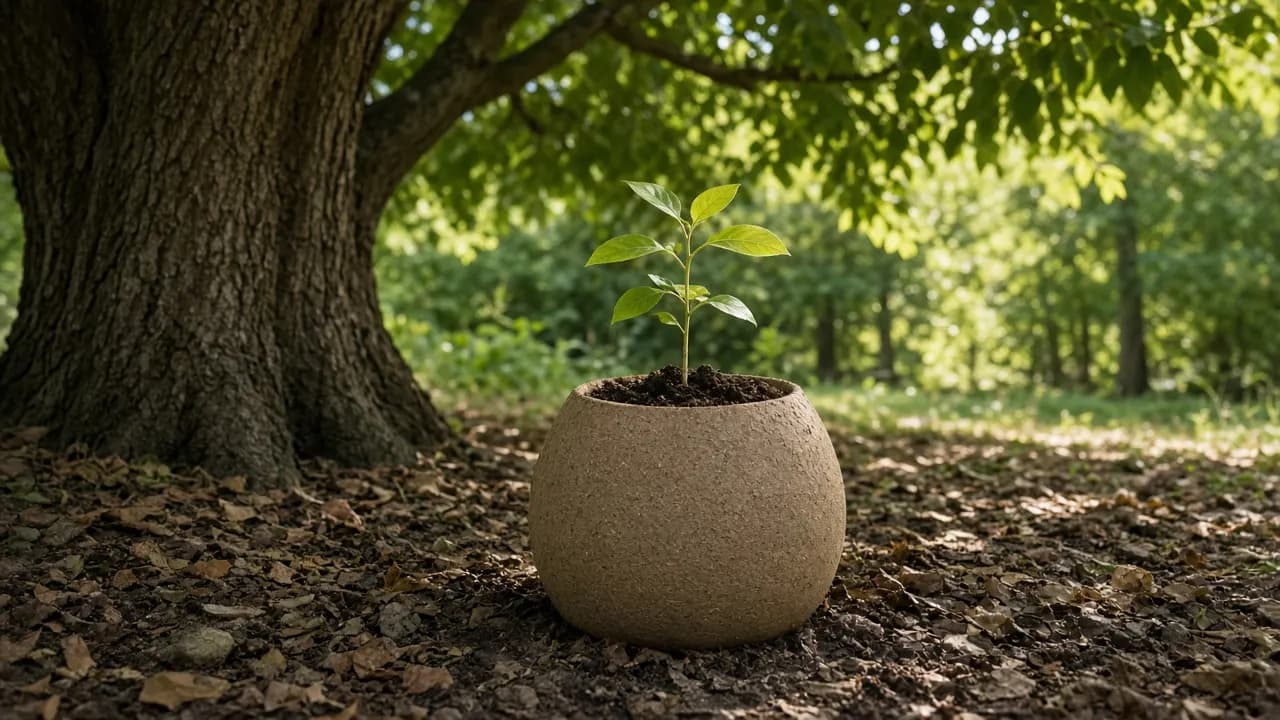
Eco memorial prices, from urn to tree
Bio urns vary more in price than you might expect. A national guide puts biodegradable urns at $70–$260[6], depending on material, size and whether a seed or tree system is included. For a lake or sea release, one water urn designed to float briefly and dissolve sells for $149[7]. In Mount Vernon, the tree and the soil amendments are usually the cheapest part of the whole memorial.
Rather than repeat the price table on every city page, we keep one for Texas: Texas costs. What each service includes is on the services page.

Free tool
Memorial budget planner
Add up cremation, urn, keepsakes and a farewell so the total holds no surprises.
Where you can plant or release ashes in Texas
Natural burial grounds and some pet cemeteries in Texas accept ashes in biodegradable urns, and a few ask for nothing else: no plastic, no metal, no varnish. If you're considering one, ask what the urn may be made of, whether a tree or marker is allowed above it, and whether the fee includes looking after the plot.
To find your county or city office in Texas, start with the official Texas local government directory.
The rules that apply across Texas (home burial, scattering and who oversees pet cremation) are summarized on our Texas page. Mount Vernon may add its own conditions, so check with the city or county before digging.
A simple plan for your pet's eco memorial
- Talk it through with your household first, especially if anyone would rather keep the ashes at home.
- Measure your space. Trees spread more than people expect; in a smaller garden a shrub, a big pot or a border may be the kinder fit.
- Test the soil at the planting site. Ground that already reads alkaline calls for a species that tolerates lime, plus more compost or composted bark than usual.
- Spread the ashes through a wide planting area, not in one band directly beneath the root ball.
- Water well for two summers. It's drought in the early years, not cold, that kills the majority of memorial trees that don't make it.
- Keep a record noting which species you planted, when, and how the soil was mixed, so future care or taking a cutting is straightforward.
Ways to mark the spot and the date
Grandchildren in the Dallas area or farther away may want a small part of a family pet they grew up visiting. Mini urns, pendants or small glass vials can each hold a pinch of ash and travel easily. Ask the provider before cremation to prepare these separately, and have each one labeled with the pet's name so they are never mixed up later.
or compare your instinct with the poll results, look through our guides and the blog, run the numbers with the free planning tools, Our services overview lays out every option side by side. You can also browse every city in the United States. Nearby, we also cover Austin, San Antonio, Dallas and Houston, and every city in Texas.

Reader polls
What would you choose?
Vote anonymously and see how other readers answered. The results are live counts from people who visit this site, so they show real opinions, not a scientific sample.
Would you consider releasing your pet's ashes in water?
Tap an answer to vote and see how others answered. Anonymous.
If you rent or might move, how would you handle a memorial planting?
Tap an answer to vote and see how others answered. Anonymous.
If you had to decide today, which aftercare would you choose for your pet?
Tap an answer to vote and see how others answered. Anonymous.

Free tools to help you plan
Memorial budget planner
Add up cremation, urn, keepsakes and a farewell so the total holds no surprises.

Memorial tree finder
Pick a tree for a planting urn that suits your climate, space and pet.

Aftercare options compared
Compare private, communal and water cremation with burial on cost, timing and what comes home.
Questions people ask
When is the hardest time of year to arrange a burial in Mount Vernon?
There is no frozen-ground season here; average lows stay above freezing all year. The other pressure point is August, when highs around 95°F mean a body needs cooling and collecting quickly.
Is cremation common in Texas?
For people, yes: about 55.7%[5] of Texas deaths end in cremation, according to NFDA 2024 Cremation & Burial Report state projections (via Occasional Sage) (2024). Nobody publishes the same figure for pets, but in our experience pet choices in Mount Vernon follow the human pattern closely, so cremation is the default most families here start from.
Can a provider from a neighbouring town collect from Mount Vernon?
Usually yes. Mount Pleasant is about 15 miles away, Winnsboro is about 16 miles away and Pittsburg is about 20 miles away, all inside a normal collection radius. Get the mileage written into the quote so there is no surprise on the day.
How many pet owners live in Mount Vernon?
By our estimate, about 960 households in Mount Vernon have at least one dog or cat, and around 80 are lost each year. We calculate this from the city's population of about 2,610, the average household size and national ownership and lifespan figures, so treat it as a floor rather than an exact count.
Is water cremation better for the environment?
It uses much less energy: pet aquamation is claimed to use about 90%[9] less energy than flame cremation, and it uses about as much water as 1–3 pet baths[10] per pet. The strongest carbon figures come from studies of human funerals, not pets, so treat them as a direction rather than a promise. You still get ashes back for a bio urn.
Which memorial plants are dangerous to cats and dogs?
Lilies are highly toxic to cats, even the pollen. Sago palm, oleander, yew, azalea and foxglove can poison dogs, and several of them harm cats and horses too. If you have pets at home in Mount Vernon, ask a vet or nursery to confirm a plant is safe before you buy it. Grasses, many herbs and most fruit trees are safer choices, though large amounts of fallen fruit can still upset a dog's stomach.


Sources and our estimates
- [1] 53% of US households own a dog, which is about 71 million households. American Pet Products Association (APPA) 2025 State of the Industry, 2025.
- [2] US dogs have an average life expectancy at birth of 12.69 years. Montoya et al. 2023, Frontiers in Veterinary Science - Banfield Pet Hospital life expectancy tables (13.3 million dogs, 2.4 million cats, 2013-2019), 2023.
- [3] 39% of US households own a cat, which is about 53 million households. American Pet Products Association (APPA) 2025 State of the Industry, 2025.
- [4] US cats seen at Banfield hospitals have an average life expectancy at birth of 11.18 years. Montoya et al. 2023, Frontiers in Veterinary Science - Banfield Pet Hospital life expectancy tables (13.3 million dogs, 2.4 million cats, 2013-2019), 2023.
- [5] The NFDA projected Texas's cremation rate at 55.7% for 2024. NFDA 2024 Cremation & Burial Report state projections (via Occasional Sage), 2024.
- [6] Funeral.com cites U.S. Funerals Online that biodegradable urns typically cost about $70–$260. Funeral.com – How Much Do Cremation Urns Cost in 2025, 2025.
- [7] The Living Urn's Eco Water Urn for water burial costs $149 and holds up to 225 cubic inches; it floats for several minutes before dissolving. The Living Urn – Eco Water Urn, 2026.
- [8] Each shelter-animal flame cremation emits about 31 kg CO2e on average. Our estimate: 19,000 t CO2e / 607,000 animals. How we calculate.
- [9] Pet aquamation is described as available across all 50 US states, and is claimed to use about 90% less energy than flame cremation. Be a Tree Cremation pet aquamation guide, 2025.
- [10] Aquamation uses about the same water per pet as 1–3 pet baths. Veterinary Sustainability Alliance — Aquamation, 2024.
Plan a living memorial in Mount Vernon
Tell us what you need and where you are. We'll reply by email with clear options and prices so you can decide in your own time.