Planting your pet's ashes in West
About 80 dogs and cats are lost in West each year, by our estimate. If you'd like your pet's ashes to grow into a tree or return to the water, this page covers the soil, the season and the cost.
- A memorial that moves with you
- Why pure ashes harm young roots
- Written prices you can compare

West, Texas
Where a living memorial fits in West
Jewelry can carry more than ashes. Some engravers can reproduce a pet's nose print or paw print on a pendant, using an ink impression or a clear photo. Request a paw or nose print from whoever is caring for your pet before cremation if you think you might want one later. It is easy to do at the time and impossible afterward.
West is known for its Czech heritage, from kolache bakeries along the interstate to the Westfest celebration each Labor Day weekend. Some families draw on that tradition for a memorial: a pillow or wall hanging embroidered with Czech folk patterns and the pet's name, or a carved wooden box with a traditional design. A quiet, plain urn is just as fitting.
In rural areas around West, family pets are sometimes buried whole on the property rather than cremated. If you'd prefer that, check local rules on depth and distance from water. If you'd like a tree above the grave, plant it beside the grave, not directly on it, so the roots aren't disturbed and the ground can settle. For cremated pets, a planting urn gives you the tree without a large grave, and it can be placed exactly where you want.
With roughly 2,629 residents, West is the 278th-largest of the 325 Texas communities we cover. Grand Prairie, roughly 61 miles off, is the closest larger centre, and a share of the providers who cover West run from there.
Families in West often end up using a provider from Hillsboro (15 miles, a larger centre), Whitney (17 miles) and Waco (18 miles, a larger centre). That is normal: crematories serve a radius, not a single town, and the drive is priced into collection.
Our estimate
970
Estimated dog- or cat-owning households in West
How we calculated this
2,629 ÷ 2.5 = 1,052 households; × 53% (dog) + 39% (cat) = 970. A household with several pets counts once.
Our estimate
80
dog and cat deaths per year in West, our estimate
How we calculated this
970 dog/cat-owning homes ÷ average lifespan (dog: 12.69 yrs + cat: 11.18 yrs) ≈ 80 a year. Treat it as a minimum.
53%[1]
53% of US households own a dog, which is about 71 million households.
12.69 years[2]
US dogs have an average life expectancy at birth of 12.69 years.
39%[3]
39% of US households own a cat, which is about 53 million households.
11.18 years[4]
US cats seen at Banfield hospitals have an average life expectancy at birth of 11.18 years.
The published sources behind those figures are Montoya et al. 2023, Frontiers in Veterinary Science and American Pet Products Association (APPA) 2025 State of the Industry.

Cremation, burial and green choices in Texas
In Texas, with a human cremation rate of roughly 55.7%[5], you'll often find pet cemeteries and pet crematories operating side by side. Some cemeteries now offer small plots for ashes, occasionally with a tree or shrub above them. That's worth comparing with a garden planting at home: a cemetery plot stays put if you move, while your own garden costs nothing and stays private.
That Texas rate is a human one, published by NFDA 2024 Cremation & Burial Report state projections (via Occasional Sage) (2024). We quote it for West only as a pointer to how families here already think about cremation.
West seasons and your memorial tree
Biodegradable urns are made to break down, and heat and humidity can start that early. In West, where August highs average about 97°F, keep a paper, cornstarch or coconut-fiber urn indoors, somewhere cool and dry, until the planting day. Don't leave it in a car, a hot shed or a garage through June, July, August and September, or it may soften or split before it reaches the ground.
In West's heat, containers dry out fast. If you're planting a memorial in a pot on a patio or balcony, choose a large, light-colored container, which heats up less than a small dark one, and place it where it gets afternoon shade in June, July, August and September. Use only a small share of the ashes in the pot, water until it drains freely so salts flush out, and check the soil every day in the hottest weeks.
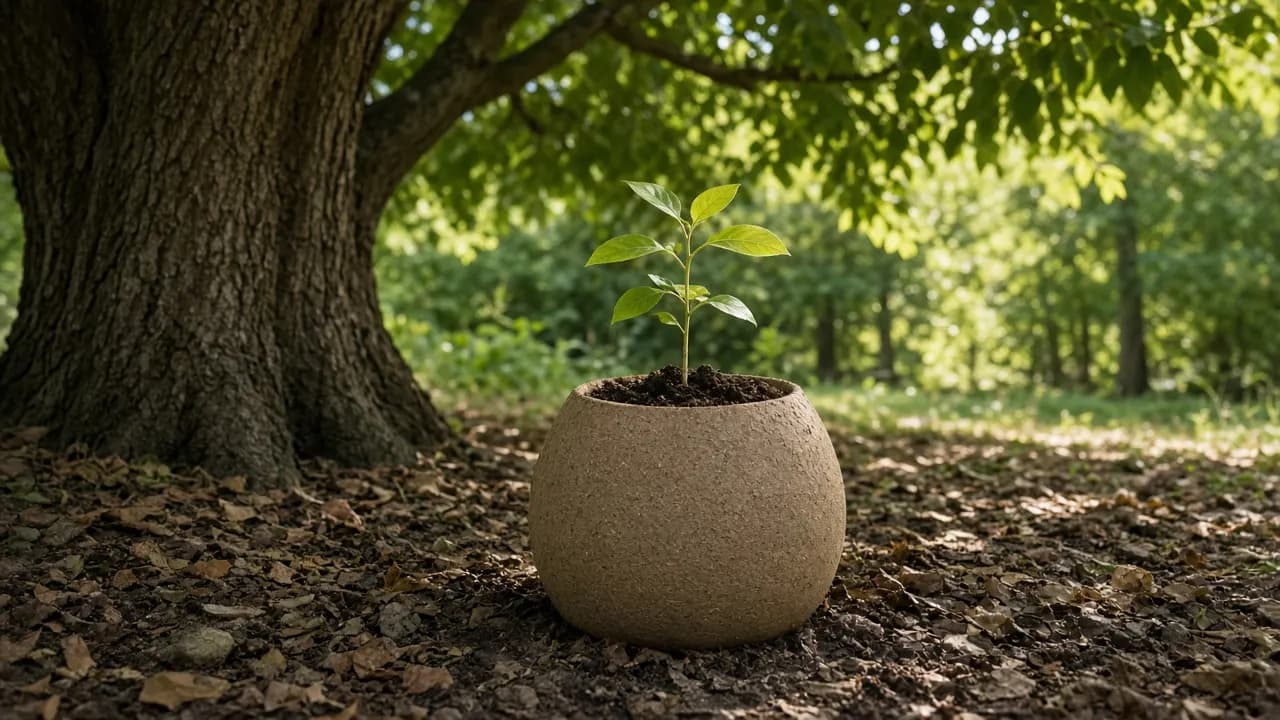
Adding up the cost of a bio urn memorial in West
It helps to compare a planted memorial with the alternatives. A pet cemetery burial for a dog averages about $831[6] in the US, which by our estimate is around 3.2 times the national average for private cremation[7]. Private cremation plus a bio urn and a sapling in your own West garden usually comes in far below a cemetery plot, and there are no yearly maintenance fees.
The Texas price table breaks costs down by product; our services page explains what sits behind each line.

Free tool
Memorial budget planner
Add up cremation, urn, keepsakes and a farewell so the total holds no surprises.
Rules worth knowing in Texas before you scatter
If you live under a homeowners' association, a co-op board or a tenancy agreement in Texas, its rules can matter more than any public law. Many restrict new trees, digging near shared pipes or heavy pots on balconies. A quick read of the rules, or one email to the manager, tells you whether a tree, a shrub bed or a container memorial is the right fit.
The official Texas local government directory lists every county and city office, which is the quickest way to find who to ask in West.
The rules that apply across Texas (home burial, scattering and who oversees pet cremation) are summarized on our Texas page. West may add its own conditions, so check with the city or county before digging.
From ashes to a growing tree: the steps
- Take your time. Nothing about a bio urn is urgent. Arrange cremation first and collect the ashes when they're ready; planting can wait weeks or months.
- Ask for individual cremation, by flame or by water, so you know the ashes going into the ground are your pet's alone. A plain box is enough when a display urn isn't part of the plan.
- Check how much ash you have. Many kits are sized for a set volume, and a large dog's ashes may not all fit.
- Choose the place and the tree together. Think about sun, space, underground pipes and whether you'll still live there in ten years.
- Mix, don't layer. Blend the ashes through plenty of compost and soil, let the mix rest if you can and test the pH.
- Plant in the right season for West, water deeply and mulch a wide ring around the base.
- Mark the spot using a modest stone or a garden tag, and write the planting date down where it won't get lost.
Living memorials beyond the backyard
Strong prairie winds, summer hail and the occasional ice storm test any memorial left outside in McLennan County. A solid granite marker set flush with the ground resists wind and mowers, while taller or lighter pieces can topple. If you want a living memorial, a native such as a cedar elm, a bur oak or a Texas redbud tolerates the heavy blackland soil.
the planning tools turn your pet's details into figures, read our guides and latest articles, See what each option includes on our services page, or see what other families chose in the poll results. Close to West we also cover Austin, San Antonio, El Paso and Dallas; the full list for Texas and for the United States is a click away.

Reader polls
What would you choose?
Vote anonymously and see how other readers answered. The results are live counts from people who visit this site, so they show real opinions, not a scientific sample.
Would you consider releasing your pet's ashes in water?
Tap an answer to vote and see how others answered. Anonymous.
What kind of tree or plant would you choose?
Tap an answer to vote and see how others answered. Anonymous.
If you had to decide today, which aftercare would you choose for your pet?
Tap an answer to vote and see how others answered. Anonymous.

Free tools to help you plan
Memorial budget planner
Add up cremation, urn, keepsakes and a farewell so the total holds no surprises.

Memorial tree finder
Pick a tree for a planting urn that suits your climate, space and pet.

Aftercare options compared
Compare private, communal and water cremation with burial on cost, timing and what comes home.
Questions people ask
Is West big enough to have several pet aftercare providers?
Probably, on the numbers. By our estimate about 970 West households keep a dog or cat and around 80 lose one each year, which is enough steady demand to support more than one provider. We derive that from population (about 2,629), household size and national ownership and lifespan figures.
Where are the providers that serve West actually based?
Some are local, and some run from Grand Prairie, about 61 miles away. That is normal for a town this size. What matters is the collection time they quote for West and whether the drive is priced into the total, so ask both up front.
Does the West climate change what I should do first?
Only the timing. In August, with highs near 97°F, cool the body and book collection the same day. Winters here are mild enough that burial or scattering is possible in any month.
Why does the West page quote a human cremation rate?
Because it is the best local signal we have. NFDA 2024 Cremation & Burial Report state projections (via Occasional Sage) (2024) reports about 55.7%[5] of Texas residents are cremated. There is no official pet equivalent, and inventing one would be worse than quoting a real, clearly labelled number.
Will the seed in a tree urn grow?
Not always. Seeds from kits can fail to sprout if they weren't stored or chilled correctly, and alkaline soil around them makes it harder. A young tree from a nursery near West is far more reliable, and most planting urns work just as well with a sapling in the top chamber.
What if my pet dies when it's too hot or cold to plant?
Wait. Ashes don't need to go into the ground quickly, and a tree planted in the wrong season is more likely to fail. Keep them in the container from the crematory, use the time to choose a species and prepare the soil mix, and plant when the weather in West is kind to young roots.


Sources and our estimates
- [1] 53% of US households own a dog, which is about 71 million households. American Pet Products Association (APPA) 2025 State of the Industry, 2025.
- [2] US dogs have an average life expectancy at birth of 12.69 years. Montoya et al. 2023, Frontiers in Veterinary Science - Banfield Pet Hospital life expectancy tables (13.3 million dogs, 2.4 million cats, 2013-2019), 2023.
- [3] 39% of US households own a cat, which is about 53 million households. American Pet Products Association (APPA) 2025 State of the Industry, 2025.
- [4] US cats seen at Banfield hospitals have an average life expectancy at birth of 11.18 years. Montoya et al. 2023, Frontiers in Veterinary Science - Banfield Pet Hospital life expectancy tables (13.3 million dogs, 2.4 million cats, 2013-2019), 2023.
- [5] The NFDA projected Texas's cremation rate at 55.7% for 2024. NFDA 2024 Cremation & Burial Report state projections (via Occasional Sage), 2024.
- [6] CareCredit's 2025 cost study put the US national average for pet cemetery burial of a dog at $831 (range $659-$1,513). CareCredit (Synchrony) - How Much Does It Cost To Euthanize a Dog? (2025 ASQ360 procedural cost study), 2025.
- [7] US pet cemetery burial for a dog costs about 3.2x a private cremation ($831 vs $260 national averages). Our estimate: 831 / 260 = 3.20. How we calculate.
- [8] Switching one human-scale cremation to alkaline hydrolysis saves about 112 kg CO2e under TNO's accounting. Our estimate: 79.9 - (-31.8) kg CO2e. How we calculate.
Plan a living memorial in West
Tell us what you need and where you are. We'll reply by email with clear options and prices so you can decide in your own time.