A living memorial for your pet in Longview
Roughly 1,200 Longview families say goodbye to a dog or cat each year, by our count. A living memorial is one way to mark it. This guide explains how to make one that actually grows.
- Trees matched to Longview's climate
- Soil-safe planting method for ashes
- Real prices for bio urns and aquamation

Longview, Washington
What an eco memorial looks like in Longview
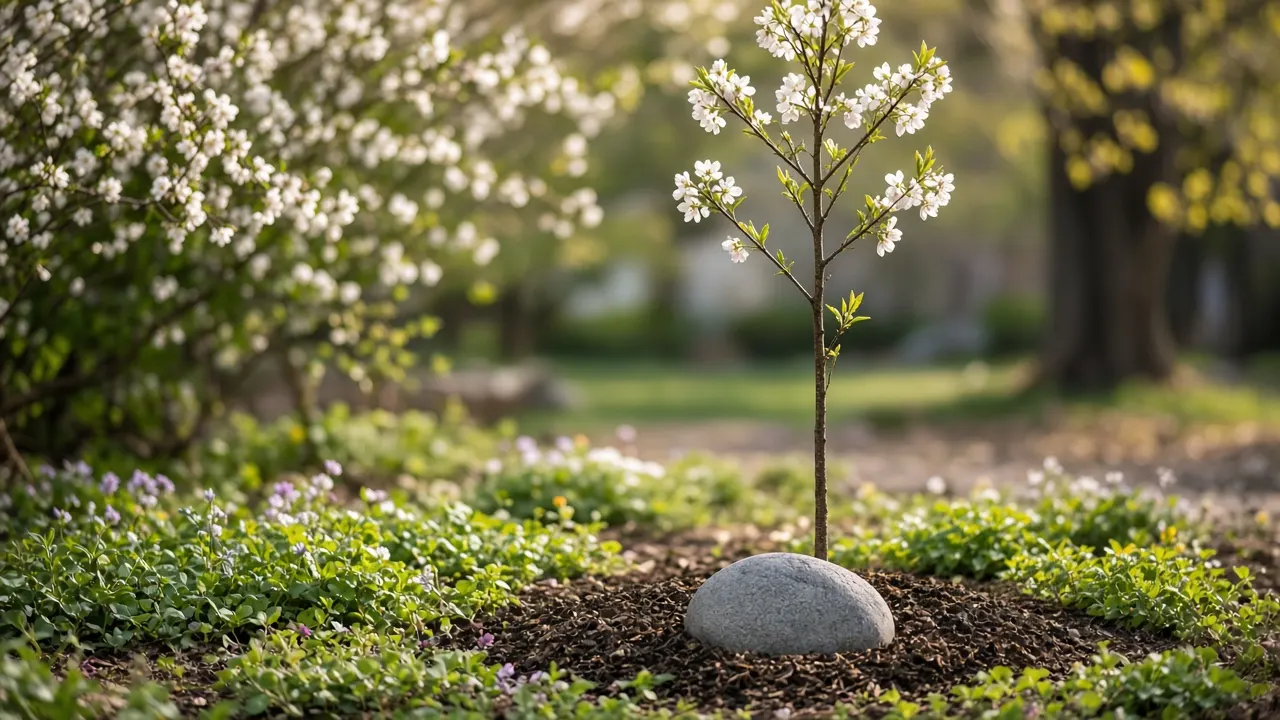
Longview's older homes and established gardens suit outdoor memorials: a stone beneath a dogwood, a bench by the vegetable beds, or a rhododendron rooted over a biodegradable urn. Anything buried should be on property you own. Renters and anyone thinking of moving usually do better with an indoor urn, and some families also frame an ink print of a paw or hoof taken before cremation.
The lower Columbia's rain and moss take a toll on outdoor markers most of the year. Granite and bronze last; painted concrete and resin fade and flake. Indoors, pick an urn that suits your room and your animal; out of direct sun, even a wooden box lasts for generations, and a small engraved plate can add a name and dates.
Country land around Longview gives you options city families don't have, and a few extra things to think about. Keep ash plantings well away from wells, springs and streams, and away from ground where livestock graze or crops are grown. Choose a spot with some shelter from wind for a young tree, and remember that deer and rabbits find new plantings quickly; a simple tree guard or wire cage for the first few years can make all the difference.
Longview is home to about 38,362 people, the 33rd-largest of the 67 Washington communities we cover. The nearest larger centre is Portland, about 46 miles (74 km) away, which is where some providers serving Longview are based.
The closest communities we cover are Battle Ground (33 miles), Vancouver (39 miles, a larger centre) and Centralia (40 miles). Providers serving those towns often travel to Longview too, so it can be worth asking them for a quote.
Our estimate
14,000
How many dog- or cat-owning households Longview has (estimate)
How we calculated this
38,362 ÷ 2.5 = 15,345 households; × 53% (dog) + 39% (cat) = 14,000. Multi-pet homes count once.
Our estimate
1,200
Longview families who lose a dog or cat each year (estimate)
How we calculated this
14,000 dog/cat-owning homes ÷ average lifespan (dog: 12.69 yrs + cat: 11.18 yrs) ≈ 1,200 a year. A floor, not a ceiling.
53%[1]
53% of US households own a dog, which is about 71 million households.
12.69 years[2]
US dogs have an average life expectancy at birth of 12.69 years.
39%[3]
39% of US households own a cat, which is about 53 million households.
11.18 years[4]
US cats seen at Banfield hospitals have an average life expectancy at birth of 11.18 years.
None of the figures on this this page are ours alone: they rest on American Pet Products Association (APPA) 2025 State of the Industry and Montoya et al. 2023, Frontiers in Veterinary Science.

How Washington feels about cremation
With a human cremation rate near 79.1%[5], Washington has plenty of crematories competing for families, and that tends to show in the choice on offer. Ask more than one pet provider what they include. Some return ashes in a simple cardboard or paper tube, some add a wooden urn you may not want, and a few can quote for water cremation. The cheapest honest quote is usually the one you can plant from.
That Washington rate is a human one, published by Direct Cremate (citing CANA) (2024). We quote it for Longview only as a pointer to how families here already think about cremation.
Choosing the right month to plant in Longview
Wet winters are the main hazard for a memorial planting in Longview. Around November, heavy soils can stay waterlogged for weeks, and roots sitting in cold, salty water rot easily. If your ground drains slowly, plant on a low mound, raised a little above the surrounding soil, so excess water runs away from the ash blend rather than pooling in it.
In a gentle climate like Longview's, grass and weeds grow nearly all year, and they compete hard with a young tree for water. Keep a clear circle of bare, mulched soil around the base, at least an arm's length across, for the first three years. It also stops mowers and strimmers from nicking the bark, which is how many young trees are lost.
What bio urns and aquamation cost in Longview
Add up every part before you commit. Beyond the cremation, a living memorial in Longview can include the bio urn, compost and bark, a pH kit, the tree or shrub, a guard against deer or rabbits, and perhaps a marker. Our memorial budget planner lists each line so nothing surprises you. Most families find the tree is the cheapest part and the cremation the most expensive.
The Washington price table breaks costs down by product; our services page explains what sits behind each line.

Free tool
Memorial budget planner
Add up cremation, urn, keepsakes and a farewell so the total holds no surprises.
Where you can plant or release ashes in Washington
What you plant can matter as much as where. Parks and nature reserves in Washington often forbid planting anything at all, and even on private land some trees and shrubs are listed as invasive in parts of the region. A local nursery or native plant society can steer you toward a species that won't spread into wild land.
Washington keeps an official directory of local governments; use it to reach the county or city office that covers Longview.
The Washington page sets out who oversees pet cremation and what the state says about burial and scattering. Longview's own bylaws can sit on top of that, so ask before you dig.
A simple plan for your pet's eco memorial
- Confirm the ashes will come back. With a communal cremation there's normally nothing to collect afterwards, which leaves you with nothing to put in an urn.
- Pick the type of bio urn: a planting urn for a tree, a plain burial urn for a garden corner, a water urn for a lake or the sea.
- Ask permission before using ground you don't own, whether that's a landlord, a farmer or whoever runs the park.
- Plan for the weather. In Longview, avoid frozen, baked or waterlogged ground; a calm, mild day is best for planting or a release.
- Release gently on water. Set the urn on the surface, let it float and sink on its own, and add only loose petals.
- Come back in a year. Top up the mulch, see how much the tree has put on, and photograph it to record the first anniversary.
Keeping the memorial alive in Longview
Families with roots in Cowlitz County often have relatives spread along the I-5 corridor from Portland to Seattle. Splitting ashes between one main urn and small tokens lets several households keep a share. Settle on the number of portions with the provider ahead of cremation, label each clearly, and consider slipping a short note about the animal into every container.
look through our guides and the blog, The services page is the place to compare what is included, use the free tools before you ring anyone, or see what other families chose in the poll results. More local pages: Bellevue, Spokane, Tacoma and Vancouver, the Washington overview and every city in the United States.

Reader polls
What would you choose?
Vote anonymously and see how other readers answered. The results are live counts from people who visit this site, so they show real opinions, not a scientific sample.
Would you consider releasing your pet's ashes in water?
Tap an answer to vote and see how others answered. Anonymous.
If water cremation (aquamation) were offered near you, would you choose it?
Tap an answer to vote and see how others answered. Anonymous.
If you had to decide today, which aftercare would you choose for your pet?
Tap an answer to vote and see how others answered. Anonymous.

Free tools to help you plan
Memorial budget planner
Add up cremation, urn, keepsakes and a farewell so the total holds no surprises.

Memorial tree finder
Pick a tree for a planting urn that suits your climate, space and pet.

Aftercare options compared
Compare private, communal and water cremation with burial on cost, timing and what comes home.
Questions people ask
Why does the Longview page quote a human cremation rate?
Because it is the best local signal we have. Direct Cremate (citing CANA) (2024) reports about 79.1%[5] of Washington residents are cremated. There is no official pet equivalent, and inventing one would be worse than quoting a real, clearly labelled number.
How does Longview's weather affect pet aftercare?
August is the hottest month in Longview, with average highs around 80°F, so prompt collection matters most then. Winters are mild, with average lows staying above freezing, so outdoor burial or scattering is usually possible year round.
Where are the providers that serve Longview actually based?
Some are local, and some run from Portland, about 46 miles away. That is normal for a town this size. What matters is the collection time they quote for Longview and whether the drive is priced into the total, so ask both up front.
Can a provider from a neighbouring town collect from Longview?
Usually yes. Battle Ground is about 33 miles away, Vancouver is about 39 miles away and Centralia is about 40 miles away, all inside a normal collection radius. Get the mileage written into the quote so there is no surprise on the day.
What if the soil in Longview is already alkaline?
Then ashes push it further, so be generous with compost and composted bark, choose a lime-tolerant tree or shrub, and test the pH before planting. Chalky and limestone soils are common in many regions. Plants that dislike lime, such as azaleas and blueberries, are a poor choice for an ash planting anywhere.
What trees grow well as a memorial in Longview's mild climate?
Almost anything that suits your space, which is why it's worth thinking about size. A small flowering tree, a fruit tree on a dwarfing rootstock or a native shrub suits most gardens better than a big forest tree. A local nursery can tell you which natives do well in Longview and which tolerate slightly alkaline soil after ashes are mixed in.


Sources and our estimates
- [1] 53% of US households own a dog, which is about 71 million households. American Pet Products Association (APPA) 2025 State of the Industry, 2025.
- [2] US dogs have an average life expectancy at birth of 12.69 years. Montoya et al. 2023, Frontiers in Veterinary Science - Banfield Pet Hospital life expectancy tables (13.3 million dogs, 2.4 million cats, 2013-2019), 2023.
- [3] 39% of US households own a cat, which is about 53 million households. American Pet Products Association (APPA) 2025 State of the Industry, 2025.
- [4] US cats seen at Banfield hospitals have an average life expectancy at birth of 11.18 years. Montoya et al. 2023, Frontiers in Veterinary Science - Banfield Pet Hospital life expectancy tables (13.3 million dogs, 2.4 million cats, 2013-2019), 2023.
- [5] Washington had a 79.1% cremation rate in 2024, among the highest in the US. Direct Cremate (citing CANA), 2024.
- [6] If just 10% of U.S. pet cremations moved to aquamation, about 4,200 t CO2e a year would be avoided. Our estimate: 1.5M x 10% x 31.3 kg x 90% reduction. How we calculate.
Get bio urn options for Longview
Tell us what you need and where you are. We'll reply by email with clear options and prices so you can decide in your own time.