Growing something from the goodbye in Cudahy
Cudahy has an estimated 6,500 dog- or cat-owning households. When a planting or water memorial feels right for yours, here's what works in the local climate and what to ask before you buy.
- When to plant in your season
- How much ash your urn must hold
- Aquamation providers in your area

Cudahy, Wisconsin
Your living memorial options around Cudahy
Wisconsin's human cremation rate is around 70%, so the idea of ashes living on a shelf, or being shared out, is familiar to many local families. That comfort carries over to pets: some people commission a portrait, others choose a garden stone engraved with a name and dates. Ask the provider about the options they can order, how long engraving takes, and whether you can see a sample first.
Many Cudahy homes are modest in size, so memorials tend to be pieces that fit a mantel, a bookshelf or a coat pocket. A slim urn, an ink impression of a paw or nose, or a charm with a pinch of cremated remains inside all suit tight spaces. If relatives live elsewhere in the Milwaukee area, the ashes can be split so each household keeps a share nearby.
Small towns tend to have long memories, and a memorial tree in Cudahy is often planted with a lot of history around it: the same yard for decades, a family farm, a favorite fishing spot. If the land is likely to stay in the family, a long-lived native tree is a lovely choice. If it might be sold, consider a shrub bed, a portion of ashes kept back, or a water release that doesn't depend on who owns the ground in twenty years.
About 17,655 people live in Cudahy, which makes it the 50th-largest of the 50 Wisconsin communities we cover. Milwaukee, roughly 7 miles off, is the closest larger centre, and a share of the providers who cover Cudahy run from there.
Cudahy sits within easy reach of South Milwaukee (2 miles), Oak Creek (5 miles, a larger centre) and Milwaukee (7 miles, a larger centre). A provider based in any of them will usually collect from Cudahy; ask what the mileage adds to the bill.
Our estimate
6,500
Estimated dog- or cat-owning households in Cudahy
How we calculated this
17,655 ÷ 2.5 = 7,062 households; × 53% (dog) + 39% (cat) = 6,500. Multi-pet homes count once.
Our estimate
540
Cudahy families who lose a dog or cat each year (estimate)
How we calculated this
6,500 dog/cat-owning homes ÷ average lifespan (dog: 12.69 yrs + cat: 11.18 yrs) ≈ 540 a year. A floor, not a ceiling.
53%[1]
53% of US households own a dog, which is about 71 million households.
12.69 years[2]
US dogs have an average life expectancy at birth of 12.69 years.
39%[3]
39% of US households own a cat, which is about 53 million households.
11.18 years[4]
US cats seen at Banfield hospitals have an average life expectancy at birth of 11.18 years.
None of the figures on this this page are ours alone: they rest on Montoya et al. 2023, Frontiers in Veterinary Science and American Pet Products Association (APPA) 2025 State of the Industry.

The local attitude to ashes and memorials
About 70.7%[5] of people in Wisconsin are cremated, so ashes are part of everyday life here in a way they aren't everywhere. Many families have already scattered or planted a grandparent's ashes and know how it felt. If you did, you'll recognise much of the process for a pet, with one difference worth knowing: a pet's ashes are a much smaller amount, which makes mixing them safely into soil far easier.
For the Wisconsin figure we rely on NFDA 2024 Cremation & Burial Report state projections (via Occasional Sage) (2024). Read it as a picture of local custom around death and remembrance in Cudahy rather than as pet data.
Seasons, soil and weather for a memorial in Cudahy
Early spring in Cudahy is when nurseries sell bare-root trees, often at a lower price than trees in pots. They need planting quickly, as soon as the ground can be dug after January, February, March and December, which fits well with ashes that have waited through the winter. Have the soil blend ready beforehand, soak the roots for an hour, and plant on a calm, overcast day.
A Cudahy winter is a useful waiting room. With 4 months of freezing lows, you can mix the ashes with compost in a covered bin or tub in a garage or shed during the cold months and let the mix rest. One gardening guide suggests at least 90–120 days[6] before planting, which fits neatly between a winter loss and spring planting. Test the pH before the tree goes in.
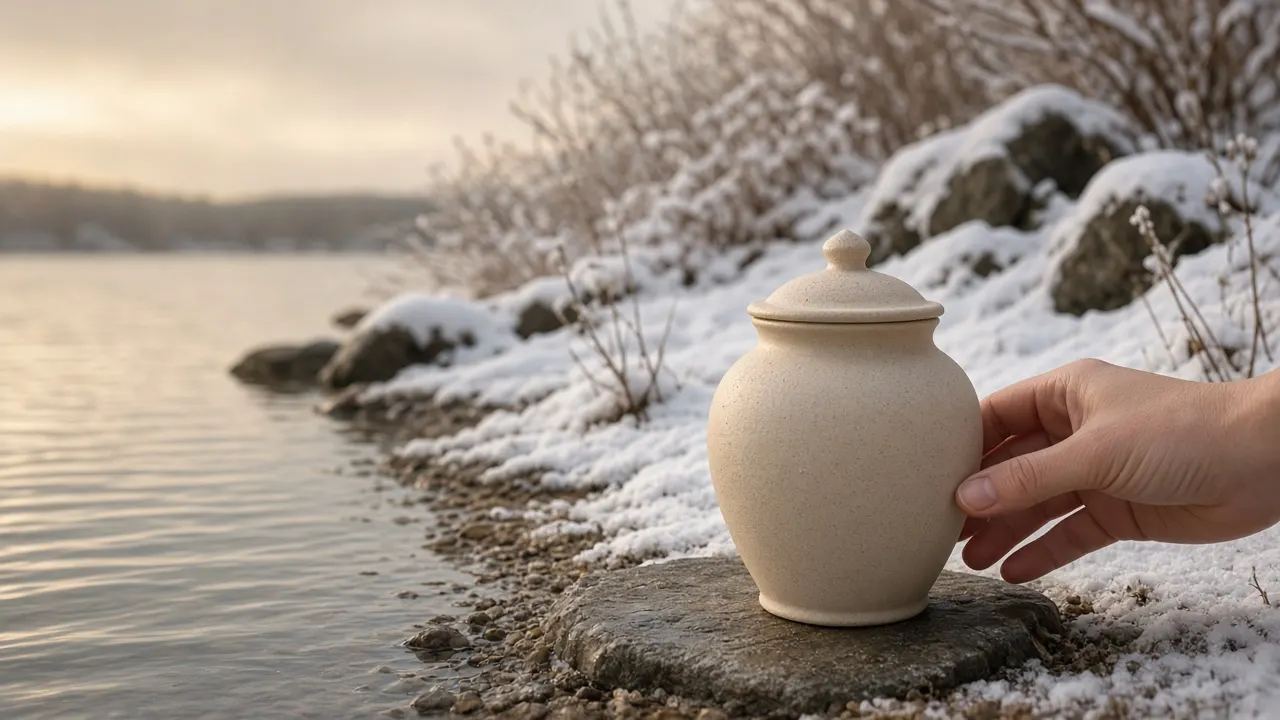
Adding up the cost of a bio urn memorial in Cudahy
It helps to compare a planted memorial with the alternatives. A pet cemetery burial for a dog averages about $831[7] in the US, which by our estimate is around 3.2 times the national average for private cremation[8]. Private cremation plus a bio urn and a sapling in your own Cudahy garden usually comes in far below a cemetery plot, and there are no yearly maintenance fees.
For a line-by-line price table, see the Wisconsin overview; for what's included in each option, see our services.

Free tool
Memorial budget planner
Add up cremation, urn, keepsakes and a farewell so the total holds no surprises.
Where you can plant or release ashes in Wisconsin
What you plant can matter as much as where. Parks and nature reserves in Wisconsin often forbid planting anything at all, and even on private land some trees and shrubs are listed as invasive in parts of the region. A local nursery or native plant society can steer you toward a species that won't spread into wild land.
Not sure which office covers Cudahy? The Wisconsin local government directory is the official list.
Start with the Wisconsin rules, which cover burial, scattering and oversight for the whole state, and treat Cudahy's local ordinances as a possible extra layer.
How to plan a living memorial, in order
- Talk it through with your household first, especially if anyone would rather keep the ashes at home.
- Measure your space. A tree needs room to grow; a shrub, a pot or a flower bed may suit your garden better.
- Test the soil where you plan to plant. If it's already alkaline, choose a lime-tolerant species and add extra compost or composted bark.
- Spread the ashes through a wide planting area, not in one band directly beneath the root ball.
- Water well for two summers. It's drought in the early years, not cold, that kills the majority of memorial trees that don't make it.
- Keep a record of the species, the date and what went into the soil, so you can care for it or move a cutting later.
Ways to mark the spot and the date
Outdoor memorials near the lake take a beating from freeze-thaw cycles, wet snow and road salt carried on the wind. Granite, cast bronze and fired stoneware outlast molded resin and painted timber through a Wisconsin winter. A biodegradable urn set under a new shrub in spring is another route, since the soil will be workable again by April or May.
run the numbers with the free planning tools, Compare every option on our services page, there are guides for the big decisions and articles for the details, or compare your instinct with the poll results. You can also browse every city in the United States. Nearby, we also cover Madison, Kenosha, Racine and Appleton, and every city in Wisconsin.

Reader polls
What would you choose?
Vote anonymously and see how other readers answered. The results are live counts from people who visit this site, so they show real opinions, not a scientific sample.
If you rent or might move, how would you handle a memorial planting?
Tap an answer to vote and see how others answered. Anonymous.
Would you consider releasing your pet's ashes in water?
Tap an answer to vote and see how others answered. Anonymous.
If you had to decide today, which aftercare would you choose for your pet?
Tap an answer to vote and see how others answered. Anonymous.

Free tools to help you plan
Memorial budget planner
Add up cremation, urn, keepsakes and a farewell so the total holds no surprises.

Memorial tree finder
Pick a tree for a planting urn that suits your climate, space and pet.

Aftercare options compared
Compare private, communal and water cremation with burial on cost, timing and what comes home.
Questions people ask
How does Cudahy's weather affect pet aftercare?
July is the hottest month in Cudahy, with average highs around 82°F, so prompt collection matters most then. Average lows drop below freezing in January, February, March and December, which can make digging a grave hard until spring.
Can a provider from a neighbouring town collect from Cudahy?
Usually yes. South Milwaukee is about 2 miles away, Oak Creek is about 5 miles away and Milwaukee is about 7 miles away, all inside a normal collection radius. Get the mileage written into the quote so there is no surprise on the day.
Is cremation common in Wisconsin?
For people, yes: about 70.7%[5] of Wisconsin deaths end in cremation, according to NFDA 2024 Cremation & Burial Report state projections (via Occasional Sage) (2024). Nobody publishes the same figure for pets, but in our experience pet choices in Cudahy follow the human pattern closely, so cremation is the default most families here start from.
Roughly how many pets die in Cudahy each year?
Our estimate is around 540. It comes from Cudahy's population (about 17,655), the average household size, the share of homes with a dog or cat (about 6,500 households here) and the average lifespan. It is arithmetic, not a count, so read it as a rough floor.
Can I bury pet ashes on a farm or rural land near Cudahy?
On land you own, burying ashes is generally allowed. Keep the planting well away from wells, springs and streams, and away from ground where livestock graze or crops are grown. On someone else's land, including family land, ask the owner first and agree that the memorial can stay if the land changes hands.
Do bio urns work with ashes from flame cremation?
Yes. A bio urn works with ashes from flame cremation or water cremation. Both leave mineral-rich, alkaline ash, so the soil advice is the same either way: dilute the ashes well through compost and soil, let the mix rest if you can, and test the pH before a young tree goes in.


Sources and our estimates
- [1] 53% of US households own a dog, which is about 71 million households. American Pet Products Association (APPA) 2025 State of the Industry, 2025.
- [2] US dogs have an average life expectancy at birth of 12.69 years. Montoya et al. 2023, Frontiers in Veterinary Science - Banfield Pet Hospital life expectancy tables (13.3 million dogs, 2.4 million cats, 2013-2019), 2023.
- [3] 39% of US households own a cat, which is about 53 million households. American Pet Products Association (APPA) 2025 State of the Industry, 2025.
- [4] US cats seen at Banfield hospitals have an average life expectancy at birth of 11.18 years. Montoya et al. 2023, Frontiers in Veterinary Science - Banfield Pet Hospital life expectancy tables (13.3 million dogs, 2.4 million cats, 2013-2019), 2023.
- [5] The NFDA projected Wisconsin's cremation rate at 70.7% for 2024. NFDA 2024 Cremation & Burial Report state projections (via Occasional Sage), 2024.
- [6] Gardening Know How advises letting an ash/soil-amendment mixture sit for at least 90 to 120 days before planting. Gardening Know How — Planting With Cremains: Is There a Safe Way to Bury Ashes, 2024.
- [7] CareCredit's 2025 cost study put the US national average for pet cemetery burial of a dog at $831 (range $659-$1,513). CareCredit (Synchrony) - How Much Does It Cost To Euthanize a Dog? (2025 ASQ360 procedural cost study), 2025.
- [8] US pet cemetery burial for a dog costs about 3.2x a private cremation ($831 vs $260 national averages). Our estimate: 831 / 260 = 3.20. How we calculate.
- [9] U.S. pet flame cremations emit on the order of 47,000 t CO2e a year. Our estimate: 1.5M pet cremations x 31.3 kg CO2e. How we calculate.
Get bio urn options for Cudahy
Tell us what you need and where you are. We'll reply by email with clear options and prices so you can decide in your own time.