Eco-friendly pet aftercare, ranked honestly and without the greenwash
Where it's allowed and safe, a simple home burial has the lightest footprint, and if you want ashes back, water cremation of a human body is estimated at about 1/10[1] of the carbon of flame. The process you choose matters far more than the urn you put the ashes in.
By the Bio Urns & Eco Memorials editorial team · Updated September 24, 2026 · 6 min read · Sources
- A plain ranking of the greener options
- Where the real footprint comes from
- Questions that expose a hollow green claim
The short answer
What is the most eco-friendly aftercare for a pet?
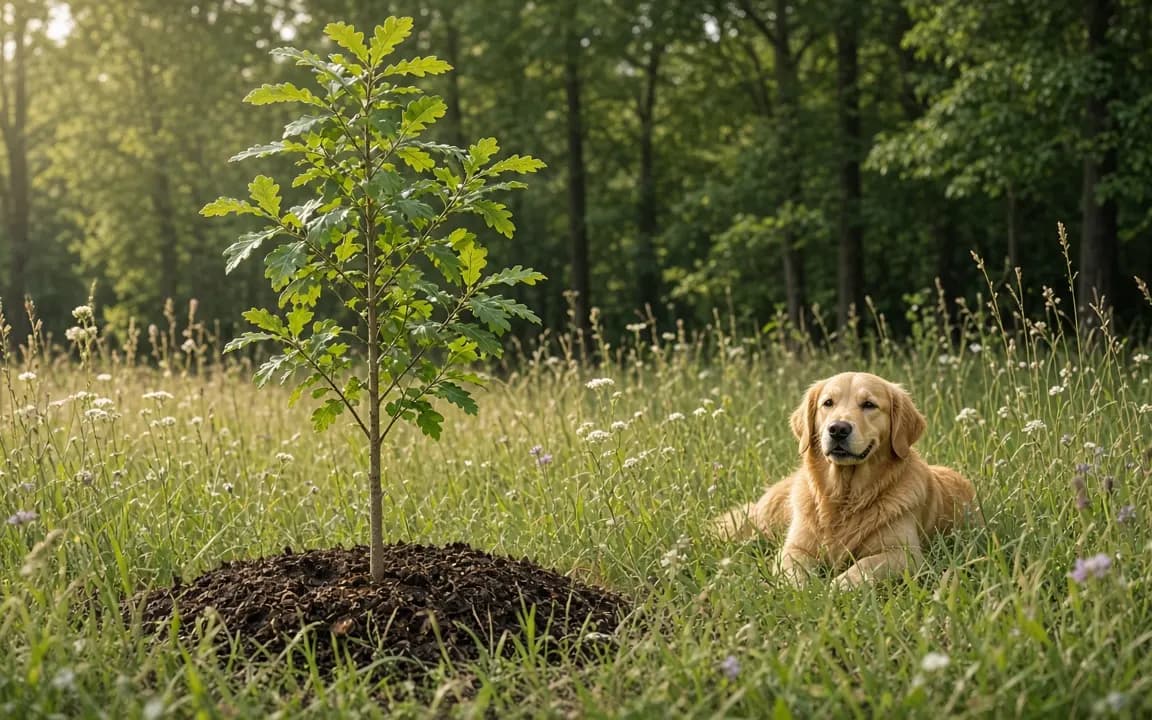
The lowest-impact goodbye is usually a home burial with no casket, on land you own, where local rules allow it and your pet wasn't euthanized with drugs that could harm wildlife. If you want ashes back, water cremation (aquamation) uses far less energy than flame. A biodegradable urn is a good finishing touch, but it's a small part of the total.
Plenty of people want this. In recent US research, 61.4%[2] of consumers said they'd like to explore green funeral options, and one market report found 40%[3] of consumers raise environmental concerns about pet aftercare specifically. What they usually find is a lot of leafy branding and very few numbers.
So this guide does two things. It ranks the main options by what actually drives their footprint, and it gives you a short set of questions to put to any provider or urn seller who calls their product green. If you already know you want a living memorial, the services page shows every kind we help arrange.
Lightest to heaviest
How do the main green choices rank against each other?
| Option | Main source of impact | Ashes back? | Watch for |
|---|---|---|---|
| Home burial, no casket | Digging and a little transport | No | Local rules, water nearby, euthanasia drugs |
| Water cremation (aquamation) | Heating water for many hours | Yes | Limited availability; ask about the liquid |
| Communal flame cremation | Fuel shared across many animals | No | No ashes to plant or keep |
| Natural burial ground | Travel and land set aside | No | Distance from home; plot fees |
| Private flame cremation + bio urn | Gas to heat a chamber for one pet | Yes | Urn materials and how the chamber is run |
The order isn't fixed. A home burial that means a two-hour drive with a borrowed trailer, or digging beside a well, stops being the gentle option. A natural burial ground ten minutes away may beat water cremation that needs a courier across three counties. Treat the table as a starting point, then adjust for your own distances.
Water cremation is still rare as a first choice. When US owners were asked about their preferred future aftercare, just 1.9%[4] picked alkaline hydrolysis, far behind flame cremation and home burial. Part of that is awareness, and part is simply that many people have never been offered it.
Where the footprint lives
Why does the cremation matter more than the urn?
Flame cremation spends most of its energy heating a brick-lined chamber to a very high temperature and holding it there. A Dutch life-cycle study of human funerals put a single cremation at 79.9 kg CO2e[5]. For animals, by our estimate each shelter-animal flame cremation emits ~31 kg CO2e per animal[6], working from published shelter figures.
Now compare the urn. A paper, coir or cornstarch urn is a few ounces of plant material that rots away in a season or two. Even a shipped ceramic urn is a small fraction of what the cremation itself burned. One retailer's guide puts biodegradable pet urns at $15–$80[7], which makes them one of the cheaper parts of the whole goodbye as well as one of the lighter ones.
Home burial
When is home burial the greenest option, and when isn't it?
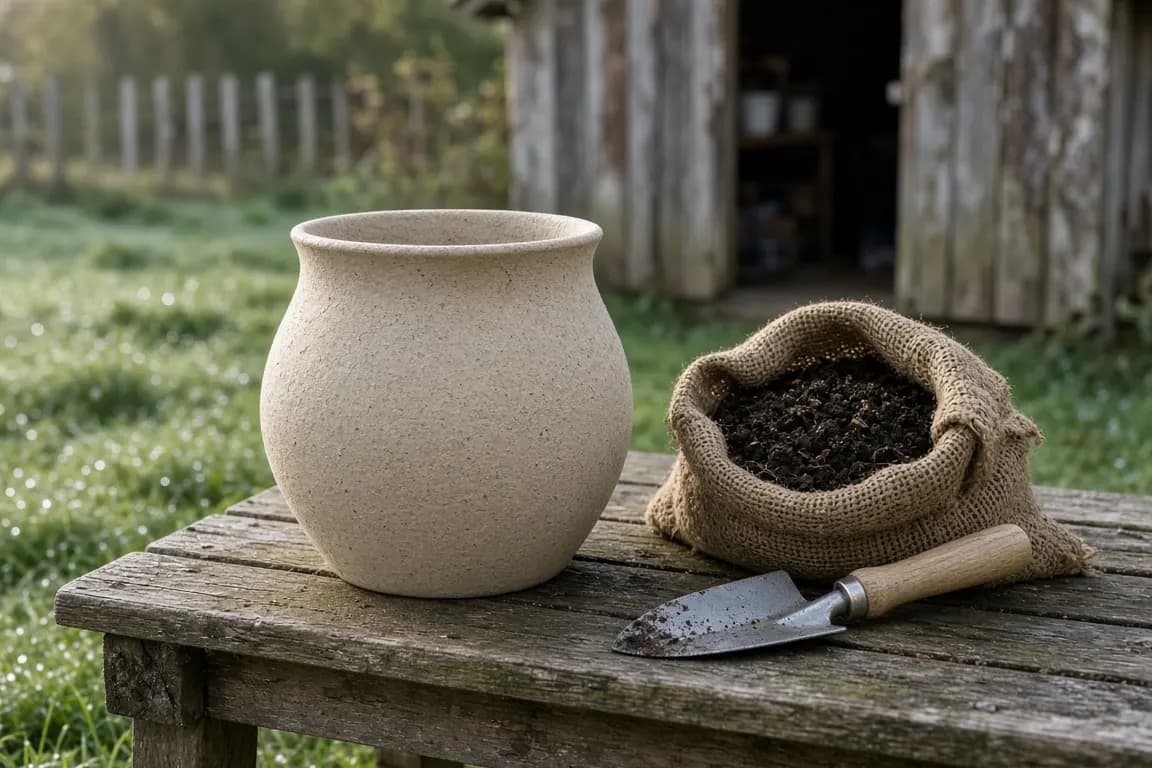
Burying a pet on your own land uses no fuel beyond a shovel and returns the body straight to the soil. Wrap them in a cotton sheet, a wool blanket or plain paper rather than plastic, and skip varnished wooden boxes. A deep hole, well away from wells, streams and vegetable beds, keeps the burial from affecting anything you or wildlife drink.
The big exception is euthanasia. Since 2003[8], US euthanasia drug labels have carried a warning that euthanized animals must be buried deeply or cremated so scavenging wildlife can't eat them. A shallow grave that a fox or eagle can reach isn't green at all. Ask your vet whether the drug they used affects your plans.
Home burial also depends on where you live. Towns and counties set their own rules, and renting changes the answer entirely. Our permission questions before scattering or burying walk through yards, rentals, HOAs and family land. In England, government guidance on animal burials sets distances from wells, springs and watercourses, a sensible benchmark even where your own local rules are looser.
Natural burial grounds
Is a natural burial ground worth the extra cost?
A natural or conservation burial ground accepts bodies without embalming or sealed caskets and keeps the land as meadow or woodland. For pets, one Oregon ground lists a whole-body burial at $750–$950[9], including the plot and opening and closing the grave. That's several times a private cremation, so it's a values choice more than a budget one. The Green Burial Council publishes standards for natural and conservation burial grounds, so it's fair to ask whether a pet ground follows them.
What you're paying for is protected land. In the Dutch study, land use was the single largest environmental cost of a conventional human burial, €52[10] of a roughly €85 environmental cost per body. A natural burial ground turns that cost around, because the ground stays wild instead of becoming mown lawn with rows of stone.
Spotting greenwash
How can you tell whether a green claim is real?
Most green claims in pet aftercare aren't lies, just vague. The fix is to ask a question that forces a specific answer. A provider with a genuinely lower footprint will usually be glad you asked.
- Which process, exactly? "Eco cremation" can mean water cremation, a newer flame unit, or just a paper urn added to a normal cremation.
- Measured or quoted? Ask whether an energy or carbon figure comes from their own equipment or from a manufacturer's brochure.
- Per pet or per body? Many headline numbers come from human studies. A cat is not a person, and the ratio may differ.
- What is the urn made of? Ask for the materials and how long it takes to break down, in soil or in water. "Biodegradable" with no time frame tells you little.
- How far will your pet travel? Collection from a distant facility can outweigh a small efficiency gain.
- For water cremation, where does the liquid go? A clear answer about wastewater treatment is a good sign.
For the urn side of the question, our explainer on biodegradable urn materials shows what each material really does in the ground. For the process side, we've gathered the evidence on whether aquamation is better for the environment.
After the cremation
Can the ashes themselves harm soil or water?
Ashes aren't toxic in the way people sometimes fear, but they're far from neutral. Cremated remains sit at a pH of about 11.7[11], strongly alkaline, and carry a lot of sodium. Poured in one heap, they can scorch roots and leave a bare patch in a lawn for a surprisingly long time.
The gentle approach is dilution. On land, spread ashes thinly or blend them through plenty of compost and soil before planting; our soil mix guide for planting with ashes explains how. In a large body of water, dilution happens on its own, which is one reason scattering pet ashes in water has little lasting effect when done with permission.

Free tool
Aftercare options compared
Compare private, communal and water cremation with burial on cost, timing and what comes home.
Making it yours
How do you choose a greener goodbye that still feels right?
Green is one priority among several. Some families care most about having a place to visit, others about cost, others about keeping every bit of their pet close. The option with the smallest footprint won't help if it leaves you uneasy for years.
What matters most to you in a greener goodbye?
Tap an answer to vote and see how others answered. Anonymous.
A good compromise for many people is water cremation followed by a soil or water bio urn, with a small keepsake portion kept at home. Add the pieces up with the memorial budget planner, or send us your details and say which matters more to you: the lowest footprint, a place to visit, or the lowest cost. We'll reply with options that fit. Our location pages note where water cremation is easier to find, and the poll results show what other readers put first.

Reader polls
What would you choose?
Vote anonymously and see how other readers answered. The results are live counts from people who visit this site, so they show real opinions, not a scientific sample.
What matters most to you in a greener goodbye?
Tap an answer to vote and see how others answered. Anonymous.
Had you heard of water cremation (aquamation) before today?
Tap an answer to vote and see how others answered. Anonymous.
If you had to decide today, which aftercare would you choose for your pet?
Tap an answer to vote and see how others answered. Anonymous.

Questions people ask
Is communal cremation greener than private cremation?
Per animal, usually yes. A communal cycle heats the chamber once for several pets, so each one accounts for a smaller share of the fuel. The trade-off is that no ashes come back, so there's nothing to plant or scatter. If a living memorial matters to you, private water cremation is often the middle path.
Does using a bio urn make flame cremation eco-friendly?
It helps a little, but not much. A biodegradable urn avoids a container that lasts for centuries, yet the cremation's gas use is many times larger than anything in the urn. Think of the bio urn as a kinder last step rather than a way to cancel out the process before it.
Could burying my pet in the garden pollute groundwater?
A single small pet buried at a reasonable depth, away from wells and streams, is very unlikely to cause a problem. The risk grows with large animals, high water tables, sandy soil and animals that were euthanized or carried an infectious disease. If any of those apply, ask your vet or local council before digging.
Are carbon-offset cremation packages worth paying for?
Only if the provider tells you what the offset buys, who verifies it and how much carbon it covers per pet. An offset doesn't change what happens at the chamber. Choosing water cremation or burial where possible cuts emissions directly, and costs you nothing extra in paperwork.
What is the greenest option for a very large dog?
Large dogs magnify every difference, because more fuel is needed to cremate them. Private water cremation, where you can find it, is usually the lower-energy route. Home burial is possible for some families, but the hole needs to be deep and well away from water, which takes real effort and space.
What should I do with the plastic bag and box the ashes come in?
Ashes often come back in a sealed plastic bag inside a cardboard box or temporary urn. Keep the bag until the ashes are planted or released, because it keeps moisture out. Afterwards, the cardboard can be recycled or composted, and the bag goes in household waste. Many keepsake makers can reuse a temporary tin.
Keep reading

Living memorials we help arrange
Tree urns, water urns, burial urns and water cremation referrals.

Compare aftercare options
Rank burial, water cremation and flame cremation by what matters to you.

More from the blog
Planting, water releases, permissions and urn materials.

How we research
Where our figures come from and what we won't claim.
Sources and our estimates
- [1] Alkaline hydrolysis has about a tenth of the carbon footprint of conventional cremation, according to People's Memorial Association's Nora Menkin. National Geographic — The environmental toll of cremating the dead (2019), 2019.
- [2] 61.4% of US consumers say they are interested in exploring green funeral options. NFDA 2025 Cremation & Burial Report (press release), 2025.
- [3] Astute Analytica reports that 40% of consumers raise environmental concerns about pet aftercare choices. Astute Analytica via GlobeNewswire — Global Pet Preservation Services Market to Hit USD 112.7 Million by 2032 (Apr 2, 2024), 2024.
- [4] Asked their preferred future after-death care, 40.4% of US owners chose traditional flame cremation and 34.9% home burial; 10.7% chose cemetery burial and 1.9% alkaline hydrolysis (aquamation). Cooney, Kogan, Brooks, Ellis - Pet Owners' Expectations for Pet End-of-Life Support and After-Death Body Care, Topics in Companion Animal Medicine (2020), 2020.
- [5] A TNO life-cycle assessment estimated the global-warming impact of an average cremation at 79.9 kg CO2-equivalent per body. TNO report TNO-060-UT-2011-01432, 'Environmental impact of different funeral technologies' (Keijzer & Kok, 2011), 2011.
- [6] Each shelter-animal flame cremation emits about 31 kg CO2e on average. Our estimate: 19,000 t CO2e / 607,000 animals. How we calculate.
- [7] Memorials.com's pet urn cost guide puts biodegradable pet urns at $15–$80. Memorials.com – Pet Urn Cost Guide, 2025.
- [8] Since 2003 the FDA has required euthanasia drug labels to warn that euthanized animals must be disposed of by deep burial, incineration or another approved method to keep scavenging wildlife from eating the carcass. Cornell Waste Management Institute & Penn State - Horse Mortality: Carcass Disposal Alternatives (2012), 2003.
- [9] Great River Natural Burial in Oregon charges $750–$950 for a whole-body pet burial: a $500 plot plus $250–$450 opening and closing by size. Great River Natural Burial – Pet Cemetery Pricing, 2026.
- [10] Land use was the largest single environmental cost for burial in the TNO study (€52 of roughly €85 per body). TNO report TNO-060-UT-2011-01432, 'Environmental impact of different funeral technologies' (Keijzer & Kok, 2011), 2011.
- [11] Cremated remains have a very high pH of approximately 11.7, which is toxic to plants without amendment. Larkspur Conservation — Giving Cremated Remains a New Life Through Science, 2024.
Find lower-impact aftercare near you
Tell us what you need and where you are. We'll reply by email with clear options and prices so you can decide in your own time.