How to mix pet ashes with soil so a memorial plant can thrive
Pet ashes are too alkaline and salty to put straight on roots, so mix them into a large volume of compost-rich soil, let the blend rest for a few months, and test the pH before planting. Below are starting amounts for every pet size, from a cat to a giant-breed dog.
By the Bio Urns & Eco Memorials editorial team · Updated September 24, 2026 · 7 min read · Sources
- Starting soil volumes for cats through giant dogs
- Which amendments soften ash and which make it worse
- How to test the blend before a plant goes in
The short answer
How do you mix pet ashes into soil for planting?
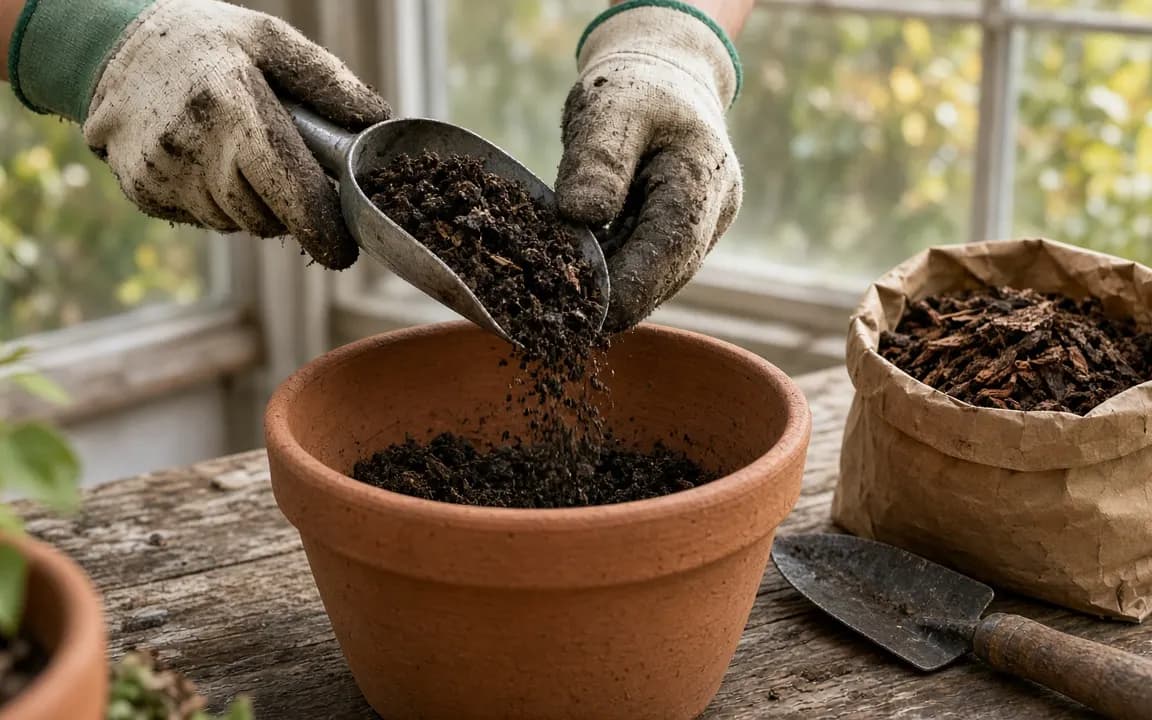
Spread the ashes through a large volume of compost-rich, slightly acidic soil rather than tipping them into one hole. As a starting point, use at least ten parts amended soil to one part ash by volume, rest the blend outdoors for three to four months, then test its pH before a plant goes in. There is no single correct ratio, so treat every figure below as general guidance you check with a test.
The reason is chemistry, not superstition. Cremated remains test at a pH of about 11.7[1], far above the 6.0 to 7.0 range that most garden plants prefer. They are mostly calcium phosphate from bone, with a good dose of sodium. Young roots sitting in a concentrated pocket of that material struggle to take up iron and water.
Before today, did you know pure pet ashes are too alkaline for most young plants?
Tap an answer to vote and see how others answered. Anonymous.
The problem
Why do pure ashes harm young roots?
Think of pet ashes as a very strong garden lime with salt stirred in. Three things go wrong when roots meet them undiluted.
- High pH locks up nutrients. Above about pH 7.5, iron, manganese and zinc become hard for roots to absorb. The first sign is often pale leaves with green veins.
- Sodium pulls water the wrong way. Salty soil makes it harder for roots to draw in moisture, so a plant can wilt even when the ground is damp.
- Ash packs tight. Fine bone powder can settle into a dense layer that sheds water and blocks air, especially in clay.
- None of it breaks down quickly. Calcium phosphate is stable. Ash doesn't rot like compost, so dilution and time do the work.
Commercial tree urns handle this with a neutralizing mix in a separate chamber, which is why kits like the $119[2] Living Urn pet system include their own additive. If you're curious how those chambers are arranged, our explainer on how a tree urn works walks through the design.
What to mix in
Which soil amendments work well with pet ashes?
You want materials that add organic matter, hold moisture, buffer pH and, ideally, lean slightly acidic. Most of these are cheap and sold at any garden center.
| Amendment | What it does | Notes |
|---|---|---|
| Mature garden compost | Adds organic matter and microbes that buffer pH | The backbone of most mixes; use plenty |
| Composted pine bark fines | Mildly acidic, keeps the blend open and airy | Good in clay; choose fine, aged bark |
| Leaf mould | Holds water, gently acidic when made from oak or beech leaves | Free if you have trees; takes a year to make |
| Pine needles | Slow, gentle acidifier and a light mulch | Works as a top layer after planting |
| Coir (coconut fiber) | Peat-free moisture holder, close to neutral | Buy washed or buffered coir to avoid extra salt |
| Elemental sulfur | Soil bacteria convert it to acid over weeks and months | Use small amounts and follow the label; it acts slowly |
Native soil counts too. A sandy soil has little buffering power, so lean harder on compost. A heavy clay holds salts longer, so add bark for drainage. If you're unsure what you have, a county extension soil test tells you the starting pH and texture for a small fee. Michigan State University Extension's facts about soil acidity and lime explain why a lab test beats guessing from a single probe reading.
Amounts by pet size
How much soil do you need for your pet's ashes?
Start with how much ash you have. Cremated remains usually weigh about 3-5% of body weight[3], and the urn industry's rule of thumb is roughly one cubic inch of volume per pound of body weight, giving urn sizes of about 12 cubic inches for a 12 lb cat and 70 cubic inches for a 70 lb dog[4]. A US cup is a little over 14 cubic inches, which makes the kitchen math easy.
Some real-world anchors, by our estimate: a 12 lb cat returns around 6.7 oz[5] of ash, a 30 kg (66 lb) dog around 0.9-1.5 kg[6], and a median giant-breed dog about 3.8 lb[7]. The table turns those into a starting soil volume at a dilution of ten to twenty parts amended soil per part ash.
| Pet | Approx. ash volume | Amended soil to mix in | Practical setting |
|---|---|---|---|
| Cat or small pet, up to 15 lb | Up to 1 cup | 0.5 to 1 gallon | One large pot or a single perennial |
| Small dog, 15 to 30 lb | 1 to 2 cups | 1 to 2.5 gallons | A shrub hole or a 15-inch container |
| Medium dog, 30 to 60 lb | 2 to 4 cups | 2.5 to 5 gallons | A small tree or two shrubs |
| Large dog, 60 to 90 lb | 4 to 6.5 cups | 5 to 8 gallons | A tree, blended in a wide ring |
| Giant dog, over 90 lb | 6.5 cups or more | 8 to 10+ gallons | A tree plus a second planting, or split the ashes |
Those volumes assume you'll mix well and rest the blend. If your soil tests high to begin with, go toward the larger figure or divide the ashes between two places. The urn size calculator gives a quick volume estimate from your pet's weight if you'd rather not do the arithmetic.
Free tool
Urn size calculator
Find the urn volume you need from your pet's weight, plus keepsake and sharing options.
Step by step
What is the step-by-step method for blending and resting?
- Pick a mixing vessel. A clean wheelbarrow, a large tub or a heavy-duty tarp works. Wear a dust mask and gloves; ash is very fine.
- Lightly dampen the ashes. A mist of water stops dust drifting and helps them bind with the soil.
- Add amendments in layers. Alternate a scoop of ash with several scoops of compost and bark, turning as you go until no pale streaks remain.
- Moisten the whole batch. Aim for the feel of a wrung-out sponge.
- Rest it outdoors. Cover loosely in a tub with drainage holes or a breathable sack. Gardening guidance suggests leaving an ash and amendment blend for 90–120 days[8] before planting.
- Turn and water monthly. Watering through the rest period helps rinse sodium down and out.
- Test before planting. Take a small sample and check the pH, as below.
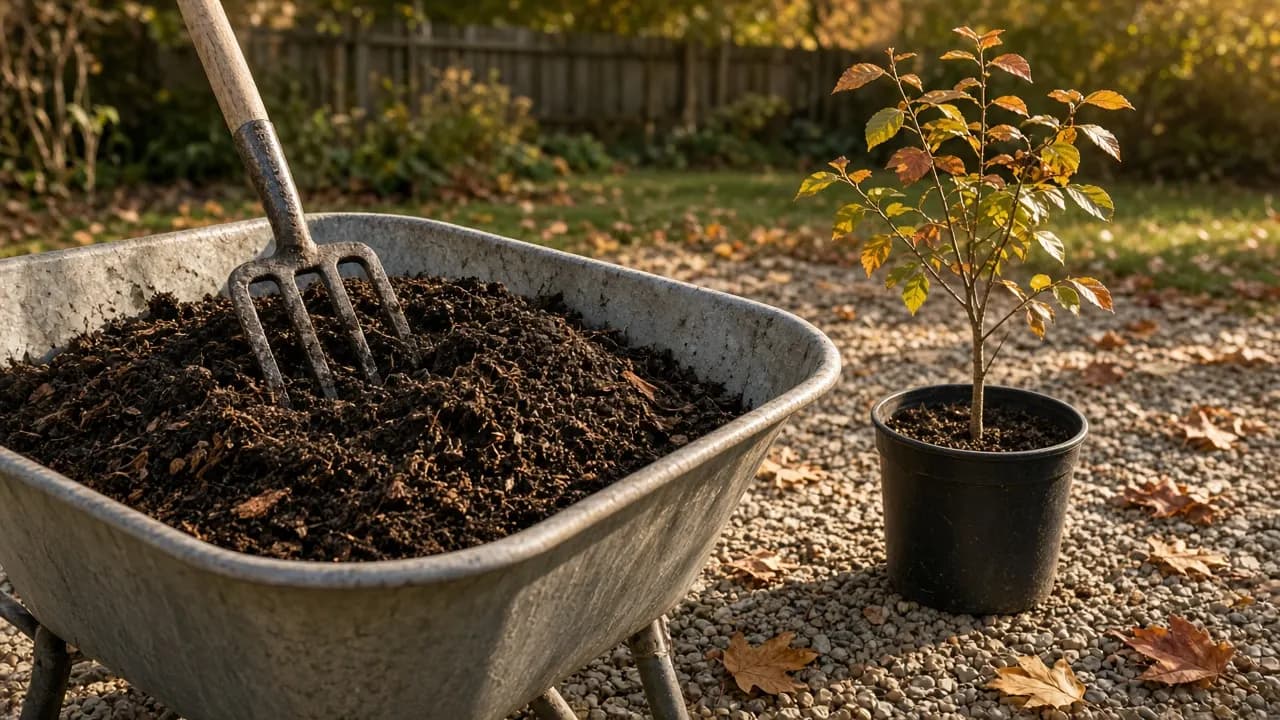
The rest period often lines up naturally with the calendar. Ashes returned in late summer can rest through fall and be planted in early spring, which suits most trees anyway. Our living memorial timeline lays out the months from return to first leaves.
Testing
How do you test the pH before planting?
A home test kit or an inexpensive probe meter is enough to spot a problem. For a clearer reading, send a sample to your state's extension soil lab, which also reports salts on request. Colorado State University Extension also warns that lowering the pH of alkaline soil is slow work, so a high reading is a reason to dilute further rather than wait for it to drift down.
- Sample from several spots in the blend and mix them, so one ash-heavy scoop doesn't skew the result.
- Use distilled water for a slurry test; tap water can be alkaline itself.
- Aim for 6.0 to 7.0 for most trees and shrubs, or slightly lower for acid-lovers like dogwood and Japanese maple.
- Still above 7.5? Add more compost or bark, work in a little elemental sulfur, water well and retest in four to six weeks.
Keep a note of the reading and date. It is useful later if the plant shows stress, and our troubleshooting piece on planting memorials with ashes explains what the common warning signs mean.
Where it goes
Should you plant in a container or in the ground?
A container keeps the ashes together and moves with you, which matters to renters and anyone who might relocate. The trade-off is that pots dry out quickly and hold salts, so water until it runs from the base, and choose a pot at least 15 inches across for anything woody.
In the ground, spread the rested blend in a wide ring around and below the root ball rather than packing it into the bottom of the hole. Roots grow outward, and a ring lets them meet the blend gradually. Keep plain, untreated soil directly against the root ball for the first few inches.
If a ready-made system suits you better, one retailer lists biodegradable pet urns at about $15–$80[9], and some kits include the neutralizer so you skip the mixing. Choosing a species that tolerates higher pH also widens your margin; our list of trees that suit a pet memorial flags which ones cope. When you're ready, tell us about your plans and we'll reply with urns and kits that fit your pet's size. For the full range of planting, garden and water urns, see our bio urn options; for climate notes where you live, try the location pages, and the poll results show how many readers knew about the pH problem.

Reader polls
What would you choose?
Vote anonymously and see how other readers answered. The results are live counts from people who visit this site, so they show real opinions, not a scientific sample.
Before today, did you know pure pet ashes are too alkaline for most young plants?
Tap an answer to vote and see how others answered. Anonymous.
Where are (or will be) your pet's ashes?
Tap an answer to vote and see how others answered. Anonymous.
Do you keep more than one memorial for the same pet?
Tap an answer to vote and see how others answered. Anonymous.


Questions people ask
Is there an exact ratio of ashes to soil?
No. The right amount depends on your native soil, the plant and how much ash you have. Ten to twenty parts amended soil per part ash by volume is a sensible starting point, but the pH test after resting is what tells you whether the blend is ready. Adjust with more compost or bark if it reads high.
Can I skip the resting period if I use lots of compost?
You can plant sooner with a very dilute blend, but resting gives the amendments time to buffer the ash and gives rain or watering time to rinse sodium down. If you plant early, water deeply and often, keep the ash-rich soil away from the root ball, and check the pH again after a month.
Does it matter whether my pet had flame cremation or aquamation?
Both return bone mineral that is alkaline and needs diluting. Remains from water cremation are often finer and whiter, and there can be a little more of them. The same approach applies: mix generously, rest the blend and test before planting.
Should I sieve or crush the ashes first?
Most returned ashes are already processed to a fine, sandy texture. If you notice larger fragments, they are harmless in a planting mix and will sit in the soil like grit. Crushing them further mainly makes more dust, so it isn't necessary for gardening purposes.
Can I mix the ashes into an existing flower bed instead?
Yes, if you spread them thinly across a wide area and work them into the top few inches with compost. Avoid beds of acid-loving plants such as azaleas, blueberries or camellias. A broad, thin spread is gentler on established roots than a concentrated pocket.
What should I wear when handling the ashes?
A simple dust mask and garden gloves are enough. Ash is fine and alkaline, so it can irritate eyes and dry out skin. Dampening it lightly before mixing and working out of the wind keeps it where you want it.


Sources and our estimates
- [1] Cremated remains have a very high pH of approximately 11.7, which is toxic to plants without amendment. Larkspur Conservation — Giving Cremated Remains a New Life Through Science, 2024.
- [2] The Living Urn's pet bio-urn planting system (without a tree) costs $119. The Living Urn – Pet tree urn, 2026.
- [3] Embrace notes cremated remains typically weigh about 3-5% of the pet's original body weight. Embrace Pet Insurance - Bury or Cremate Your Dog? Costs, Pros & Cons, 2025.
- [4] Using the industry rule of thumb of 1 cubic inch of urn space per pound of body weight, a 12 lb cat needs an urn of about 12 cubic inches; a 70 lb dog needs about 70 cubic inches. Our estimate: urn cu in = body weight lb x 1 (industry rule of thumb, not a measured value). How we calculate.
- [5] A 12 lb cat would be expected to return about 6.7 oz (0.42 lb) of cremated remains. Our estimate: 12 lb x 3.5% x 16 oz/lb. How we calculate.
- [6] A 30 kg (66 lb) dog typically leaves about 0.9-1.5 kg of cremated remains, which helps size urns on location pages. Our estimate: 30 kg x 3% = 0.9 kg; 30 kg x 5% = 1.5 kg. How we calculate.
- [7] A median-weight giant-breed dog (48.8 kg / 108 lb) would be expected to return about 1.71 kg (3.8 lb) of cremated remains, needing an urn of about 108 cubic inches. Our estimate: 48.8 kg x 3.5% x 2.2046 lb/kg; urn = 108 lb x 1 cu in/lb. How we calculate.
- [8] Gardening Know How advises letting an ash/soil-amendment mixture sit for at least 90 to 120 days before planting. Gardening Know How — Planting With Cremains: Is There a Safe Way to Bury Ashes, 2024.
- [9] Memorials.com's pet urn cost guide puts biodegradable pet urns at $15–$80. Memorials.com – Pet Urn Cost Guide, 2025.
Get help planning a planted memorial
Tell us what you need and where you are. We'll reply by email with clear options and prices so you can decide in your own time.