A living memorial for your pet in Marina
Marina has an estimated 8,550 dog- or cat-owning households. When a planting or water memorial feels right for yours, here's what works in the local climate and what to ask before you buy.
- When to plant in your season
- How much ash your urn must hold
- Aquamation providers in your area

Marina, California
Bio urns, trees and water in Marina
Marina's housing is a mix of newer homes with small yards, apartments and university or military housing where outdoor changes may be restricted. A small urn, a framed print or a pendant holding ash suit all of them, and none requires permission from a landlord or housing office. If you expect to move with the military or after graduation, choose something that packs easily.
Many Marina families feel drawn to the bay and the dunes, and memorials often reflect that setting: an urn in ocean blues, a stone smoothed like beach pebbles or a keepsake shaped like a shell. Others choose something tied to the old fort's open lands, like a native oak planted with ashes. Ask about dividing remains if relatives live far away.
In rural areas around Marina, family pets are sometimes buried whole on the property rather than cremated. If you'd prefer that, check local rules on depth and distance from water. If you'd like a tree above the grave, plant it beside the grave, not directly on it, so the roots aren't disturbed and the ground can settle. For cremated pets, a planting urn gives you the tree without a large grave, and it can be placed exactly where you want.
Marina's population is around 23,256, the 248th-largest of the 307 California communities we cover. Some of the providers who serve Marina are based about 45 miles away in San Jose, the nearest larger centre, so collection times reflect that drive.
Families in Marina often end up using a provider from Seaside (5 miles), Monterey (8 miles) and Pacific Grove (8 miles). That is normal: crematories serve a radius, not a single town, and the drive is priced into collection.
Our estimate
8,550
Marina: dog- or cat-owning households, our estimate
How we calculated this
23,256 ÷ 2.5 = 9,302 households; × 53% (dog) + 39% (cat) = 8,550. Homes are counted once however many pets they keep.
Our estimate
710
Estimated dog and cat losses in Marina each year
How we calculated this
8,550 dog/cat-owning homes ÷ average lifespan (dog: 12.69 yrs + cat: 11.18 yrs) ≈ 710 a year. The real figure is unlikely to be lower.
53%[1]
53% of US households own a dog, which is about 71 million households.
12.69 years[2]
US dogs have an average life expectancy at birth of 12.69 years.
39%[3]
39% of US households own a cat, which is about 53 million households.
11.18 years[4]
US cats seen at Banfield hospitals have an average life expectancy at birth of 11.18 years.
If a number here surprises you, the primary material is American Pet Products Association (APPA) 2025 State of the Industry and Montoya et al. 2023, Frontiers in Veterinary Science; we only apply it to this.

How California feels about cremation
About 70.5%[5] of people in California are cremated, so ashes are part of everyday life here in a way they aren't everywhere. Many families have already scattered or planted a grandparent's ashes and know how it felt. If you did, you'll recognise much of the process for a pet, with one difference worth knowing: a pet's ashes are a much smaller amount, which makes mixing them safely into soil far easier.
NFDA 2024 Cremation & Burial Report state projections (via Occasional Sage) (2024) is where the California figure comes from. It counts people; we use it because attitudes to cremating a pet in Marina tend to follow attitudes to cremation generally.
Seasons, soil and weather for a memorial in Marina
In Marina, winters are gentle, with December lows around 41°F, and summers are warm rather than scorching. That opens up evergreen choices, such as a native evergreen shrub or a small conifer, which give you a green memorial all year. Whatever you choose, water through the first summer, keep grass away from the base and replace mulch each spring.
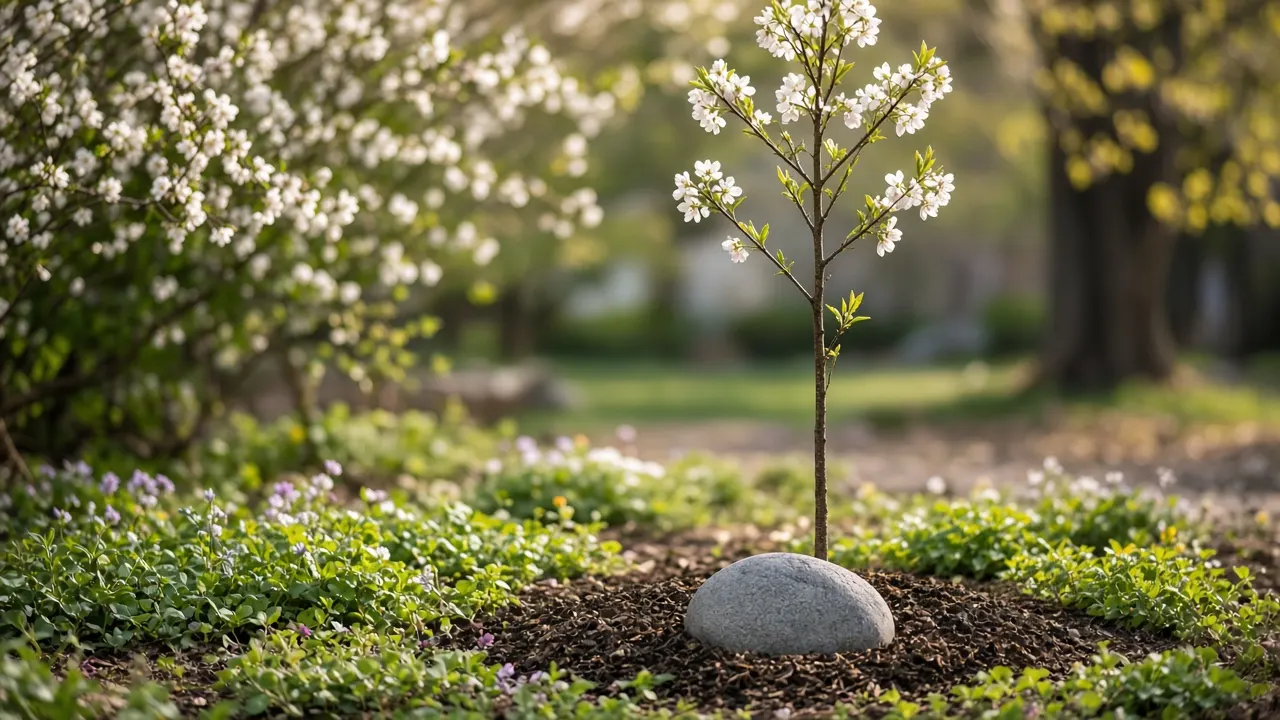
A mild climate like Marina's gives you a wide choice of trees and shrubs, and that's where the risk lies: it's tempting to choose something that looks lovely but is short-lived or grows too big. Think about the spot in twenty years. A small flowering tree, a fruit tree on a dwarfing rootstock or a native shrub suits most yards far better than a forest tree planted beside the house.
Budgeting for a living memorial in Marina
Here's how the pieces add up for a Marina family. Private cremation of a dog averages about $260[6] nationally. A pet bio urn with a seed capsule is sold for about $99[7], and a planting system without the tree for $119[8]. Compost, pine bark and a pH kit add a few dollars more. Ask local providers for a written total before you choose.
The full price table by product is on our California page, and the services page explains what each option includes.

Free tool
Memorial budget planner
Add up cremation, urn, keepsakes and a farewell so the total holds no surprises.
Land, water and permission in California
Two questions cover most situations in California: who owns or manages this land or water, and have they said yes? For your own garden, the answer is you. For a rented home, it's your landlord, in writing. For parks and public water, it's the relevant agency. For a relative's garden, it's them, and it's worth agreeing that the tree stays even if the house is sold.
The official California local government directory lists every county and city office, which is the quickest way to find who to ask in Marina.
The rules that apply across California (home burial, scattering and who oversees pet cremation) are summarized on our California page. Marina may add its own conditions, so check with the city or county before digging.
What to do first, and what can wait for the right season
- If the pet belonged to a child, be straightforward about the death and explain cremation simply, pitched at a level they can understand.
- Let them choose the plant, but from a handful of options you've vetted first for hardiness and for being harmless to the other animals in the house.
- Use a pot for a small pet such as a hamster, rabbit or guinea pig: there's only a small amount of ash, and a pot keeps the memorial close.
- Give them real jobs on the day: blending the compost, scooping it into the pot, watering, picking a stone to paint.
- Explain the ashes honestly as part of their pet that's now feeding the plant, and answer questions as they come, even months later.
- Take a photo of the child with the plant each year on the same date. It becomes a record of both of them growing.
Keeping the memorial alive in Marina
Salt wind and blowing sand from the dunes take a toll on anything left outdoors in Marina, scouring paint and pitting soft stone. Choose polished granite or bronze, and set markers in a sheltered corner of the yard. For a living memorial, coastal natives such as ceanothus or a cypress seedling tolerate the wind better than most, and planting during the winter rains helps them root.
try the free planning tools, For a plain comparison of the choices, open services, there are guides for the big decisions and articles for the details, or see what other families chose in the poll results. If you live between Marina and San Diego, Fresno, Los Angeles and Sacramento, either page applies. Every other community in California, and all of the United States, is listed too.

Reader polls
What would you choose?
Vote anonymously and see how other readers answered. The results are live counts from people who visit this site, so they show real opinions, not a scientific sample.
If you rent or might move, how would you handle a memorial planting?
Tap an answer to vote and see how others answered. Anonymous.
Would you consider releasing your pet's ashes in water?
Tap an answer to vote and see how others answered. Anonymous.
If you had to decide today, which aftercare would you choose for your pet?
Tap an answer to vote and see how others answered. Anonymous.

Free tools to help you plan
Memorial budget planner
Add up cremation, urn, keepsakes and a farewell so the total holds no surprises.

Memorial tree finder
Pick a tree for a planting urn that suits your climate, space and pet.

Aftercare options compared
Compare private, communal and water cremation with burial on cost, timing and what comes home.
Questions people ask
Why does the Marina page quote a human cremation rate?
Because it is the best local signal we have. NFDA 2024 Cremation & Burial Report state projections (via Occasional Sage) (2024) reports about 70.5%[5] of California residents are cremated. There is no official pet equivalent, and inventing one would be worse than quoting a real, clearly labelled number.
Which nearby towns can I compare with Marina?
The closest communities we cover are Seaside (about 5 miles), Monterey (about 8 miles) and Pacific Grove (about 8 miles). Providers based in those places often serve Marina too. Ask each one for a written total that includes collection, so the distance is priced in.
When is the hardest time of year to arrange a burial in Marina?
There is no frozen-ground season here; average lows stay above freezing all year. The other pressure point is September, when highs around 74°F mean a body needs cooling and collecting quickly.
Where are the providers that serve Marina actually based?
Some are local, and some run from San Jose, about 45 miles away. That is normal for a town this size. What matters is the collection time they quote for Marina and whether the drive is priced into the total, so ask both up front.
How long does it take to get ashes back for planting?
Most private cremations return ashes within one to two weeks, and water cremation cycles themselves take 12–20 hours[10], so allow a similar time. In a smaller place, if the cremation happens in a larger centre such as San Jose, it may take a little longer. Planting can wait, so there's no need to rush.
Can I take my pet's ashes on a plane to plant them somewhere else?
Usually, yes. Most airlines let you carry cremated remains in hand luggage, but security staff need to be able to X-ray the container, so a wooden, plastic or cardboard container is easier than a metal urn. Keep the certificate from the crematory with you. Leave any seed pod at home if you're crossing a border that restricts plant material.


Sources and our estimates
- [1] 53% of US households own a dog, which is about 71 million households. American Pet Products Association (APPA) 2025 State of the Industry, 2025.
- [2] US dogs have an average life expectancy at birth of 12.69 years. Montoya et al. 2023, Frontiers in Veterinary Science - Banfield Pet Hospital life expectancy tables (13.3 million dogs, 2.4 million cats, 2013-2019), 2023.
- [3] 39% of US households own a cat, which is about 53 million households. American Pet Products Association (APPA) 2025 State of the Industry, 2025.
- [4] US cats seen at Banfield hospitals have an average life expectancy at birth of 11.18 years. Montoya et al. 2023, Frontiers in Veterinary Science - Banfield Pet Hospital life expectancy tables (13.3 million dogs, 2.4 million cats, 2013-2019), 2023.
- [5] The NFDA projected California's cremation rate at 70.5% for 2024. NFDA 2024 Cremation & Burial Report state projections (via Occasional Sage), 2024.
- [6] CareCredit's 2025 cost study put the US national average for private dog cremation at $260 (range $206-$473). CareCredit (Synchrony) - How Much Does It Cost To Euthanize a Dog? (2025 ASQ360 procedural cost study), 2025.
- [7] The Bios Urn for pets, a biodegradable urn with a seed capsule, costs $99. Bios Urn – Pets, 2026.
- [8] The Living Urn's pet bio-urn planting system (without a tree) costs $119. The Living Urn – Pet tree urn, 2026.
- [9] Switching one human-scale cremation to alkaline hydrolysis saves about 112 kg CO2e under TNO's accounting. Our estimate: 79.9 - (-31.8) kg CO2e. How we calculate.
- [10] A PET-550 aquamation cycle takes 12–20 hours for a single pet and 14–20 hours for segregated or communal cycles, with up to 14 compartments. Bio-Response Solutions — PET-550 Aquamation System product page, 2026.
Tell us about your pet and your garden
Tell us what you need and where you are. We'll reply by email with clear options and prices so you can decide in your own time.