Bio urns and eco memorials in Mountain House
About 780 dogs and cats are lost in Mountain House each year, by our estimate. If you'd like your pet's ashes to grow into a tree or return to the water, this page covers the soil, the season and the cost.
- Planting, garden and water urns compared
- Honest notes on local rules
- Help choosing a native species
Mountain House, California
Living memorials in Mountain House: the local picture
Mountain House homes tend to be newer, with small yards and modern interiors. A clean-lined urn on a shelf, a paw print framed for a hallway, or a small garden stone near the back patio all suit these spaces. If you expect to move again, which is common among newer residents, choose something portable rather than a planting you would have to leave behind.
Because Mountain House is so new, many families here are still building their traditions. A pet's memorial can become part of that, whether it is a tree planted in a new yard, a stone by the front door or a piece of jewelry worn to work. Where several people each want a memento, request separate portions at the time you order.
Horses, cattle, goats and sheep often share the land in the country around Mountain House, and some trees are dangerous to them. Wilted red maple leaves are toxic to horses, and yew is poisonous to most livestock. If the memorial will stand near a pasture or fence line, ask a vet or the local extension office which species are safe for the animals that graze nearby.
With roughly 25,315 residents, Mountain House is the 239th-largest of the 307 California communities we cover. The nearest larger centre is Stockton, about 18 miles (29 km) away, which is where some providers serving Mountain House are based.
Nearby, we also have local pages for Tracy (7 miles, a larger centre), Discovery Bay (10 miles) and Lathrop (12 miles), which can help if your vet or the provider you prefer is based there.
Our estimate
9,300
How many dog- or cat-owning households Mountain House has (estimate)
How we calculated this
25,315 ÷ 2.5 = 10,126 households; × 53% (dog) + 39% (cat) = 9,300. Homes are counted once however many pets they keep.
Our estimate
780
Mountain House families who lose a dog or cat each year (estimate)
How we calculated this
9,300 dog/cat-owning homes ÷ average lifespan (dog: 12.69 yrs + cat: 11.18 yrs) ≈ 780 a year. Treat it as a minimum.
53%[1]
53% of US households own a dog, which is about 71 million households.
12.69 years[2]
US dogs have an average life expectancy at birth of 12.69 years.
39%[3]
39% of US households own a cat, which is about 53 million households.
11.18 years[4]
US cats seen at Banfield hospitals have an average life expectancy at birth of 11.18 years.
If a number here surprises you, the primary material is American Pet Products Association (APPA) 2025 State of the Industry and Montoya et al. 2023, Frontiers in Veterinary Science; we only apply it to this.
Cremation habits in California, and what they mean for a bio urn
In California, about 70.5%[5] of people are cremated, one of the higher rates around. When most human funerals end with ashes, the question "what shall we do with them?" comes up in nearly every family, and a tree, a garden bed or a lake release is a common answer. That familiarity carries over to pets. It also means more crematories to choose from, and more chance that one of them offers water cremation.
Source for the California number: NFDA 2024 Cremation & Burial Report state projections (via Occasional Sage) (2024). Nobody publishes a pet cremation rate for Mountain House, so the human figure is the best local signal available.
Seasons, soil and weather for a memorial in Mountain House
In Mountain House's heat, containers dry out fast. If you're planting a memorial in a pot on a patio or balcony, choose a large, light-colored container, which heats up less than a small dark one, and place it where it gets afternoon shade in June, July, August and September. Use only a small share of the ashes in the pot, water until it drains freely so salts flush out, and check the soil every day in the hottest weeks.
Biodegradable urns are made to break down, and heat and humidity can start that early. In Mountain House, where July highs average about 93°F, keep a paper, cornstarch or coconut-fiber urn indoors, somewhere cool and dry, until the planting day. Don't leave it in a car, a hot shed or a garage through June, July, August and September, or it may soften or split before it reaches the ground.
What a greener goodbye costs in Mountain House
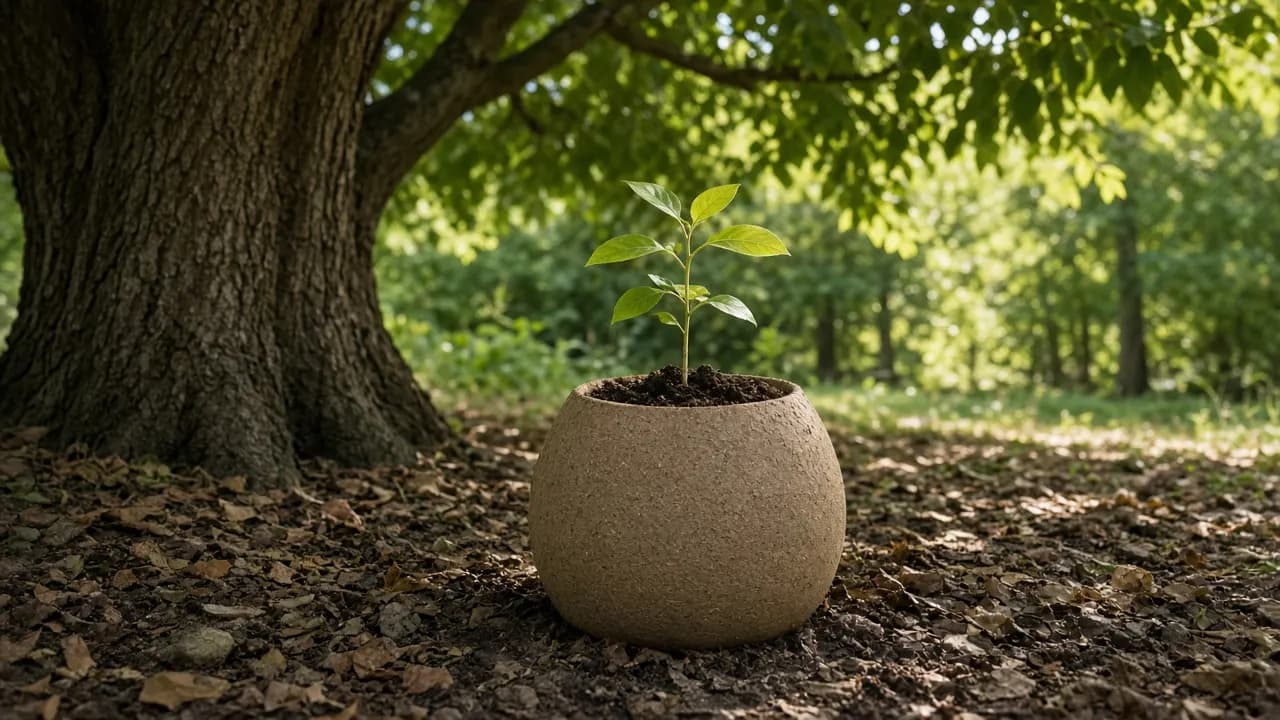
Add up every part before you commit. Beyond the cremation, a living memorial in Mountain House can include the bio urn, compost and bark, a pH kit, the tree or shrub, a guard against deer or rabbits, and perhaps a marker. Our memorial budget planner lists each line so nothing surprises you. Most families find the tree is the cheapest part and the cremation the most expensive.
The full price table by product is on our California page, and the services page explains what each option includes.

Free tool
Memorial budget planner
Add up cremation, urn, keepsakes and a farewell so the total holds no surprises.
Scattering and planting rules in California
Natural burial grounds and some pet cemeteries in California accept ashes in biodegradable urns, and a few ask for nothing else: no plastic, no metal, no varnish. If you're considering one, ask what the urn may be made of, whether a tree or marker is allowed above it, and whether the fee includes looking after the plot.
To find your county or city office in California, start with the official California local government directory.
For California's rules on burying a pet at home or scattering ashes, see the California guide. Local rules in Mountain House can be stricter than the state's, especially in homeowners' associations and rentals.
From ashes to a growing tree: the steps
- If the ashes have been on a shelf for years, you can still plant them. Cremated remains don't spoil, so there's no deadline.
- Open the container carefully somewhere sheltered from wind, and check whether the ashes are in a sealed bag inside.
- Weigh or measure what you have, then use our urn size calculator to see which planting urn or water urn fits.
- Decide whether to keep any back. Having lived with the ashes so long, plenty of families choose to plant the bulk and hold on to a small amount.
- Pick a date that carries meaning, perhaps the day they died or the day they were born, and ask the people who loved them to come.
- Treat the old urn kindly afterwards. A ceramic or wooden urn often finds a second life holding a houseplant or small mementos.
Remembering your pet, in Mountain House and wherever you go next
Hot, windy summers can fade finishes and dry out plantings in Mountain House, while winter fog keeps soil damp. For outdoor memorials, pick stone, bronze or sealed ceramic, and anchor anything lightweight against Altamont gusts. To grow a memorial tree with a biodegradable urn, set it out in late fall and shelter it from the prevailing wind with a fence or wall.
Compare every option on our services page, use the free tools before you ring anyone, the guides answer the longer questions and the blog the newer ones, or see how other readers answered in our polls. If you live between Mountain House and San Diego, San Francisco, Fresno and Los Angeles, either page applies. Every other community in California, and all of the United States, is listed too.

Reader polls
What would you choose?
Vote anonymously and see how other readers answered. The results are live counts from people who visit this site, so they show real opinions, not a scientific sample.
Would you consider releasing your pet's ashes in water?
Tap an answer to vote and see how others answered. Anonymous.
If you rent or might move, how would you handle a memorial planting?
Tap an answer to vote and see how others answered. Anonymous.
If you had to decide today, which aftercare would you choose for your pet?
Tap an answer to vote and see how others answered. Anonymous.

Free tools to help you plan
Memorial budget planner
Add up cremation, urn, keepsakes and a farewell so the total holds no surprises.

Memorial tree finder
Pick a tree for a planting urn that suits your climate, space and pet.

Aftercare options compared
Compare private, communal and water cremation with burial on cost, timing and what comes home.
Questions people ask
Can a provider from a neighbouring town collect from Mountain House?
Usually yes. Tracy is about 7 miles away, Discovery Bay is about 10 miles away and Lathrop is about 12 miles away, all inside a normal collection radius. Get the mileage written into the quote so there is no surprise on the day.
Will I have to travel to Stockton to arrange things?
Not usually. Providers based in Stockton (roughly 18 miles from Mountain House) collect from here as a matter of routine, and the paperwork is done by email or phone. If you want to be present for a witnessed cremation, that is when the drive matters.
Why does the Mountain House page quote a human cremation rate?
Because it is the best local signal we have. NFDA 2024 Cremation & Burial Report state projections (via Occasional Sage) (2024) reports about 70.5%[5] of California residents are cremated. There is no official pet equivalent, and inventing one would be worse than quoting a real, clearly labelled number.
Is Mountain House big enough to have several pet aftercare providers?
Probably, on the numbers. By our estimate about 9,300 Mountain House households keep a dog or cat and around 780 lose one each year, which is enough steady demand to support more than one provider. We derive that from population (about 25,315), household size and national ownership and lifespan figures.
How do I keep a memorial tree alive in the Mountain House heat?
Choose a drought-tolerant species that already grows well locally, plant in the cooler months, and water deeply and slowly rather than little and often, so salts from the ashes move down past the roots. A wide ring of mulch keeps the soil cooler. Expect to water through the first two summers.
How many dogs and cats are there in Mountain House?
By our estimate, about 9,300 households in Mountain House have a dog or a cat, and around 780 of those pets die each year. We calculate this from the city's population, average household size and national pet ownership and lifespan figures. The method is shown on this page, and the real number of animals is higher.


Sources and our estimates
- [1] 53% of US households own a dog, which is about 71 million households. American Pet Products Association (APPA) 2025 State of the Industry, 2025.
- [2] US dogs have an average life expectancy at birth of 12.69 years. Montoya et al. 2023, Frontiers in Veterinary Science - Banfield Pet Hospital life expectancy tables (13.3 million dogs, 2.4 million cats, 2013-2019), 2023.
- [3] 39% of US households own a cat, which is about 53 million households. American Pet Products Association (APPA) 2025 State of the Industry, 2025.
- [4] US cats seen at Banfield hospitals have an average life expectancy at birth of 11.18 years. Montoya et al. 2023, Frontiers in Veterinary Science - Banfield Pet Hospital life expectancy tables (13.3 million dogs, 2.4 million cats, 2013-2019), 2023.
- [5] The NFDA projected California's cremation rate at 70.5% for 2024. NFDA 2024 Cremation & Burial Report state projections (via Occasional Sage), 2024.
- [6] If just 10% of U.S. pet cremations moved to aquamation, about 4,200 t CO2e a year would be avoided. Our estimate: 1.5M x 10% x 31.3 kg x 90% reduction. How we calculate.
Plan a living memorial in Mountain House
Tell us what you need and where you are. We'll reply by email with clear options and prices so you can decide in your own time.