Tree, garden and water memorials in Portola Valley
About 130 dogs and cats are lost in Portola Valley each year, by our estimate. If you'd like your pet's ashes to grow into a tree or return to the water, this page covers the soil, the season and the cost.
- A memorial that moves with you
- Why pure ashes harm young roots
- Written prices you can compare

Portola Valley, California
Living memorials in Portola Valley: the local picture
The Peninsula's mild winters and dry summers are kind to most memorial materials, but deer and burrowing animals are not. A buried urn or biodegradable container should go deep enough that it will not be disturbed, and a flat stone is harder to knock over than an upright one. Rainfall arrives mostly between November and March, which is the easiest season to dig and plant.
Many Portola Valley families have deep ties to Stanford, Silicon Valley and the wider Bay Area, and relatives are often spread across the country. A memorial that divides easily can help: several small keepsake urns, a few pendants holding a trace of ashes, or prints made from one paw or hoof impression. Ask how many cups of ashes to expect, then plan how to share them.
Horses, cattle, goats and sheep often share the land in the country around Portola Valley, and some trees are dangerous to them. Wilted red maple leaves are toxic to horses, and yew is poisonous to most livestock. If the memorial will stand near a pasture or fence line, ask a vet or the local extension office which species are safe for the animals that graze nearby.
About 4,292 people live in Portola Valley, which makes it the 302nd-largest of the 307 California communities we cover. The nearest larger centre is Fremont, about 17 miles (28 km) away, which is where some providers serving Portola Valley are based.
The closest communities we cover are Woodside (3 miles), Los Altos Hills (5 miles) and Menlo Park (6 miles, a larger centre). Providers serving those towns often travel to Portola Valley too, so it can be worth asking them for a quote.
Our estimate
1,600
How many dog- or cat-owning households Portola Valley has (estimate)
How we calculated this
4,292 ÷ 2.5 = 1,717 households; × 53% (dog) + 39% (cat) = 1,600. Homes are counted once however many pets they keep.
Our estimate
130
Portola Valley families who lose a dog or cat each year (estimate)
How we calculated this
1,600 dog/cat-owning homes ÷ average lifespan (dog: 12.69 yrs + cat: 11.18 yrs) ≈ 130 a year. Treat it as a minimum.
53%[1]
53% of US households own a dog, which is about 71 million households.
12.69 years[2]
US dogs have an average life expectancy at birth of 12.69 years.
39%[3]
39% of US households own a cat, which is about 53 million households.
11.18 years[4]
US cats seen at Banfield hospitals have an average life expectancy at birth of 11.18 years.
Sources for the statistics above: Montoya et al. 2023, Frontiers in Veterinary Science and American Pet Products Association (APPA) 2025 State of the Industry.

Cremation habits in California, and what they mean for a bio urn
With a human cremation rate near 70.5%[5], California has plenty of crematories competing for families, and that tends to show in the choice on offer. Ask more than one pet provider what they include. Some return ashes in a simple cardboard or paper tube, some add a wooden urn you may not want, and a few can quote for water cremation. The cheapest honest quote is usually the one you can plant from.
For the California figure we rely on NFDA 2024 Cremation & Burial Report state projections (via Occasional Sage) (2024). Read it as a picture of local custom around death and remembrance in Portola Valley rather than as pet data.
What Portola Valley's climate means for a living memorial
In a gentle climate like Portola Valley's, grass and weeds grow nearly all year, and they compete hard with a young tree for water. Keep a clear circle of bare, mulched soil around the base, at least an arm's length across, for the first three years. It also stops mowers and strimmers from nicking the bark, which is how many young trees are lost.
A mild climate like Portola Valley's gives you a wide choice of trees and shrubs, and that's where the risk lies: it's tempting to choose something that looks lovely but is short-lived or grows too big. Think about the spot in twenty years. A small flowering tree, a fruit tree on a dwarfing rootstock or a native shrub suits most yards far better than a forest tree planted beside the house.
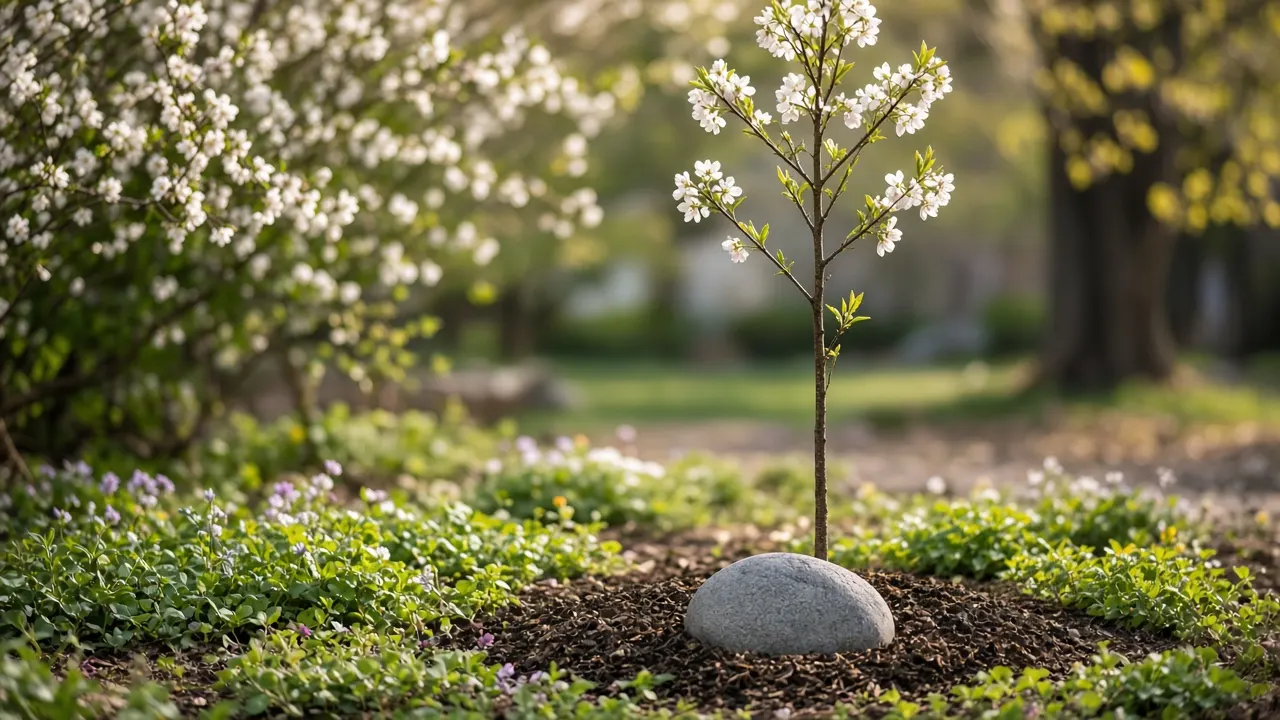
Budgeting for a living memorial in Portola Valley
It helps to compare a planted memorial with the alternatives. A pet cemetery burial for a dog averages about $831[6] in the US, which by our estimate is around 3.2 times the national average for private cremation[7]. Private cremation plus a bio urn and a sapling in your own Portola Valley garden usually comes in far below a cemetery plot, and there are no yearly maintenance fees.
We keep the detailed California price table on one page so it stays current: see California prices.

Free tool
Memorial budget planner
Add up cremation, urn, keepsakes and a farewell so the total holds no surprises.
Land, water and permission in California
What you plant can matter as much as where. Parks and nature reserves in California often forbid planting anything at all, and even on private land some trees and shrubs are listed as invasive in parts of the region. A local nursery or native plant society can steer you toward a species that won't spread into wild land.
California keeps an official directory of local governments; use it to reach the county or city office that covers Portola Valley.
Start with the California rules, which cover burial, scattering and oversight for the whole state, and treat Portola Valley's local ordinances as a possible extra layer.
Your next steps, whatever your situation
- Confirm the ashes will come back. Communal cremation usually means no ashes are returned, and you can't plant what you don't receive.
- Pick the type of bio urn: one that grows a tree, a simple biodegradable urn to bury in a quiet bed, or a floating urn meant for a lake, river or the coast.
- Ask permission before using ground you don't own, whether that's a landlord, a farmer or whoever runs the park.
- Plan for the weather. In Portola Valley, avoid frozen, baked or waterlogged ground; a calm, mild day is best for planting or a release.
- Release gently on water. Rest the urn on the surface, leave it to drift and go under in its own time, and scatter only a few loose petals.
- Come back in a year. Replace mulch, check the tree's growth and take a photo to mark the anniversary.
Keeping your pet's memory growing in Portola Valley
Homes in Portola Valley often sit among oaks and native plantings, so outdoor memorials here should blend in rather than stand out. Natural stone, weathered wood or a low marker set into leaf litter tends to suit the setting. If you are planting a tree urn, consider a native species that will not need summer irrigation. Indoors, a small urn or a framed print can live on a bookshelf without taking over the room.
or see how other readers answered in our polls, look through our guides and the blog, See what each option includes on our services page, run the numbers with the free planning tools. Close to Portola Valley we also cover San Jose, Fresno, San Francisco and Los Angeles; the full list for California and for the United States is a click away.

Reader polls
What would you choose?
Vote anonymously and see how other readers answered. The results are live counts from people who visit this site, so they show real opinions, not a scientific sample.
If water cremation (aquamation) were offered near you, would you choose it?
Tap an answer to vote and see how others answered. Anonymous.
If you rent or might move, how would you handle a memorial planting?
Tap an answer to vote and see how others answered. Anonymous.
If you had to decide today, which aftercare would you choose for your pet?
Tap an answer to vote and see how others answered. Anonymous.

Free tools to help you plan
Memorial budget planner
Add up cremation, urn, keepsakes and a farewell so the total holds no surprises.

Memorial tree finder
Pick a tree for a planting urn that suits your climate, space and pet.

Aftercare options compared
Compare private, communal and water cremation with burial on cost, timing and what comes home.
Questions people ask
Does the Portola Valley climate change what I should do first?
Only the timing. In September, with highs near 75°F, cool the body and book collection the same day. Winters here are mild enough that burial or scattering is possible in any month.
How many pet owners live in Portola Valley?
By our estimate, about 1,600 households in Portola Valley have at least one dog or cat, and around 130 are lost each year. We calculate this from the city's population of about 4,292, the average household size and national ownership and lifespan figures, so treat it as a floor rather than an exact count.
How do California attitudes to cremation compare?
NFDA 2024 Cremation & Burial Report state projections (via Occasional Sage) (2024) puts the California human cremation rate at about 70.5%[5]. We show it on the Portola Valley page because pet aftercare choices tend to track it: where cremation is normal for people, communal and private pet cremation are both easy to find.
Which nearby towns can I compare with Portola Valley?
The closest communities we cover are Woodside (about 3 miles), Los Altos Hills (about 5 miles) and Menlo Park (about 6 miles). Providers based in those places often serve Portola Valley too. Ask each one for a written total that includes collection, so the distance is priced in.
Is it safe to plant a fruit tree with my pet's ashes?
Cremated remains are mostly bone minerals, and once they're thoroughly blended into plenty of compost and garden soil, many gardeners grow fruit trees over them. The high pH and salt are the real concern for the tree, so dilute generously and test the pH. If eating fruit from the memorial feels wrong to anyone in your family, choose an ornamental tree instead.
Will the seed in a tree urn grow?
Not always. Seeds from kits can fail to sprout if they weren't stored or chilled correctly, and alkaline soil around them makes it harder. A young tree from a nursery near Portola Valley is far more reliable, and most planting urns work just as well with a sapling in the top chamber.


Sources and our estimates
- [1] 53% of US households own a dog, which is about 71 million households. American Pet Products Association (APPA) 2025 State of the Industry, 2025.
- [2] US dogs have an average life expectancy at birth of 12.69 years. Montoya et al. 2023, Frontiers in Veterinary Science - Banfield Pet Hospital life expectancy tables (13.3 million dogs, 2.4 million cats, 2013-2019), 2023.
- [3] 39% of US households own a cat, which is about 53 million households. American Pet Products Association (APPA) 2025 State of the Industry, 2025.
- [4] US cats seen at Banfield hospitals have an average life expectancy at birth of 11.18 years. Montoya et al. 2023, Frontiers in Veterinary Science - Banfield Pet Hospital life expectancy tables (13.3 million dogs, 2.4 million cats, 2013-2019), 2023.
- [5] The NFDA projected California's cremation rate at 70.5% for 2024. NFDA 2024 Cremation & Burial Report state projections (via Occasional Sage), 2024.
- [6] CareCredit's 2025 cost study put the US national average for pet cemetery burial of a dog at $831 (range $659-$1,513). CareCredit (Synchrony) - How Much Does It Cost To Euthanize a Dog? (2025 ASQ360 procedural cost study), 2025.
- [7] US pet cemetery burial for a dog costs about 3.2x a private cremation ($831 vs $260 national averages). Our estimate: 831 / 260 = 3.20. How we calculate.
- [8] If just 10% of U.S. pet cremations moved to aquamation, about 4,200 t CO2e a year would be avoided. Our estimate: 1.5M x 10% x 31.3 kg x 90% reduction. How we calculate.
Get bio urn options for Portola Valley
Tell us what you need and where you are. We'll reply by email with clear options and prices so you can decide in your own time.