Tree, garden and water memorials in Saratoga
Roughly 930 Saratoga families say goodbye to a dog or cat each year, by our count. A living memorial is one way to mark it. This guide explains how to make one that actually grows.
- Planting, garden and water urns compared
- Honest notes on local rules
- Help choosing a native species

Saratoga, California
Bio urns, trees and water in Saratoga
Saratoga has a long tradition of gardens, from its Japanese-style public garden to the wooded grounds of its hillside arts estate, and many residents treat their own yards with the same care. A memorial planting, a quiet stone path or a small bench with a plaque can fit naturally. If you might move someday, pair it with a portable keepsake you can bring with you.
Saratoga's cool, damp winters and dry summers are gentle on stone, but shady wooded yards can encourage moss and leaf staining. A darker granite or sealed marker stays legible longer. If you plant a bio urn, a spring planting gives roots time before the dry months, and a native plant or oak seedling will handle hillside conditions with little help.
Many homes around Saratoga rely on a septic system, and tree roots love the moist soil over a drain field. Keep a memorial tree well away from the tank and the leach lines, and choose a smaller shrub if space near the house is tight. Your septic contractor or the permit plan for the property will show where the lines run.
About 30,418 people live in Saratoga, which makes it the 214th-largest of the 307 California communities we cover. The nearest larger centre is San Jose, about 9 miles (15 km) away, which is where some providers serving Saratoga are based.
If you want to compare providers, look at Los Gatos (4 miles), Cupertino (4 miles) and Campbell (4 miles). Distance matters because pickup fees and the time until the ashes come back both grow with the drive.
Our estimate
11,000
How many dog- or cat-owning households Saratoga has (estimate)
How we calculated this
30,418 ÷ 2.5 = 12,167 households; × 53% (dog) + 39% (cat) = 11,000. Multi-pet homes count once.
Our estimate
930
Saratoga families who lose a dog or cat each year (estimate)
How we calculated this
11,000 dog/cat-owning homes ÷ average lifespan (dog: 12.69 yrs + cat: 11.18 yrs) ≈ 930 a year. The real figure is unlikely to be lower.
53%[1]
53% of US households own a dog, which is about 71 million households.
12.69 years[2]
US dogs have an average life expectancy at birth of 12.69 years.
39%[3]
39% of US households own a cat, which is about 53 million households.
11.18 years[4]
US cats seen at Banfield hospitals have an average life expectancy at birth of 11.18 years.
None of the figures on this this page are ours alone: they rest on Montoya et al. 2023, Frontiers in Veterinary Science and American Pet Products Association (APPA) 2025 State of the Industry.

Why cremation culture in California shapes your options
In California, about 70.5%[5] of people are cremated, one of the higher rates around. When most human funerals end with ashes, the question "what shall we do with them?" comes up in nearly every family, and a tree, a garden bed or a lake release is a common answer. That familiarity carries over to pets. It also means more crematories to choose from, and more chance that one of them offers water cremation.
NFDA 2024 Cremation & Burial Report state projections (via Occasional Sage) (2024) is where the California figure comes from. It counts people; we use it because attitudes to cremating a pet in Saratoga tend to follow attitudes to cremation generally.
When to plant in Saratoga's climate
A mild climate like Saratoga's gives you a wide choice of trees and shrubs, and that's where the risk lies: it's tempting to choose something that looks lovely but is short-lived or grows too big. Think about the spot in twenty years. A small flowering tree, a fruit tree on a dwarfing rootstock or a native shrub suits most yards far better than a forest tree planted beside the house.
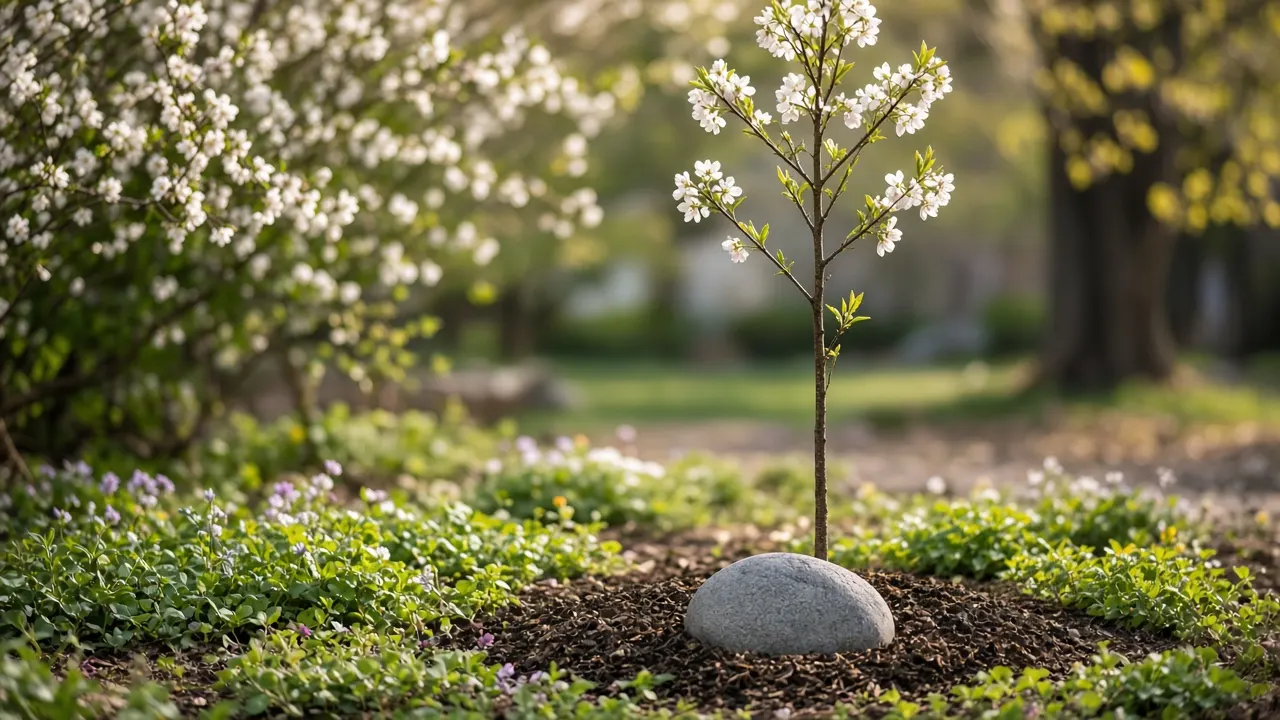
Wet winters are the main hazard for a memorial planting in Saratoga. Around January, heavy soils can stay waterlogged for weeks, and roots sitting in cold, salty water rot easily. If your ground drains slowly, plant on a low mound, raised a little above the surrounding soil, so excess water runs away from the ash blend rather than pooling in it.
Eco memorial prices, from urn to tree
A living memorial in Saratoga has two costs: the cremation and the urn. Biodegradable pet urns are among the cheaper urns you can buy, listed at about $15–$80[6] in one national price guide, and a sapling from a local nursery often costs less than a decorative display urn. If you'd like water cremation, one pet insurer's guide lists aquamation at $80 to $450 depending on size[7]. The table shows published examples.
The California price table breaks costs down by product; our services page explains what sits behind each line.

Free tool
Memorial budget planner
Add up cremation, urn, keepsakes and a farewell so the total holds no surprises.
Who to ask before you plant or scatter in California
Cremated remains aren't a health hazard in the way a body is, which is why planting ashes in your own garden is rarely restricted. Public places are different. Parks, nature reserves, beaches and waterways in California each have a manager with their own policy, and some don't allow scattering or planting at all. A short email before the day saves an awkward conversation.
Not sure which office covers Saratoga? The California local government directory is the official list.
The rules that apply across California (home burial, scattering and who oversees pet cremation) are summarized on our California page. Saratoga may add its own conditions, so check with the city or county before digging.
A simple plan for your pet's eco memorial
- If you're remembering more than one animal, settle at the start on one shared planting or separate ones. Either works, but once the ashes are combined there's no undoing it.
- Label each container clearly with the name and date as it comes back, especially if the ashes return months or years apart.
- Choose a bigger planting area when there are several sets of ashes; a long hedge, a cluster of shrubs or a few fruit trees gives the minerals more ground to disperse into.
- Keep a spoonful of each in its own keepsake, so a family member who was closest to one particular pet has something just for them.
- Plan for the pets still living with you. Fresh soil with the scent of bone in it invites digging, so fence or cover the spot until it has settled.
- Add a marker for each name, or one stone that lists them all, so visitors know who the planting is for.
Keeping your pet's memory growing in Saratoga
Many Saratoga homes sit on large lots with mature gardens, so outdoor memorials are common: an engraved stone near a favorite oak, a small bed of flowers, or a tree planted over a biodegradable urn. Indoors, a hand-turned wooden urn or a framed paw print suits the town's craftsman and ranch-style homes. Ashes jewelry is another way to keep a pet close.
or see how other readers answered in our polls, go deeper with the guides or catch up on recent articles, Our services overview lays out every option side by side, run the numbers with the free planning tools. You can also browse every city in the United States. Nearby, we also cover Los Angeles, Fresno, Sacramento and San Jose, and every city in California.

Reader polls
What would you choose?
Vote anonymously and see how other readers answered. The results are live counts from people who visit this site, so they show real opinions, not a scientific sample.
If water cremation (aquamation) were offered near you, would you choose it?
Tap an answer to vote and see how others answered. Anonymous.
Would you consider releasing your pet's ashes in water?
Tap an answer to vote and see how others answered. Anonymous.
If you had to decide today, which aftercare would you choose for your pet?
Tap an answer to vote and see how others answered. Anonymous.

Free tools to help you plan
Memorial budget planner
Add up cremation, urn, keepsakes and a farewell so the total holds no surprises.

Memorial tree finder
Pick a tree for a planting urn that suits your climate, space and pet.

Aftercare options compared
Compare private, communal and water cremation with burial on cost, timing and what comes home.
Questions people ask
How do California attitudes to cremation compare?
NFDA 2024 Cremation & Burial Report state projections (via Occasional Sage) (2024) puts the California human cremation rate at about 70.5%[5]. We show it on the Saratoga page because pet aftercare choices tend to track it: where cremation is normal for people, communal and private pet cremation are both easy to find.
How many pet owners live in Saratoga?
By our estimate, about 11,000 households in Saratoga have at least one dog or cat, and around 930 are lost each year. We calculate this from the city's population of about 30,418, the average household size and national ownership and lifespan figures, so treat it as a floor rather than an exact count.
Where are the providers that serve Saratoga actually based?
Some are local, and some run from San Jose, about 9 miles away. That is normal for a town this size. What matters is the collection time they quote for Saratoga and whether the drive is priced into the total, so ask both up front.
Can a provider from a neighbouring town collect from Saratoga?
Usually yes. Los Gatos is about 4 miles away, Cupertino is about 4 miles away and Campbell is about 4 miles away, all inside a normal collection radius. Get the mileage written into the quote so there is no surprise on the day.
Can I scatter my pet's ashes in a park in Saratoga?
Usually only with permission, and some parks don't allow it at all. Parks are managed by a city, county, state or national agency, each with its own policy, and many were written for human ashes. Contact the park office, explain it's a small amount of pet ash, and ask whether there's a preferred spot.
What happens to the memorial tree if I move away from Saratoga?
It stays with the land, and ashes mixed into soil can't be recovered. If a move is possible, plant in a large container, plant at a relative's home, or keep a small portion of the ashes back for a future garden. Cuttings from many shrubs root easily, so you can take a piece of the plant with you.


Sources and our estimates
- [1] 53% of US households own a dog, which is about 71 million households. American Pet Products Association (APPA) 2025 State of the Industry, 2025.
- [2] US dogs have an average life expectancy at birth of 12.69 years. Montoya et al. 2023, Frontiers in Veterinary Science - Banfield Pet Hospital life expectancy tables (13.3 million dogs, 2.4 million cats, 2013-2019), 2023.
- [3] 39% of US households own a cat, which is about 53 million households. American Pet Products Association (APPA) 2025 State of the Industry, 2025.
- [4] US cats seen at Banfield hospitals have an average life expectancy at birth of 11.18 years. Montoya et al. 2023, Frontiers in Veterinary Science - Banfield Pet Hospital life expectancy tables (13.3 million dogs, 2.4 million cats, 2013-2019), 2023.
- [5] The NFDA projected California's cremation rate at 70.5% for 2024. NFDA 2024 Cremation & Burial Report state projections (via Occasional Sage), 2024.
- [6] Memorials.com's pet urn cost guide puts biodegradable pet urns at $15–$80. Memorials.com – Pet Urn Cost Guide, 2025.
- [7] Embrace Pet Insurance lists US communal cremation at $30-$200, partitioned at $50-$250, private at $100-$500+ and aquamation at $80-$450. Embrace Pet Insurance - Bury or Cremate Your Dog? Costs, Pros & Cons, 2025.
- [8] U.S. pet flame cremations emit on the order of 47,000 t CO2e a year. Our estimate: 1.5M pet cremations x 31.3 kg CO2e. How we calculate.
Plan a living memorial in Saratoga
Tell us what you need and where you are. We'll reply by email with clear options and prices so you can decide in your own time.