A living memorial for your pet in Clayton
By our estimate, around 12,000 households in Clayton share their home with a dog or cat, and roughly 1,000 of those pets die each year. More of those families now ask about planting or water memorials. Here's how to do it well.
- When to plant in your season
- How much ash your urn must hold
- Aquamation providers in your area

Clayton, North Carolina
Planning a greener goodbye in Clayton
Dividing ashes is common among Clayton families whose grown children live in Raleigh, Charlotte or out of state. Tiny keepsake vessels, lockets and fused-glass pieces let several people hold a share. Ask each maker exactly how many teaspoons their item needs before anything is portioned out, and only then choose the main container, so it fits what genuinely remains rather than the whole original volume.
Red clay soil and sticky summers punish most things placed outside in Clayton yards. Cast concrete often grows dark mildew under shrubs, and untreated pine plaques split within a few seasons. Polished granite or glazed stoneware keeps its looks far longer. Should you prefer planting, a flowering dogwood or eastern redbud takes readily to Piedmont ground and flowers every April in memory.
Many people near Clayton have a lake, pond or river they walked with their dog every day. A water-soluble urn released there can feel exactly right. Before you do it, check who owns or manages the water: a private pond needs the owner's say-so, a public lake is usually managed by a state or county agency, and some reservoirs supply drinking water and don't allow anything to be released. Choose a quiet time and let nothing float away.
Clayton is home to about 32,633 people, the 37th-largest of the 64 North Carolina communities we cover. The nearest larger centre is Raleigh, about 14 miles (22 km) away, which is where some providers serving Clayton are based.
The closest communities we cover are Knightdale (10 miles), Garner (10 miles) and Wendell (11 miles). Providers serving those towns often travel to Clayton too, so it can be worth asking them for a quote.
Our estimate
12,000
Estimated dog- or cat-owning households in Clayton
How we calculated this
32,633 ÷ 2.5 = 13,053 households; × 53% (dog) + 39% (cat) = 12,000. Homes are counted once however many pets they keep.
Our estimate
1,000
Estimated dog and cat losses in Clayton each year
How we calculated this
12,000 dog/cat-owning homes ÷ average lifespan (dog: 12.69 yrs + cat: 11.18 yrs) ≈ 1,000 a year. The real figure is unlikely to be lower.
53%[1]
53% of US households own a dog, which is about 71 million households.
12.69 years[2]
US dogs have an average life expectancy at birth of 12.69 years.
39%[3]
39% of US households own a cat, which is about 53 million households.
11.18 years[4]
US cats seen at Banfield hospitals have an average life expectancy at birth of 11.18 years.
Where these figures come from: Montoya et al. 2023, Frontiers in Veterinary Science and American Pet Products Association (APPA) 2025 State of the Industry.

Cremation, burial and green choices in North Carolina
Cremation and burial are both familiar in North Carolina, where about 57.3%[5] of people are cremated. For many families that means a pet's aftercare starts with a question of tradition: bury in the yard as earlier generations did, or cremate and keep the ashes. A bio urn sits happily between the two. It returns the ashes to the earth like a burial, but without a large grave, and it can be planted in a spot you choose later.
For the North Carolina figure we rely on NFDA 2024 Cremation & Burial Report state projections (via Occasional Sage) (2024). Read it as a picture of local custom around death and remembrance in Clayton rather than as pet data.
Clayton seasons and your memorial tree
Biodegradable urns are made to break down, and heat and humidity can start that early. In Clayton, where July highs average about 91°F, keep a paper, cornstarch or coconut-fiber urn indoors, somewhere cool and dry, until the planting day. Don't leave it in a car, a hot shed or a garage through June, July and August, or it may soften or split before it reaches the ground.
Summer water can be busy or unsafe in hot places. Around Clayton, shorelines are crowded in July, and some lakes close for algae blooms in the heat. For a lake or river goodbye, pick a cooler month or go at first light, check for any water-quality notices, and choose a spot where you can reach the water easily without slipping.
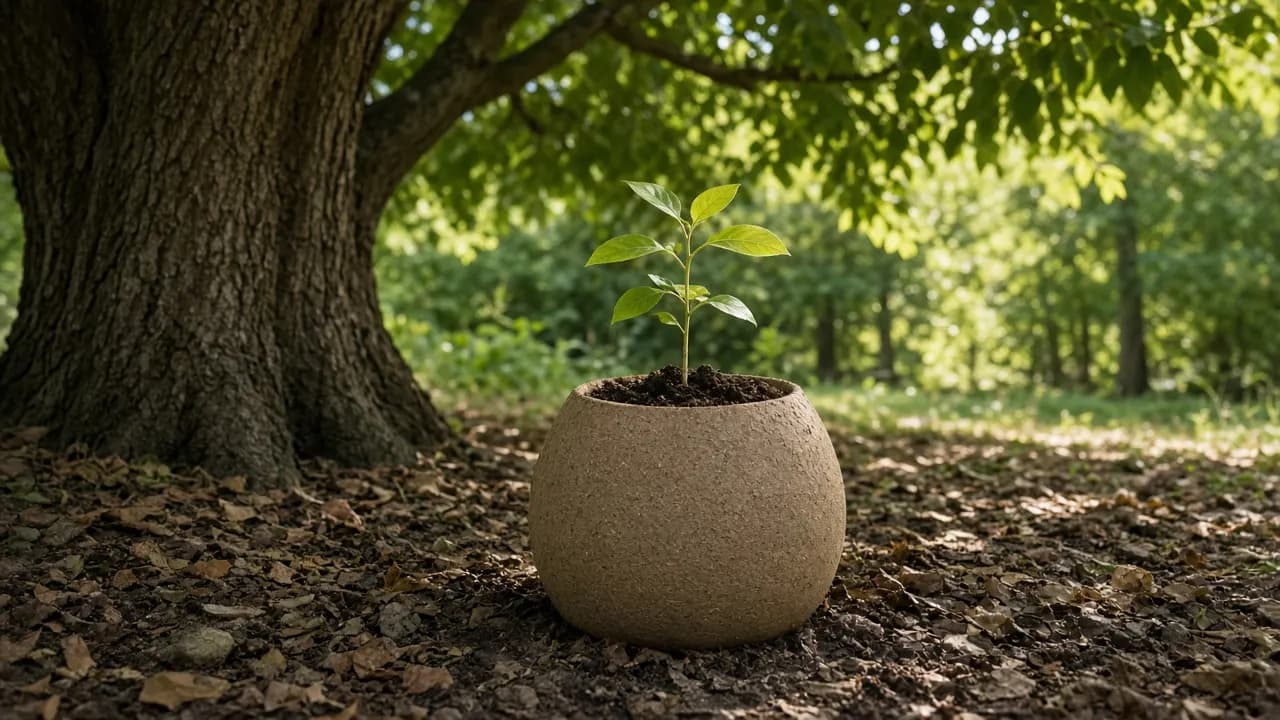
Price ranges for planting and water urns
It helps to compare a planted memorial with the alternatives. A pet cemetery burial for a dog averages about $831[6] in the US, which by our estimate is around 3.2 times the national average for private cremation[7]. Private cremation plus a bio urn and a sapling in your own Clayton garden usually comes in far below a cemetery plot, and there are no yearly maintenance fees.
For a line-by-line price table, see the North Carolina overview; for what's included in each option, see our services.

Free tool
Memorial budget planner
Add up cremation, urn, keepsakes and a farewell so the total holds no surprises.
Scattering and planting rules in North Carolina
Two questions cover most situations in North Carolina: who owns or manages this land or water, and have they said yes? For your own garden, the answer is you. For a rented home, it's your landlord, in writing. For parks and public water, it's the relevant agency. For a relative's garden, it's them, and it's worth agreeing that the tree stays even if the house is sold.
Not sure which office covers Clayton? The North Carolina local government directory is the official list.
The rules that apply across North Carolina (home burial, scattering and who oversees pet cremation) are summarized on our North Carolina page. Clayton may add its own conditions, so check with the city or county before digging.
Planting a memorial in Clayton, step by step
- If the pet belonged to a child, be straightforward about the death and explain cremation simply, pitched at a level they can understand.
- Let them choose the plant, but from a handful of options you've vetted first for hardiness and for being harmless to the other animals in the house.
- Use a pot for a small pet such as a hamster, rabbit or guinea pig: there's only a small amount of ash, and a pot keeps the memorial close.
- Give them real jobs on the day: filling the pot, mixing the soil, watering, choosing a painted stone.
- Explain the ashes honestly as part of their pet that's now feeding the plant, and answer questions as they come, even months later.
- Take a photo of the child with the plant each year on the same date. It becomes a record of both of them growing.
Living memorials beyond the backyard
A lot of Clayton families unpacked here only recently, and plenty expect another move before long. That argues for a remembrance piece that packs easily: an engraved wooden box, a compact ceramic vessel, even a pendant. For something for the garden, a modest flat stone you could lift into a car trunk suits a rental or starter home better than a heavy statue bolted to a slab.
run the numbers with the free planning tools, See what each option includes on our services page, or see how other readers answered in our polls, go deeper with the guides or catch up on recent articles. Close to Clayton we also cover Greensboro, Fayetteville, Raleigh and Durham; the full list for North Carolina and for the United States is a click away.

Reader polls
What would you choose?
Vote anonymously and see how other readers answered. The results are live counts from people who visit this site, so they show real opinions, not a scientific sample.
What kind of tree or plant would you choose?
Tap an answer to vote and see how others answered. Anonymous.
Would you consider releasing your pet's ashes in water?
Tap an answer to vote and see how others answered. Anonymous.
If you had to decide today, which aftercare would you choose for your pet?
Tap an answer to vote and see how others answered. Anonymous.

Free tools to help you plan
Memorial budget planner
Add up cremation, urn, keepsakes and a farewell so the total holds no surprises.

Memorial tree finder
Pick a tree for a planting urn that suits your climate, space and pet.

Aftercare options compared
Compare private, communal and water cremation with burial on cost, timing and what comes home.
Questions people ask
Is cremation common in North Carolina?
For people, yes: about 57.3%[5] of North Carolina deaths end in cremation, according to NFDA 2024 Cremation & Burial Report state projections (via Occasional Sage) (2024). Nobody publishes the same figure for pets, but in our experience pet choices in Clayton follow the human pattern closely, so cremation is the default most families here start from.
Will I have to travel to Raleigh to arrange things?
Not usually. Providers based in Raleigh (roughly 14 miles from Clayton) collect from here as a matter of routine, and the paperwork is done by email or phone. If you want to be present for a witnessed cremation, that is when the drive matters.
Can a provider from a neighbouring town collect from Clayton?
Usually yes. Knightdale is about 10 miles away, Garner is about 10 miles away and Wendell is about 11 miles away, all inside a normal collection radius. Get the mileage written into the quote so there is no surprise on the day.
Does the Clayton climate change what I should do first?
Only the timing. In July, with highs near 91°F, cool the body and book collection the same day. In January, when lows sit below freezing, a home burial may have to wait for a thaw, so cremation with ashes returned keeps your options open.
What happens to the memorial tree if I move away from Clayton?
It stays with the land, and ashes mixed into soil can't be recovered. If a move is possible, plant in a large container, plant at a relative's home, or keep a small portion of the ashes back for a future garden. Cuttings from many shrubs root easily, so you can take a piece of the plant with you.
Can I scatter my pet's ashes in a park in Clayton?
Usually only with permission, and some parks don't allow it at all. Parks are managed by a city, county, state or national agency, each with its own policy, and many were written for human ashes. Contact the park office, explain it's a small amount of pet ash, and ask whether there's a preferred spot.


Sources and our estimates
- [1] 53% of US households own a dog, which is about 71 million households. American Pet Products Association (APPA) 2025 State of the Industry, 2025.
- [2] US dogs have an average life expectancy at birth of 12.69 years. Montoya et al. 2023, Frontiers in Veterinary Science - Banfield Pet Hospital life expectancy tables (13.3 million dogs, 2.4 million cats, 2013-2019), 2023.
- [3] 39% of US households own a cat, which is about 53 million households. American Pet Products Association (APPA) 2025 State of the Industry, 2025.
- [4] US cats seen at Banfield hospitals have an average life expectancy at birth of 11.18 years. Montoya et al. 2023, Frontiers in Veterinary Science - Banfield Pet Hospital life expectancy tables (13.3 million dogs, 2.4 million cats, 2013-2019), 2023.
- [5] The NFDA projected North Carolina's cremation rate at 57.3% for 2024. NFDA 2024 Cremation & Burial Report state projections (via Occasional Sage), 2024.
- [6] CareCredit's 2025 cost study put the US national average for pet cemetery burial of a dog at $831 (range $659-$1,513). CareCredit (Synchrony) - How Much Does It Cost To Euthanize a Dog? (2025 ASQ360 procedural cost study), 2025.
- [7] US pet cemetery burial for a dog costs about 3.2x a private cremation ($831 vs $260 national averages). Our estimate: 831 / 260 = 3.20. How we calculate.
- [8] U.S. pet flame cremations emit on the order of 47,000 t CO2e a year. Our estimate: 1.5M pet cremations x 31.3 kg CO2e. How we calculate.
Get eco memorial ideas by email
Tell us what you need and where you are. We'll reply by email with clear options and prices so you can decide in your own time.