Bio urns and eco memorials in Garner
Roughly 1,250 Garner families say goodbye to a dog or cat each year, by our count. A living memorial is one way to mark it. This guide explains how to make one that actually grows.
- Planting, garden and water urns compared
- Honest notes on local rules
- Help choosing a native species

Garner, North Carolina
What an eco memorial looks like in Garner
Garner families tend to favor low-key memorials that fit ordinary suburban routines: a lidded box on a hallway shelf, a flat stone among the hostas, or a paw print impression hung near the back door. When grown children or grandparents would like a share, ask the provider to prepare several small portions at the time you book, rather than dividing ashes later.
The trails around Lake Benson, and the greenway links running toward Raleigh, give some Garner families a meaningful place to remember a pet. Town parks generally expect you to ask before scattering, so check first with the parks office. If you do scatter, fill a locket or tiny urn beforehand; having a little of your animal close can matter on birthdays and anniversaries.
Many homes around Garner rely on a septic system, and tree roots love the moist soil over a drain field. Keep a memorial tree well away from the tank and the leach lines, and choose a smaller shrub if space near the house is tight. Your septic contractor or the permit plan for the property will show where the lines run.
With roughly 41,562 residents, Garner is the 29th-largest of the 64 North Carolina communities we cover. Some of the providers who serve Garner are based about 6 miles away in Raleigh, the nearest larger centre, so collection times reflect that drive.
The closest communities we cover are Raleigh (6 miles, a larger centre), Knightdale (10 miles) and Clayton (10 miles). Providers serving those towns often travel to Garner too, so it can be worth asking them for a quote.
Our estimate
15,500
Garner: dog- or cat-owning households, our estimate
How we calculated this
41,562 ÷ 2.5 = 16,625 households; × 53% (dog) + 39% (cat) = 15,500. A household with several pets counts once.
Our estimate
1,250
Garner families who lose a dog or cat each year (estimate)
How we calculated this
15,500 dog/cat-owning homes ÷ average lifespan (dog: 12.69 yrs + cat: 11.18 yrs) ≈ 1,250 a year. The real figure is unlikely to be lower.
53%[1]
53% of US households own a dog, which is about 71 million households.
12.69 years[2]
US dogs have an average life expectancy at birth of 12.69 years.
39%[3]
39% of US households own a cat, which is about 53 million households.
11.18 years[4]
US cats seen at Banfield hospitals have an average life expectancy at birth of 11.18 years.
The published sources behind those figures are American Pet Products Association (APPA) 2025 State of the Industry and Montoya et al. 2023, Frontiers in Veterinary Science.

Cremation, burial and green choices in North Carolina
About 57.3%[5] of people who die in North Carolina are cremated. That's a human statistic, but it shapes local services: in places where cremation is common but not dominant, there are usually enough crematories to compare, while greener options like water cremation may be less widespread. It's worth asking any provider directly whether they offer aquamation, and whether the ashes come back in a simple container you can plant from.
The North Carolina figure comes from NFDA 2024 Cremation & Burial Report state projections (via Occasional Sage) (2024). It describes people, not pets, so read it as a sign of local attitudes rather than a pet statistic.
Garner seasons and your memorial tree
In a hot climate like Garner's, with highs of about 91°F in July, salt is a bigger problem than in wetter places. Rain is what washes sodium from ashes down past the roots, and dry heat lets it build up near the surface. Mix the ashes through a much larger volume of soil and compost than you'd think necessary, and water deeply and slowly after planting so salts move down, not up.
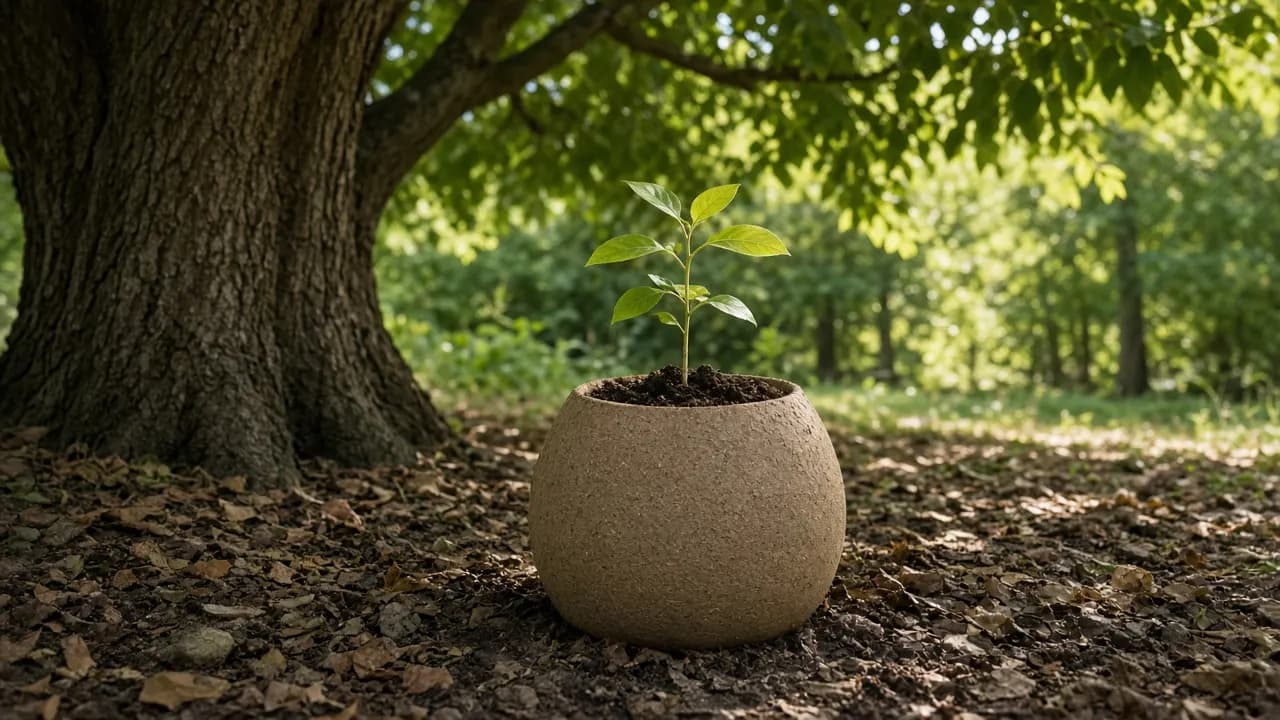
Heat narrows the tree list in Garner. Months like June, July and August bring sustained highs, so choose species that already cope locally: drought-tolerant natives, or trees a local nursery recommends for full sun. A seed from a planting kit, bred somewhere cooler, is a gamble here. Plant a sturdy nursery sapling instead, mulch a wide ring around it and plan to water it through its first two summers.
What a greener goodbye costs in Garner
It helps to compare a planted memorial with the alternatives. A pet cemetery burial for a dog averages about $831[6] in the US, which by our estimate is around 3.2 times the national average for private cremation[7]. Private cremation plus a bio urn and a sapling in your own Garner garden usually comes in far below a cemetery plot, and there are no yearly maintenance fees.
For a line-by-line price table, see the North Carolina overview; for what's included in each option, see our services.

Free tool
Memorial budget planner
Add up cremation, urn, keepsakes and a farewell so the total holds no surprises.
Who to ask before you plant or scatter in North Carolina
Rules about ashes were mostly written for people, and pet ashes often sit in a grey area. That's a reason to ask, not a reason to assume. On land you own, planting or burying ashes is generally fine. Anywhere else in North Carolina, from parks to beaches to a friend's field, the land manager or owner decides, so ask first.
Not sure which office covers Garner? The North Carolina local government directory is the official list.
The North Carolina page sets out who oversees pet cremation and what the state says about burial and scattering. Garner's own bylaws can sit on top of that, so ask before you dig.
What to do first, and what can wait for the right season
- If you're remembering more than one animal, settle at the start on one shared planting or separate ones. Either works, but once the ashes are combined there's no undoing it.
- Label each container clearly the moment it arrives, name and date on the lid, which matters most when the sets come home a long way apart.
- Choose a bigger planting area for several sets of ashes: a hedge, a group of shrubs or a small orchard spreads the mineral load across more soil.
- Keep a spoonful of each in separate keepsakes if anyone in the family wants to remember one animal on its own.
- Plan for the pets still living with you. A new planting that smells of bone attracts diggers, so protect it for the first few months.
- Add a marker for each name, or a single stone carrying all of them, so anyone visiting understands who is remembered there.
Ways to mark the spot and the date
For outdoor memorials in Garner's humid heat, granite and bronze hold up far better than painted concrete or plastic ornaments. A crape myrtle or dogwood set over a biodegradable urn can grow into a living memorial within a few seasons. If you expect to move elsewhere in the Triangle before long, a large glazed pot lets the planting come too.
run the numbers with the free planning tools, Compare every option on our services page, or compare your instinct with the poll results, look through our guides and the blog. Close to Garner we also cover Fayetteville, Durham, Greensboro and Charlotte; the full list for North Carolina and for the United States is a click away.

Reader polls
What would you choose?
Vote anonymously and see how other readers answered. The results are live counts from people who visit this site, so they show real opinions, not a scientific sample.
If water cremation (aquamation) were offered near you, would you choose it?
Tap an answer to vote and see how others answered. Anonymous.
If you rent or might move, how would you handle a memorial planting?
Tap an answer to vote and see how others answered. Anonymous.
If you had to decide today, which aftercare would you choose for your pet?
Tap an answer to vote and see how others answered. Anonymous.

Free tools to help you plan
Memorial budget planner
Add up cremation, urn, keepsakes and a farewell so the total holds no surprises.

Memorial tree finder
Pick a tree for a planting urn that suits your climate, space and pet.

Aftercare options compared
Compare private, communal and water cremation with burial on cost, timing and what comes home.
Questions people ask
Is cremation common in North Carolina?
For people, yes: about 57.3%[5] of North Carolina deaths end in cremation, according to NFDA 2024 Cremation & Burial Report state projections (via Occasional Sage) (2024). Nobody publishes the same figure for pets, but in our experience pet choices in Garner follow the human pattern closely, so cremation is the default most families here start from.
Can a provider from a neighbouring town collect from Garner?
Usually yes. Raleigh is about 6 miles away, Knightdale is about 10 miles away and Clayton is about 10 miles away, all inside a normal collection radius. Get the mileage written into the quote so there is no surprise on the day.
When is the hardest time of year to arrange a burial in Garner?
January: average lows are below freezing then, and frozen ground makes a home grave slow or impossible until it thaws. The other pressure point is July, when highs around 91°F mean a body needs cooling and collecting quickly.
How many pet owners live in Garner?
By our estimate, about 15,500 households in Garner have at least one dog or cat, and around 1,250 are lost each year. We calculate this from the city's population of about 41,562, the average household size and national ownership and lifespan figures, so treat it as a floor rather than an exact count.
I rent in Garner. Can I still have a living memorial?
Yes. Plant in a large container, such as a half-barrel or a big pot with a dwarf tree or flowering shrub, and it moves with you. Use only a small share of the ashes in the pot, well mixed with compost. If you'd like to plant in a rented yard, get the landlord's permission in writing, and remember the tree stays when you leave.
How much does pet aquamation cost?
One US pet insurer's guide lists aquamation at $80 to $450 depending on size[9]. As a real example, a Delaware provider charges $150–$450[10] for private aquamation by weight, including a standard urn, and $50–$225[11] for communal. Prices in Garner depend on who offers it, so ask for a written total.


Sources and our estimates
- [1] 53% of US households own a dog, which is about 71 million households. American Pet Products Association (APPA) 2025 State of the Industry, 2025.
- [2] US dogs have an average life expectancy at birth of 12.69 years. Montoya et al. 2023, Frontiers in Veterinary Science - Banfield Pet Hospital life expectancy tables (13.3 million dogs, 2.4 million cats, 2013-2019), 2023.
- [3] 39% of US households own a cat, which is about 53 million households. American Pet Products Association (APPA) 2025 State of the Industry, 2025.
- [4] US cats seen at Banfield hospitals have an average life expectancy at birth of 11.18 years. Montoya et al. 2023, Frontiers in Veterinary Science - Banfield Pet Hospital life expectancy tables (13.3 million dogs, 2.4 million cats, 2013-2019), 2023.
- [5] The NFDA projected North Carolina's cremation rate at 57.3% for 2024. NFDA 2024 Cremation & Burial Report state projections (via Occasional Sage), 2024.
- [6] CareCredit's 2025 cost study put the US national average for pet cemetery burial of a dog at $831 (range $659-$1,513). CareCredit (Synchrony) - How Much Does It Cost To Euthanize a Dog? (2025 ASQ360 procedural cost study), 2025.
- [7] US pet cemetery burial for a dog costs about 3.2x a private cremation ($831 vs $260 national averages). Our estimate: 831 / 260 = 3.20. How we calculate.
- [8] If just 10% of U.S. pet cremations moved to aquamation, about 4,200 t CO2e a year would be avoided. Our estimate: 1.5M x 10% x 31.3 kg x 90% reduction. How we calculate.
- [9] Embrace Pet Insurance lists US communal cremation at $30-$200, partitioned at $50-$250, private at $100-$500+ and aquamation at $80-$450. Embrace Pet Insurance - Bury or Cremate Your Dog? Costs, Pros & Cons, 2025.
- [10] Delaware Pet Aquamation charges $150–$450 for private aquamation by weight, from under 10 lb to 150 lb and over, including a standard urn. Delaware Pet Aquamation – Pricing, 2026.
- [11] Communal aquamation at the same Delaware provider costs $50–$225 by weight. Delaware Pet Aquamation – Pricing, 2026.
Get eco memorial ideas by email
Tell us what you need and where you are. We'll reply by email with clear options and prices so you can decide in your own time.