Greener pet aftercare in Red Oak, Texas
Roughly 630 Red Oak families say goodbye to a dog or cat each year, by our count. A living memorial is one way to mark it. This guide explains how to make one that actually grows.
- A memorial that moves with you
- Why pure ashes harm young roots
- Written prices you can compare

Red Oak, Texas
Living memorials in Red Oak: the local picture
Plenty of Red Oak households have parents, siblings or grown children elsewhere around the Metroplex who shared holidays with the family pet. Cremation lets everyone have a part in remembering: ashes can stay in one home, be divided into several small keepsakes, or wait until everyone settles on a place. Say at the outset if you plan to share them.
Newer Red Oak subdivisions often come with modest back yards and homeowners' association guidelines, while the older parts of town have deep lots and big pecan or oak trees. A granite marker in the shade suits one setting; an urn on a living-room shelf suits the other. Many families choose based on which room or corner they walk past every single day.
Getting a bio urn in Red Oak is mostly a matter of ordering online, but getting the soil right is a local job. Ask a nursery or your county extension office whether the ground is chalky, clay or sandy. Clay holds salts near the roots and drains poorly, so dig a wider hole and mix in more compost. Sandy soil drains well but holds little, so water the young tree more often in its first summers.
With roughly 20,394 residents, Red Oak is the 148th-largest of the 325 Texas communities we cover. Grand Prairie, roughly 17 miles off, is the closest larger centre, and a share of the providers who cover Red Oak run from there.
Our pages for Glenn Heights (4 miles), Lancaster (6 miles) and DeSoto (7 miles, a larger centre) describe the same choices from those towns' point of view, and the providers overlap, so a quote from one often covers Red Oak as well.
Our estimate
7,500
Estimated dog- or cat-owning households in Red Oak
How we calculated this
20,394 ÷ 2.5 = 8,158 households; × 53% (dog) + 39% (cat) = 7,500. Multi-pet homes count once.
Our estimate
630
Red Oak families who lose a dog or cat each year (estimate)
How we calculated this
7,500 dog/cat-owning homes ÷ average lifespan (dog: 12.69 yrs + cat: 11.18 yrs) ≈ 630 a year. Treat it as a minimum.
53%[1]
53% of US households own a dog, which is about 71 million households.
12.69 years[2]
US dogs have an average life expectancy at birth of 12.69 years.
39%[3]
39% of US households own a cat, which is about 53 million households.
11.18 years[4]
US cats seen at Banfield hospitals have an average life expectancy at birth of 11.18 years.
The published sources behind those figures are Montoya et al. 2023, Frontiers in Veterinary Science and American Pet Products Association (APPA) 2025 State of the Industry.

The local attitude to ashes and memorials
The human cremation rate in Texas sits around 55.7%[5], so many families have a foot in both camps, and generations can disagree. Grandparents may expect a grave in the yard; younger relatives may want ashes they can take with them. Talking it through before the vet asks you to choose saves a hard conversation on a hard day. A tree over buried ashes often satisfies both sides.
We take the Texas rate from NFDA 2024 Cremation & Burial Report state projections (via Occasional Sage) (2024). It is a human statistic; there is no equivalent pet figure for Red Oak, and we would rather show a real number than invent one.
When to plant in Red Oak's climate
Red Oak summers are hard on young trees: August averages highs around 97°F. Don't plant a memorial tree in the hottest months. Aim for the cooler part of the year, when roots can grow before the next summer arrives. Ashes don't need to go into the ground quickly, so keeping them safely at home for a few months is completely fine.
Biodegradable urns are made to break down, and heat and humidity can start that early. In Red Oak, where August highs average about 97°F, keep a paper, cornstarch or coconut-fiber urn indoors, somewhere cool and dry, until the planting day. Don't leave it in a car, a hot shed or a garage through June, July, August and September, or it may soften or split before it reaches the ground.
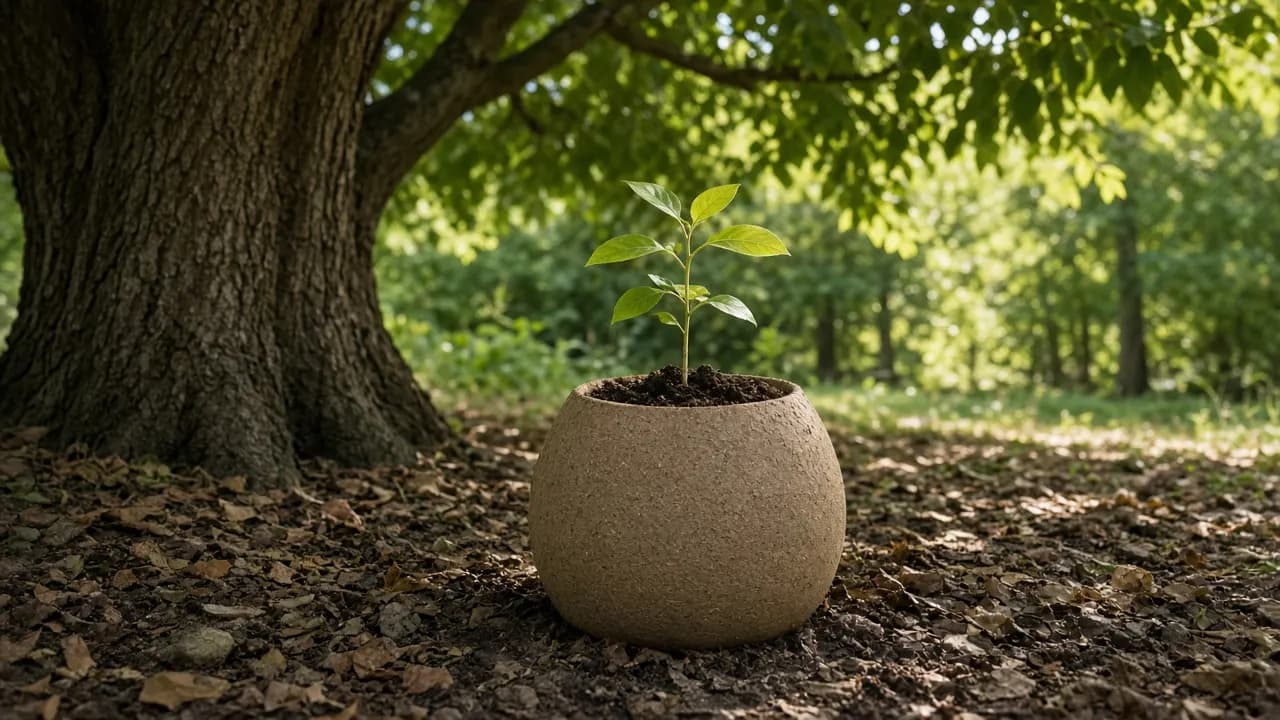
Eco memorial prices, from urn to tree
Here's how the pieces add up for a Red Oak family. Private cremation of a dog averages about $260[6] nationally. A pet bio urn with a seed capsule is sold for about $99[7], and a planting system without the tree for $119[8]. Compost, pine bark and a pH kit add a few dollars more. Ask local providers for a written total before you choose.
The full price table by product is on our Texas page, and the services page explains what each option includes.

Free tool
Memorial budget planner
Add up cremation, urn, keepsakes and a farewell so the total holds no surprises.
What Texas allows for ashes, in general terms
Water releases need a little more care than a garden planting. Rivers, lakes, reservoirs and coastal waters in Texas are managed by different bodies, and drinking-water sources are often off-limits. Wherever you release, use only a water-soluble urn or loose ashes, add nothing but loose flower petals, and let no plastic, ribbon or wreath wire float away.
To find your county or city office in Texas, start with the official Texas local government directory.
Home burial and scattering are governed at the Texas level first; our Texas rules summary has the detail. Then check whether Red Oak or your HOA adds anything.
From ashes to a growing tree: the steps
- If euthanasia is planned, find out from the practice beforehand which crematory handles their aftercare and whether aquamation is available through them.
- Book the aftercare before the appointment, so on the day itself you only have to be with your pet.
- Ask for a paw print or nose print before cremation if you'd like one. It can't be made afterwards.
- Choose the plant in advance when that feels easier. Knowing the exact spot their pet is headed for brings some families real comfort.
- Skip the display urn. A simple box or tube from the crematory is all a planting needs, and the saving can go toward the tree or shrub.
- Prepare the soil blend while you wait for the ashes, so the planting can follow within a season rather than drifting on for years.
Ways to mark the spot and the date
Ellis County's heavy clay swells in wet springs and cracks open in August, which is enough to tip a marker set straight into the soil. Some gravel or a small concrete pad under an outdoor memorial prevents that. For materials, granite, bronze and concrete tolerate the glare and the odd hard freeze, while glass and fine ceramic are happier indoors.
run the numbers with the free planning tools, or compare your instinct with the poll results, Compare every option on our services page, go deeper with the guides or catch up on recent articles. More local pages: Austin, Houston, Fort Worth and San Antonio, the Texas overview and every city in the United States.

Reader polls
What would you choose?
Vote anonymously and see how other readers answered. The results are live counts from people who visit this site, so they show real opinions, not a scientific sample.
If you rent or might move, how would you handle a memorial planting?
Tap an answer to vote and see how others answered. Anonymous.
Would you consider releasing your pet's ashes in water?
Tap an answer to vote and see how others answered. Anonymous.
If you had to decide today, which aftercare would you choose for your pet?
Tap an answer to vote and see how others answered. Anonymous.

Free tools to help you plan
Memorial budget planner
Add up cremation, urn, keepsakes and a farewell so the total holds no surprises.

Memorial tree finder
Pick a tree for a planting urn that suits your climate, space and pet.

Aftercare options compared
Compare private, communal and water cremation with burial on cost, timing and what comes home.
Questions people ask
Is Red Oak big enough to have several pet aftercare providers?
Probably, on the numbers. By our estimate about 7,500 Red Oak households keep a dog or cat and around 630 lose one each year, which is enough steady demand to support more than one provider. We derive that from population (about 20,394), household size and national ownership and lifespan figures.
Can a provider from a neighbouring town collect from Red Oak?
Usually yes. Glenn Heights is about 4 miles away, Lancaster is about 6 miles away and DeSoto is about 7 miles away, all inside a normal collection radius. Get the mileage written into the quote so there is no surprise on the day.
Does the Red Oak climate change what I should do first?
Only the timing. In August, with highs near 97°F, cool the body and book collection the same day. Winters here are mild enough that burial or scattering is possible in any month.
Will I have to travel to Grand Prairie to arrange things?
Not usually. Providers based in Grand Prairie (roughly 17 miles from Red Oak) collect from here as a matter of routine, and the paperwork is done by email or phone. If you want to be present for a witnessed cremation, that is when the drive matters.
How long can I keep pet ashes before planting them?
As long as you like. Cremated remains don't break down or spoil in a sealed container, so a planting can happen next month, next year or after a move to a house with a garden. What does break down is a biodegradable urn, so keep the ashes in their original container and only transfer them into the bio urn shortly before planting.
I rent in Red Oak. Can I still have a living memorial?
Yes. Plant in a large container, such as a half-barrel or a big pot with a dwarf tree or flowering shrub, and it moves with you. Use only a small share of the ashes in the pot, well mixed with compost. If you'd like to plant in a rented yard, get the landlord's permission in writing, and remember the tree stays when you leave.


Sources and our estimates
- [1] 53% of US households own a dog, which is about 71 million households. American Pet Products Association (APPA) 2025 State of the Industry, 2025.
- [2] US dogs have an average life expectancy at birth of 12.69 years. Montoya et al. 2023, Frontiers in Veterinary Science - Banfield Pet Hospital life expectancy tables (13.3 million dogs, 2.4 million cats, 2013-2019), 2023.
- [3] 39% of US households own a cat, which is about 53 million households. American Pet Products Association (APPA) 2025 State of the Industry, 2025.
- [4] US cats seen at Banfield hospitals have an average life expectancy at birth of 11.18 years. Montoya et al. 2023, Frontiers in Veterinary Science - Banfield Pet Hospital life expectancy tables (13.3 million dogs, 2.4 million cats, 2013-2019), 2023.
- [5] The NFDA projected Texas's cremation rate at 55.7% for 2024. NFDA 2024 Cremation & Burial Report state projections (via Occasional Sage), 2024.
- [6] CareCredit's 2025 cost study put the US national average for private dog cremation at $260 (range $206-$473). CareCredit (Synchrony) - How Much Does It Cost To Euthanize a Dog? (2025 ASQ360 procedural cost study), 2025.
- [7] The Bios Urn for pets, a biodegradable urn with a seed capsule, costs $99. Bios Urn – Pets, 2026.
- [8] The Living Urn's pet bio-urn planting system (without a tree) costs $119. The Living Urn – Pet tree urn, 2026.
- [9] U.S. pet flame cremations emit on the order of 47,000 t CO2e a year. Our estimate: 1.5M pet cremations x 31.3 kg CO2e. How we calculate.
Get bio urn options for Red Oak
Tell us what you need and where you are. We'll reply by email with clear options and prices so you can decide in your own time.