Tree, garden and water memorials in San Augustine
About 60 dogs and cats are lost in San Augustine each year, by our estimate. If you'd like your pet's ashes to grow into a tree or return to the water, this page covers the soil, the season and the cost.
- Trees matched to San Augustine's climate
- Soil-safe planting method for ashes
- Real prices for bio urns and aquamation

San Augustine, Texas
Bio urns, trees and water in San Augustine
Families often spread out from small East Texas towns to Houston, Dallas and beyond, and those who left may still feel tied to an animal back home. Consider a set of tiny vessels or pendants, one per household, which the provider can fill when the cremation is done. Photos printed on canvas or metal are another option that ships easily and costs little.
Summer heat, damp winters and heavy thunderstorms test outdoor memorials in pine country. Granite and bronze last for generations, while painted concrete and resin begin to fade and flake before long. For a planted tribute, a dogwood, redbud or young loblolly pine fits the local landscape and thrives in the sandy, acidic soil. Plant in fall so roots settle before summer.
In rural areas around San Augustine, family pets are sometimes buried whole on the property rather than cremated. If you'd prefer that, check local rules on depth and distance from water. If you'd like a tree above the grave, plant it beside the grave, not directly on it, so the roots aren't disturbed and the ground can settle. For cremated pets, a planting urn gives you the tree without a large grave, and it can be placed exactly where you want.
San Augustine's population is around 1,839, the 299th-largest of the 325 Texas communities we cover.
The closest communities we cover are Center (19 miles, a larger centre), Hemphill (20 miles) and Nacogdoches (33 miles, a larger centre). Providers serving those towns often travel to San Augustine too, so it can be worth asking them for a quote.
Our estimate
680
How many dog- or cat-owning households San Augustine has (estimate)
How we calculated this
1,839 ÷ 2.5 = 736 households; × 53% (dog) + 39% (cat) = 680. Homes are counted once however many pets they keep.
Our estimate
60
San Augustine families who lose a dog or cat each year (estimate)
How we calculated this
680 dog/cat-owning homes ÷ average lifespan (dog: 12.69 yrs + cat: 11.18 yrs) ≈ 60 a year. A floor, not a ceiling.
53%[1]
53% of US households own a dog, which is about 71 million households.
12.69 years[2]
US dogs have an average life expectancy at birth of 12.69 years.
39%[3]
39% of US households own a cat, which is about 53 million households.
11.18 years[4]
US cats seen at Banfield hospitals have an average life expectancy at birth of 11.18 years.
To check the figures yourself, see American Pet Products Association (APPA) 2025 State of the Industry and Montoya et al. 2023, Frontiers in Veterinary Science.

The local attitude to ashes and memorials
About 55.7%[5] of people in Texas are cremated, which puts it in the middle: cremation is common, but so is burial. For pets, that often means families weigh a planting urn against a whole-body burial in the yard. Both can grow a tree. The planting urn takes less space and can go almost anywhere; a whole-body grave needs more depth and distance from water, and the tree should go beside it rather than directly on top.
Source for the Texas number: NFDA 2024 Cremation & Burial Report state projections (via Occasional Sage) (2024). Nobody publishes a pet cremation rate for San Augustine, so the human figure is the best local signal available.
Choosing the right month to plant in San Augustine
In a hot climate like San Augustine's, with highs of about 95°F in August, salt is a bigger problem than in wetter places. Rain is what washes sodium from ashes down past the roots, and dry heat lets it build up near the surface. Mix the ashes through a much larger volume of soil and compost than you'd think necessary, and water deeply and slowly after planting so salts move down, not up.
In San Augustine's heat, containers dry out fast. If you're planting a memorial in a pot on a patio or balcony, choose a large, light-colored container, which heats up less than a small dark one, and place it where it gets afternoon shade in June, July, August and September. Use only a small share of the ashes in the pot, water until it drains freely so salts flush out, and check the soil every day in the hottest weeks.
What bio urns and aquamation cost in San Augustine
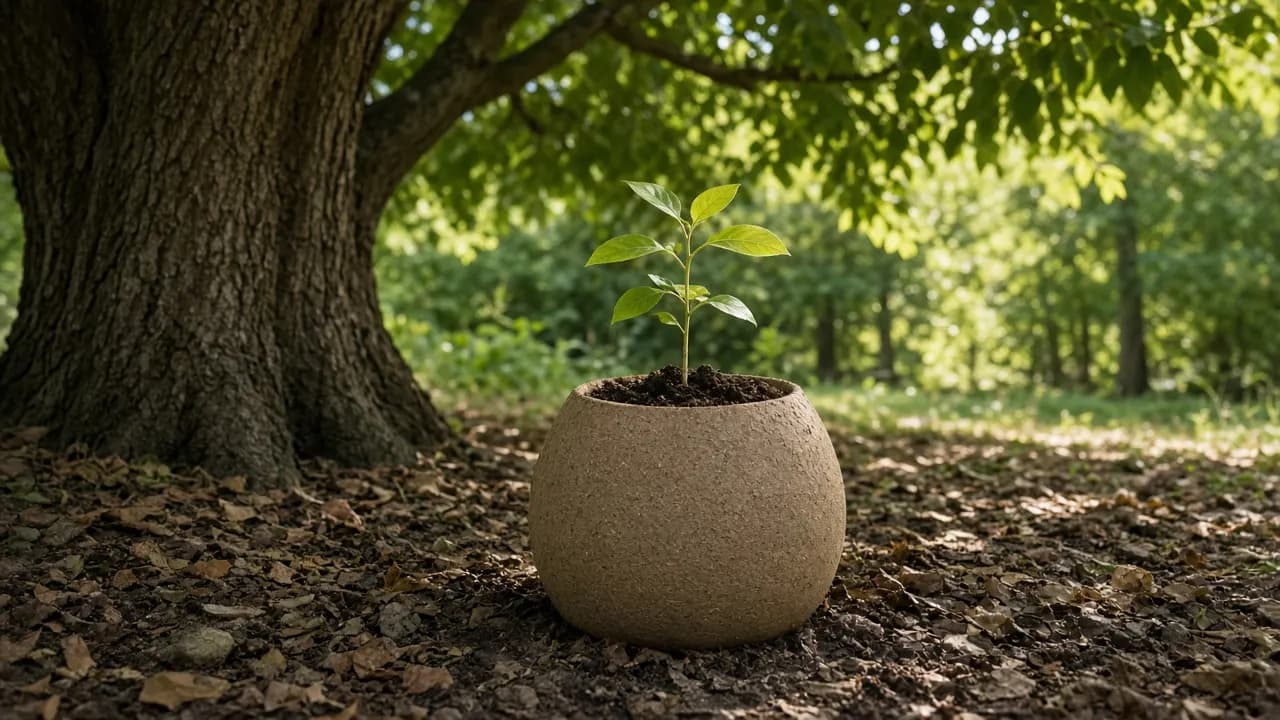
A living memorial in San Augustine has two costs: the cremation and the urn. Biodegradable pet urns are among the cheaper urns you can buy, listed at about $15–$80[6] in one national price guide, and a sapling from a local nursery often costs less than a decorative display urn. If you'd like water cremation, one pet insurer's guide lists aquamation at $80 to $450 depending on size[7]. The table shows published examples.
For a line-by-line price table, see the Texas overview; for what's included in each option, see our services.

Free tool
Memorial budget planner
Add up cremation, urn, keepsakes and a farewell so the total holds no surprises.
Where you can plant or release ashes in Texas
If you live under a homeowners' association, a co-op board or a tenancy agreement in Texas, its rules can matter more than any public law. Many restrict new trees, digging near shared pipes or heavy pots on balconies. A quick read of the rules, or one email to the manager, tells you whether a tree, a shrub bed or a container memorial is the right fit.
Not sure which office covers San Augustine? The Texas local government directory is the official list.
Home burial and scattering are governed at the Texas level first; our Texas rules summary has the detail. Then check whether San Augustine or your HOA adds anything.
What to do first, and what can wait for the right season
- If the ashes have been on a shelf for years, planting is still an option. Ashes don't degrade with age, so nothing has been missed.
- Open the container carefully somewhere sheltered from wind, and check whether the ashes are in a sealed bag inside.
- Weigh or measure what you have, then use our urn size calculator to see which planting urn or water urn fits.
- Decide whether to keep any back. Having lived with the ashes so long, plenty of families choose to plant the bulk and hold on to a small amount.
- Pick a date that carries meaning, perhaps the day they died or the day they were born, and ask the people who loved them to come.
- Treat the old urn kindly afterwards. Many people reuse a wooden or ceramic urn as a plant pot or keepsake box.
Keeping your pet's memory growing in San Augustine
History runs deep in San Augustine, from its old homes to cemeteries with stones dating back to the days of the Republic of Texas. That sense of permanence shapes how many families remember an animal: an engraved marker on family land, a photograph in the parlor, or a handcrafted keepsake meant to last. Local craftspeople and woodworkers sometimes make boxes or frames to order.
go deeper with the guides or catch up on recent articles, Compare every option on our services page, use the free tools before you ring anyone, or look at how readers voted in our polls. Close to San Augustine we also cover San Antonio, El Paso, Fort Worth and Austin; the full list for Texas and for the United States is a click away.

Reader polls
What would you choose?
Vote anonymously and see how other readers answered. The results are live counts from people who visit this site, so they show real opinions, not a scientific sample.
What kind of tree or plant would you choose?
Tap an answer to vote and see how others answered. Anonymous.
If water cremation (aquamation) were offered near you, would you choose it?
Tap an answer to vote and see how others answered. Anonymous.
If you had to decide today, which aftercare would you choose for your pet?
Tap an answer to vote and see how others answered. Anonymous.

Free tools to help you plan
Memorial budget planner
Add up cremation, urn, keepsakes and a farewell so the total holds no surprises.

Memorial tree finder
Pick a tree for a planting urn that suits your climate, space and pet.

Aftercare options compared
Compare private, communal and water cremation with burial on cost, timing and what comes home.
Questions people ask
Roughly how many pets die in San Augustine each year?
Our estimate is around 60. It comes from San Augustine's population (about 1,839), the average household size, the share of homes with a dog or cat (about 680 households here) and the average lifespan. It is arithmetic, not a count, so read it as a rough floor.
Does the San Augustine climate change what I should do first?
Only the timing. In August, with highs near 95°F, cool the body and book collection the same day. Winters here are mild enough that burial or scattering is possible in any month.
Which nearby towns can I compare with San Augustine?
The closest communities we cover are Center (about 19 miles), Hemphill (about 20 miles) and Nacogdoches (about 33 miles). Providers based in those places often serve San Augustine too. Ask each one for a written total that includes collection, so the distance is priced in.
How do Texas attitudes to cremation compare?
NFDA 2024 Cremation & Burial Report state projections (via Occasional Sage) (2024) puts the Texas human cremation rate at about 55.7%[5]. We show it on the San Augustine page because pet aftercare choices tend to track it: where cremation is normal for people, communal and private pet cremation are both easy to find.
Is it legal to release pet ashes in the sea or a river?
Rules differ by place and by who manages the water, and many were written for human remains. In general, avoid drinking-water reservoirs, busy swimming areas and places where anglers gather, use a water-soluble urn or loose ashes only, and let nothing plastic float away. Ask the relevant agency or landowner before the day.
How many dogs and cats are there in San Augustine?
By our estimate, about 680 households in San Augustine have a dog or a cat, and around 60 of those pets die each year. We calculate this from the city's population, average household size and national pet ownership and lifespan figures. The method is shown on this page, and the real number of animals is higher.


Sources and our estimates
- [1] 53% of US households own a dog, which is about 71 million households. American Pet Products Association (APPA) 2025 State of the Industry, 2025.
- [2] US dogs have an average life expectancy at birth of 12.69 years. Montoya et al. 2023, Frontiers in Veterinary Science - Banfield Pet Hospital life expectancy tables (13.3 million dogs, 2.4 million cats, 2013-2019), 2023.
- [3] 39% of US households own a cat, which is about 53 million households. American Pet Products Association (APPA) 2025 State of the Industry, 2025.
- [4] US cats seen at Banfield hospitals have an average life expectancy at birth of 11.18 years. Montoya et al. 2023, Frontiers in Veterinary Science - Banfield Pet Hospital life expectancy tables (13.3 million dogs, 2.4 million cats, 2013-2019), 2023.
- [5] The NFDA projected Texas's cremation rate at 55.7% for 2024. NFDA 2024 Cremation & Burial Report state projections (via Occasional Sage), 2024.
- [6] Memorials.com's pet urn cost guide puts biodegradable pet urns at $15–$80. Memorials.com – Pet Urn Cost Guide, 2025.
- [7] Embrace Pet Insurance lists US communal cremation at $30-$200, partitioned at $50-$250, private at $100-$500+ and aquamation at $80-$450. Embrace Pet Insurance - Bury or Cremate Your Dog? Costs, Pros & Cons, 2025.
- [8] Switching one human-scale cremation to alkaline hydrolysis saves about 112 kg CO2e under TNO's accounting. Our estimate: 79.9 - (-31.8) kg CO2e. How we calculate.
Get eco memorial ideas by email
Tell us what you need and where you are. We'll reply by email with clear options and prices so you can decide in your own time.