Growing something from the goodbye in Spanish Fork
By our estimate, around 18,000 households in Spanish Fork share their home with a dog or cat, and roughly 1,500 of those pets die each year. More of those families now ask about planting or water memorials. Here's how to do it well.
- A memorial that moves with you
- Why pure ashes harm young roots
- Written prices you can compare

Spanish Fork, Utah
Living memorials in Spanish Fork: the local picture
Canyon wind, high-altitude sun and hard freezes all wear on outdoor memorials in Spanish Fork. Pick heavy granite or bronze for anything outside, and bed it flat or into a concrete footing so it cannot tip. For a living memorial, hardy trees like a crabapple or a native juniper cope with the gusts and the winter cold, and need little care once they are rooted.
Spanish Fork Canyon and the Spanish Fork River are favorite places for many local families, and some hope to scatter part of the ashes along the river or up in the mountains. Check who manages the land, and keep well back from the water's edge. Holding a portion in an urn at home leaves room for both choices, now and later.
Horses, cattle, goats and sheep often share the land in the country around Spanish Fork, and some trees are dangerous to them. Wilted red maple leaves are toxic to horses, and yew is poisonous to most livestock. If the memorial will stand near a pasture or fence line, ask a vet or the local extension office which species are safe for the animals that graze nearby.
With roughly 48,837 residents, Spanish Fork is the 20th-largest of the 52 Utah communities we cover. The nearest larger centre is Salt Lake City, about 47 miles (75 km) away, which is where some providers serving Spanish Fork are based.
For a second opinion on price, Springville (4 miles), Payson (7 miles) and Provo (8 miles, a larger centre) are close enough that their providers cover Spanish Fork routinely. Two written quotes tell you more than any price list.
Our estimate
18,000
How many dog- or cat-owning households Spanish Fork has (estimate)
How we calculated this
48,837 ÷ 2.5 = 19,535 households; × 53% (dog) + 39% (cat) = 18,000. Homes are counted once however many pets they keep.
Our estimate
1,500
dog and cat deaths per year in Spanish Fork, our estimate
How we calculated this
18,000 dog/cat-owning homes ÷ average lifespan (dog: 12.69 yrs + cat: 11.18 yrs) ≈ 1,500 a year. A floor, not a ceiling.
53%[1]
53% of US households own a dog, which is about 71 million households.
12.69 years[2]
US dogs have an average life expectancy at birth of 12.69 years.
39%[3]
39% of US households own a cat, which is about 53 million households.
11.18 years[4]
US cats seen at Banfield hospitals have an average life expectancy at birth of 11.18 years.
Sources for the statistics above: Montoya et al. 2023, Frontiers in Veterinary Science and American Pet Products Association (APPA) 2025 State of the Industry.

How Utah feels about cremation
Burial still dominates in Utah, where the human cremation rate is about 46.1%[5], and for many families burying a pet whole feels natural. If you'd like a greener version of that, a shroud or basket made of natural fiber and a tree nearby is one way. If you'd rather cremate, a planting urn gives you a smaller, simpler burial. Either way, check local rules on burying animals before you dig.
For the Utah figure we rely on NFDA 2024 Cremation & Burial Report state projections (via Occasional Sage) (2024). Read it as a picture of local custom around death and remembrance in Spanish Fork rather than as pet data.
Seasons, soil and weather for a memorial in Spanish Fork
Soil in Spanish Fork cracks in the summer heat and heaves in the winter freeze, and a young planting feels both. A thick ring of wood-chip mulch evens things out, shading the soil through June, July and August and insulating it through January, February, November and December. Top it up each spring, keep it a hand's width away from the trunk, and check the tree has not lifted after the thaw.
Trees in Spanish Fork have to survive hot summers and freezing winters, which rules out many species sold in planting kits. Ask a local nursery for trees proven in both conditions; natives are usually the safest choice. Plant a sapling rather than a seed, mulch a wide ring to keep the roots cooler in June, July and August and steadier through the freeze, and water deeply during dry spells for two summers.
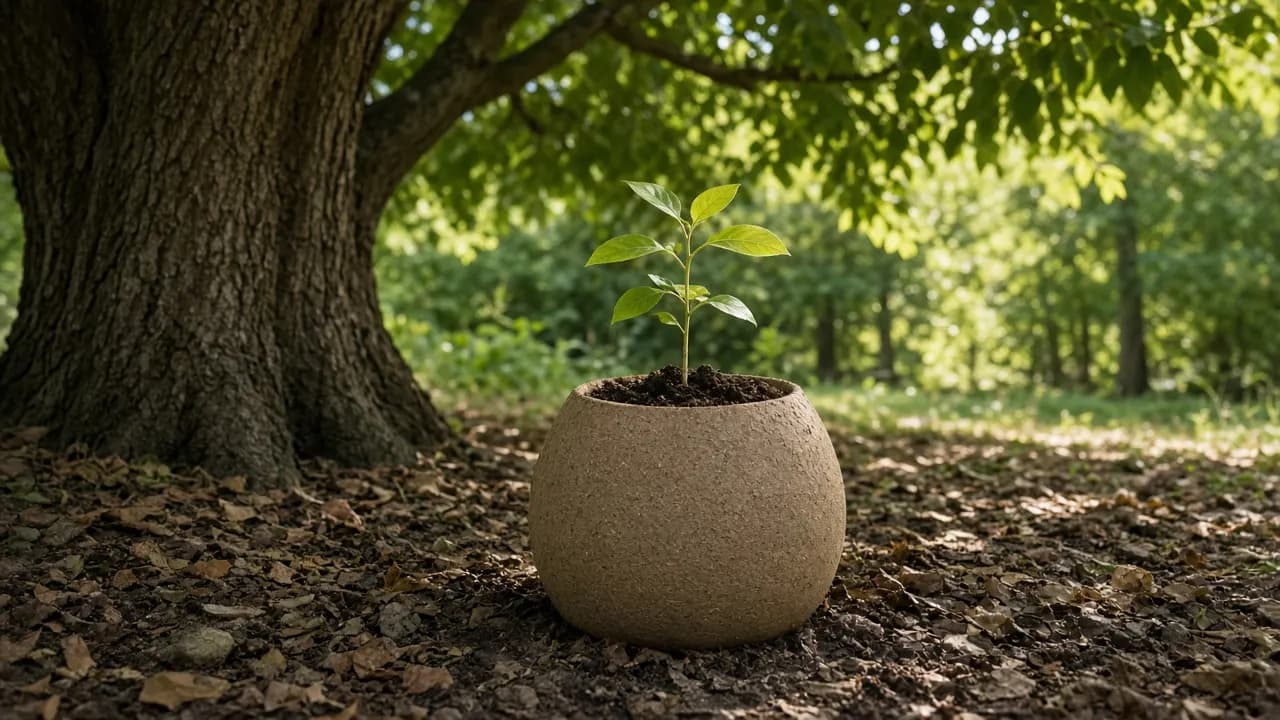
What a greener goodbye costs in Spanish Fork
Here's how the pieces add up for a Spanish Fork family. Private cremation of a dog averages about $260[6] nationally. A pet bio urn with a seed capsule is sold for about $99[7], and a planting system without the tree for $119[8]. Compost, pine bark and a pH kit add a few dollars more. Ask local providers for a written total before you choose.
The full price table by product is on our Utah page, and the services page explains what each option includes.

Free tool
Memorial budget planner
Add up cremation, urn, keepsakes and a farewell so the total holds no surprises.
Land, water and permission in Utah
Carrying ashes from one place to another is usually simple, but keep the paperwork. The certificate or letter from the crematory shows what's in the container, which helps if you're crossing borders, flying out of Utah or handing the ashes to a cemetery. Keep a copy with the ashes and another somewhere safe at home.
The official Utah local government directory lists every county and city office, which is the quickest way to find who to ask in Spanish Fork.
The Utah page sets out who oversees pet cremation and what the state says about burial and scattering. Spanish Fork's own bylaws can sit on top of that, so ask before you dig.
Planting a memorial in Spanish Fork, step by step
- If the ashes have been on a shelf for years, you can still plant them. Cremated remains don't spoil, so there's no deadline.
- Open the container carefully somewhere sheltered from wind, and check whether the ashes are in a sealed bag inside.
- Weigh or measure what you have, and put the figure into our urn size calculator to find a planting or water urn of the right capacity.
- Decide whether to keep any back. Having lived with the ashes so long, plenty of families choose to plant the bulk and hold on to a small amount.
- Pick a date that carries meaning, such as the anniversary or your pet's birthday, and invite anyone who knew them.
- Treat the old urn kindly afterwards. Many people reuse a wooden or ceramic urn as a plant pot or keepsake box.
Living memorials beyond the backyard
In a town with strong farming roots, practical memorials feel at home: a name chiseled into a fieldstone, a box built from reclaimed barn wood, or a plaque screwed to a stall door. For a softer touch, a shadow frame holding the last collar, or a clay cast of a paw or hoof, can rest on the mantel where the family gathers in the evenings.
or look at how readers voted in our polls, use the free tools before you ring anyone, look through our guides and the blog, Compare every option on our services page. If you live between Spanish Fork and Salt Lake City, St. George, West Jordan and Lehi, either page applies. Every other community in Utah, and all of the United States, is listed too.

Reader polls
What would you choose?
Vote anonymously and see how other readers answered. The results are live counts from people who visit this site, so they show real opinions, not a scientific sample.
What kind of tree or plant would you choose?
Tap an answer to vote and see how others answered. Anonymous.
Would you consider releasing your pet's ashes in water?
Tap an answer to vote and see how others answered. Anonymous.
If you had to decide today, which aftercare would you choose for your pet?
Tap an answer to vote and see how others answered. Anonymous.

Free tools to help you plan
Memorial budget planner
Add up cremation, urn, keepsakes and a farewell so the total holds no surprises.

Memorial tree finder
Pick a tree for a planting urn that suits your climate, space and pet.

Aftercare options compared
Compare private, communal and water cremation with burial on cost, timing and what comes home.
Questions people ask
Why does the Spanish Fork page quote a human cremation rate?
Because it is the best local signal we have. NFDA 2024 Cremation & Burial Report state projections (via Occasional Sage) (2024) reports about 46.1%[5] of Utah residents are cremated. There is no official pet equivalent, and inventing one would be worse than quoting a real, clearly labelled number.
Can a provider from a neighbouring town collect from Spanish Fork?
Usually yes. Springville is about 4 miles away, Payson is about 7 miles away and Provo is about 8 miles away, all inside a normal collection radius. Get the mileage written into the quote so there is no surprise on the day.
When is the hardest time of year to arrange a burial in Spanish Fork?
January, February, November and December: average lows are below freezing then, and frozen ground makes a home grave slow or impossible until it thaws. The other pressure point is July, when highs around 93°F mean a body needs cooling and collecting quickly.
Where are the providers that serve Spanish Fork actually based?
Some are local, and some run from Salt Lake City, about 47 miles away. That is normal for a town this size. What matters is the collection time they quote for Spanish Fork and whether the drive is priced into the total, so ask both up front.
What if the soil in Spanish Fork is already alkaline?
Then ashes push it further, so be generous with compost and composted bark, choose a lime-tolerant tree or shrub, and test the pH before planting. Chalky and limestone soils are common in many regions. Plants that dislike lime, such as azaleas and blueberries, are a poor choice for an ash planting anywhere.
Which memorial plants are dangerous to cats and dogs?
Lilies are highly toxic to cats, even the pollen. Sago palm, oleander, yew, azalea and foxglove can poison dogs, and several of them harm cats and horses too. If you have pets at home in Spanish Fork, ask a vet or nursery to confirm a plant is safe before you buy it. Grasses, many herbs and most fruit trees are safer choices, though large amounts of fallen fruit can still upset a dog's stomach.


Sources and our estimates
- [1] 53% of US households own a dog, which is about 71 million households. American Pet Products Association (APPA) 2025 State of the Industry, 2025.
- [2] US dogs have an average life expectancy at birth of 12.69 years. Montoya et al. 2023, Frontiers in Veterinary Science - Banfield Pet Hospital life expectancy tables (13.3 million dogs, 2.4 million cats, 2013-2019), 2023.
- [3] 39% of US households own a cat, which is about 53 million households. American Pet Products Association (APPA) 2025 State of the Industry, 2025.
- [4] US cats seen at Banfield hospitals have an average life expectancy at birth of 11.18 years. Montoya et al. 2023, Frontiers in Veterinary Science - Banfield Pet Hospital life expectancy tables (13.3 million dogs, 2.4 million cats, 2013-2019), 2023.
- [5] The NFDA projected Utah's cremation rate at 46.1% for 2024. NFDA 2024 Cremation & Burial Report state projections (via Occasional Sage), 2024.
- [6] CareCredit's 2025 cost study put the US national average for private dog cremation at $260 (range $206-$473). CareCredit (Synchrony) - How Much Does It Cost To Euthanize a Dog? (2025 ASQ360 procedural cost study), 2025.
- [7] The Bios Urn for pets, a biodegradable urn with a seed capsule, costs $99. Bios Urn – Pets, 2026.
- [8] The Living Urn's pet bio-urn planting system (without a tree) costs $119. The Living Urn – Pet tree urn, 2026.
- [9] If just 10% of U.S. pet cremations moved to aquamation, about 4,200 t CO2e a year would be avoided. Our estimate: 1.5M x 10% x 31.3 kg x 90% reduction. How we calculate.
Ask about aquamation near Spanish Fork
Tell us what you need and where you are. We'll reply by email with clear options and prices so you can decide in your own time.