Growing something from the goodbye in Monroe
Roughly 610 Monroe families say goodbye to a dog or cat each year, by our count. A living memorial is one way to mark it. This guide explains how to make one that actually grows.
- When to plant in your season
- How much ash your urn must hold
- Aquamation providers in your area

Monroe, Washington
What an eco memorial looks like in Monroe
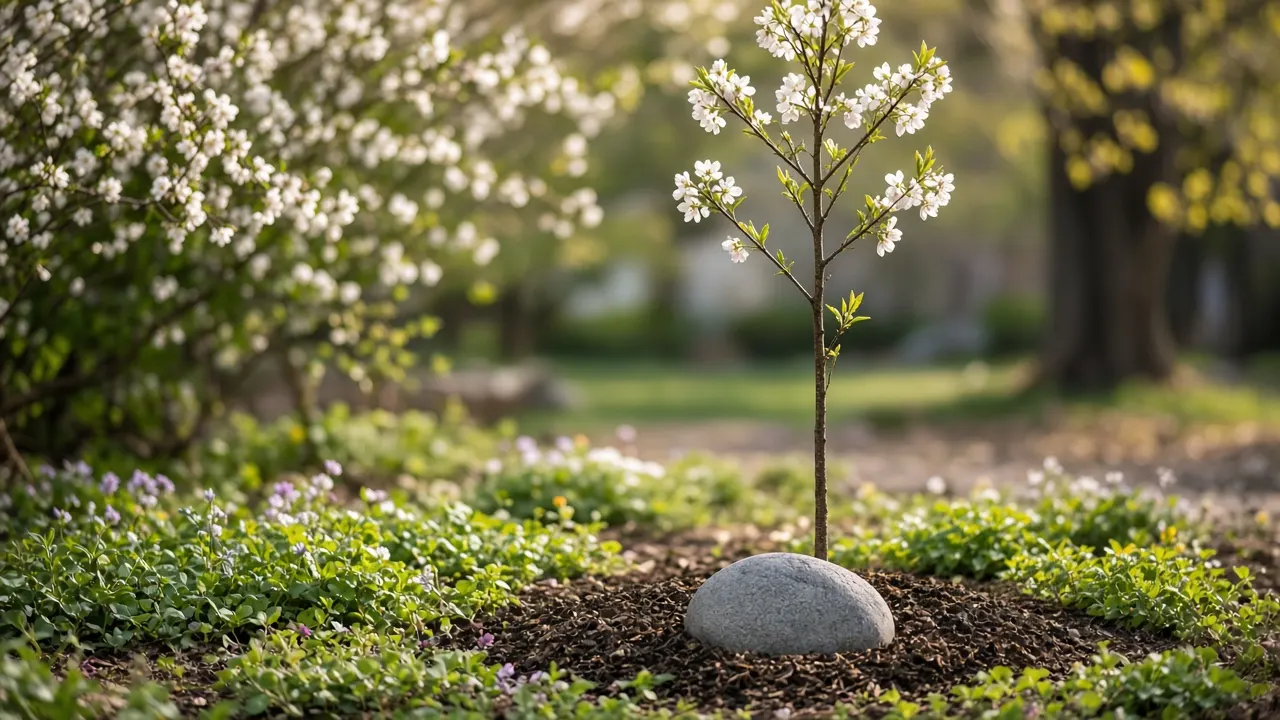
Some Monroe families mark an animal's memory with a yearly visit to the Evergreen State Fair, or by planting sunflowers where a companion loved to doze. Others bury a plantable urn and put a young cedar above it, so the tree grows as the years pass. Tributes tied to the land, the river and this valley's seasons tend to feel most natural for people who live here.
Families on acreage around Monroe often choose outdoor memorials: a boulder by the barn door, an ornamental cherry beside the pasture gate, or a flower bed edged with river stones. Those living in town may prefer a glazed urn on the upright piano, a hoofprint cast in plaster, or a ring with a hidden compartment. Many households end up doing a bit of both.
Horses, cattle, goats and sheep often share the land in the country around Monroe, and some trees are dangerous to them. Wilted red maple leaves are toxic to horses, and yew is poisonous to most livestock. If the memorial will stand near a pasture or fence line, ask a vet or the local extension office which species are safe for the animals that graze nearby.
Monroe is home to about 20,025 people, the 59th-largest of the 67 Washington communities we cover. The nearest larger centre is Seattle, about 24 miles (38 km) away, which is where some providers serving Monroe are based.
Monroe sits within easy reach of Mill Creek (11 miles), Woodinville (11 miles) and Lake Stevens (11 miles, a larger centre). A provider based in any of them will usually collect from Monroe; ask what the mileage adds to the bill.
Our estimate
7,350
Monroe: dog- or cat-owning households, our estimate
How we calculated this
20,025 ÷ 2.5 = 8,010 households; × 53% (dog) + 39% (cat) = 7,350. A household with several pets counts once.
Our estimate
610
Monroe families who lose a dog or cat each year (estimate)
How we calculated this
7,350 dog/cat-owning homes ÷ average lifespan (dog: 12.69 yrs + cat: 11.18 yrs) ≈ 610 a year. A floor, not a ceiling.
53%[1]
53% of US households own a dog, which is about 71 million households.
12.69 years[2]
US dogs have an average life expectancy at birth of 12.69 years.
39%[3]
39% of US households own a cat, which is about 53 million households.
11.18 years[4]
US cats seen at Banfield hospitals have an average life expectancy at birth of 11.18 years.
We built the this numbers from Montoya et al. 2023, Frontiers in Veterinary Science and American Pet Products Association (APPA) 2025 State of the Industry, and both are worth a look if you want the detail.

How Washington feels about cremation
With a human cremation rate near 79.1%[5], Washington has plenty of crematories competing for families, and that tends to show in the choice on offer. Ask more than one pet provider what they include. Some return ashes in a simple cardboard or paper tube, some add a wooden urn you may not want, and a few can quote for water cremation. The cheapest honest quote is usually the one you can plant from.
Source for the Washington number: Direct Cremate (citing CANA) (2024). Nobody publishes a pet cremation rate for Monroe, so the human figure is the best local signal available.
Seasons, soil and weather for a memorial in Monroe
Mild weather in Monroe makes almost any month workable for a planting ceremony or a water release, so choose a date that means something: a birthday, the anniversary of adoption, the first warm weekend of spring. If you're releasing on water, check the forecast for wind; a calm morning lets a water urn float for a moment before it sinks, which is the part many families remember.
Wet winters are the main hazard for a memorial planting in Monroe. Around November, heavy soils can stay waterlogged for weeks, and roots sitting in cold, salty water rot easily. If your ground drains slowly, plant on a low mound, raised a little above the surrounding soil, so excess water runs away from the ash blend rather than pooling in it.
Budgeting for a living memorial in Monroe
Bio urns vary more in price than you might expect. A national guide puts biodegradable urns at $70–$260[6], depending on material, size and whether a seed or tree system is included. For a lake or sea release, one water urn designed to float briefly and dissolve sells for $149[7]. In Monroe, the tree and the soil amendments are usually the cheapest part of the whole memorial.
Rather than repeat the price table on every city page, we keep one for Washington: Washington costs. What each service includes is on the services page.

Free tool
Memorial budget planner
Add up cremation, urn, keepsakes and a farewell so the total holds no surprises.
Land, water and permission in Washington
Water releases need a little more care than a garden planting. Rivers, lakes, reservoirs and coastal waters in Washington are managed by different bodies, and drinking-water sources are often off-limits. Wherever you release, use only a water-soluble urn or loose ashes, add nothing but loose flower petals, and let no plastic, ribbon or wreath wire float away.
Not sure which office covers Monroe? The Washington local government directory is the official list.
For Washington's rules on burying a pet at home or scattering ashes, see the Washington guide. Local rules in Monroe can be stricter than the state's, especially in homeowners' associations and rentals.
How to plan a living memorial, in order
- If your pet dies while you're away from Monroe, ask a local vet near where it happened to arrange individual cremation there. Bringing a body home over a long distance is rarely practical.
- Ask how the ashes can reach you: collected in person, posted by a tracked courier service, or sent to your own vet.
- Flying home with the ashes? Carry them in your hand luggage in a container that can be X-rayed, with the crematory's certificate in the same bag.
- Don't buy the bio urn on the road. Wait until you're home and know the spot, so the urn matches the place.
- Plant somewhere that links both places if you like: a tree from the region where your pet died, or one from your own garden, if it suits the climate in Monroe.
- Write down the date and place where your pet died and where it was cremated. Those details fade faster than you'd expect.
Keeping the memorial alive in Monroe
Monroe's wet winters test anything placed outside, from October until spring finally arrives. Fired clay, bronze and granite survive decades; softwood and resin weather in a few seasons. Settle a garden stone into a small pad of gravel for drainage, and store photos and fabric keepsakes indoors. If your property floods, choose the highest ground available for any memorial, or keep the ashes inside.
browse in-depth guides or recent articles, or see what other families chose in the poll results, For a plain comparison of the choices, open services, the planning tools turn your pet's details into figures. You can also browse every city in the United States. Nearby, we also cover Spokane, Vancouver, Tacoma and Seattle, and every city in Washington.

Reader polls
What would you choose?
Vote anonymously and see how other readers answered. The results are live counts from people who visit this site, so they show real opinions, not a scientific sample.
Would you consider releasing your pet's ashes in water?
Tap an answer to vote and see how others answered. Anonymous.
If you rent or might move, how would you handle a memorial planting?
Tap an answer to vote and see how others answered. Anonymous.
If you had to decide today, which aftercare would you choose for your pet?
Tap an answer to vote and see how others answered. Anonymous.

Free tools to help you plan
Memorial budget planner
Add up cremation, urn, keepsakes and a farewell so the total holds no surprises.

Memorial tree finder
Pick a tree for a planting urn that suits your climate, space and pet.

Aftercare options compared
Compare private, communal and water cremation with burial on cost, timing and what comes home.
Questions people ask
Is Monroe big enough to have several pet aftercare providers?
Probably, on the numbers. By our estimate about 7,350 Monroe households keep a dog or cat and around 610 lose one each year, which is enough steady demand to support more than one provider. We derive that from population (about 20,025), household size and national ownership and lifespan figures.
Why does the Monroe page quote a human cremation rate?
Because it is the best local signal we have. Direct Cremate (citing CANA) (2024) reports about 79.1%[5] of Washington residents are cremated. There is no official pet equivalent, and inventing one would be worse than quoting a real, clearly labelled number.
When is the hardest time of year to arrange a burial in Monroe?
There is no frozen-ground season here; average lows stay above freezing all year. The other pressure point is August, when highs around 77°F mean a body needs cooling and collecting quickly.
Will I have to travel to Seattle to arrange things?
Not usually. Providers based in Seattle (roughly 24 miles from Monroe) collect from here as a matter of routine, and the paperwork is done by email or phone. If you want to be present for a witnessed cremation, that is when the drive matters.
Can I bury pet ashes on a farm or rural land near Monroe?
On land you own, burying ashes is generally allowed. Keep the planting well away from wells, springs and streams, and away from ground where livestock graze or crops are grown. On someone else's land, including family land, ask the owner first and agree that the memorial can stay if the land changes hands.
How many families in Monroe might want a planting memorial?
We don't know the exact number, but the scale is real: by our estimate, around 610 dogs and cats die in Monroe each year. Interest in greener goodbyes is growing too; 61.4%[9] of US consumers say they'd like to explore green funeral options. If you're one of them, you're far from alone.


Sources and our estimates
- [1] 53% of US households own a dog, which is about 71 million households. American Pet Products Association (APPA) 2025 State of the Industry, 2025.
- [2] US dogs have an average life expectancy at birth of 12.69 years. Montoya et al. 2023, Frontiers in Veterinary Science - Banfield Pet Hospital life expectancy tables (13.3 million dogs, 2.4 million cats, 2013-2019), 2023.
- [3] 39% of US households own a cat, which is about 53 million households. American Pet Products Association (APPA) 2025 State of the Industry, 2025.
- [4] US cats seen at Banfield hospitals have an average life expectancy at birth of 11.18 years. Montoya et al. 2023, Frontiers in Veterinary Science - Banfield Pet Hospital life expectancy tables (13.3 million dogs, 2.4 million cats, 2013-2019), 2023.
- [5] Washington had a 79.1% cremation rate in 2024, among the highest in the US. Direct Cremate (citing CANA), 2024.
- [6] Funeral.com cites U.S. Funerals Online that biodegradable urns typically cost about $70–$260. Funeral.com – How Much Do Cremation Urns Cost in 2025, 2025.
- [7] The Living Urn's Eco Water Urn for water burial costs $149 and holds up to 225 cubic inches; it floats for several minutes before dissolving. The Living Urn – Eco Water Urn, 2026.
- [8] About 59 million U.S. pet-owning households may be open to eco-friendly aftercare options. Our estimate: 86.9M pet households x 68% interested in green funeral options. How we calculate.
- [9] 61.4% of US consumers say they are interested in exploring green funeral options. NFDA 2025 Cremation & Burial Report (press release), 2025.
Plan a living memorial in Monroe
Tell us what you need and where you are. We'll reply by email with clear options and prices so you can decide in your own time.