Bio urns and eco memorials in Kaukauna
Roughly 570 Kaukauna families say goodbye to a dog or cat each year, by our count. A living memorial is one way to mark it. This guide explains how to make one that actually grows.
- A memorial that moves with you
- Why pure ashes harm young roots
- Written prices you can compare

Kaukauna, Wisconsin
Planning a greener goodbye in Kaukauna
In a mill town where people have long worked with their hands, some Kaukauna families like a keepsake made locally: a turned wooden urn, a welded steel garden marker or a stepping stone set with a pressed paw or hoof print. Others want a small ceramic urn by the fireplace or a necklace with a sealed charm of ashes. Choose what belongs in your home.
River fog, heavy snow and winter salt spray from the highways test outdoor memorials in Kaukauna. Polished granite and bronze stand up to it, while poured concrete and resin weather poorly. For a living memorial, a lilac or serviceberry thrives in the Fox Valley; get it into the ground once the clay has dried enough to crumble in your hand, usually in May.
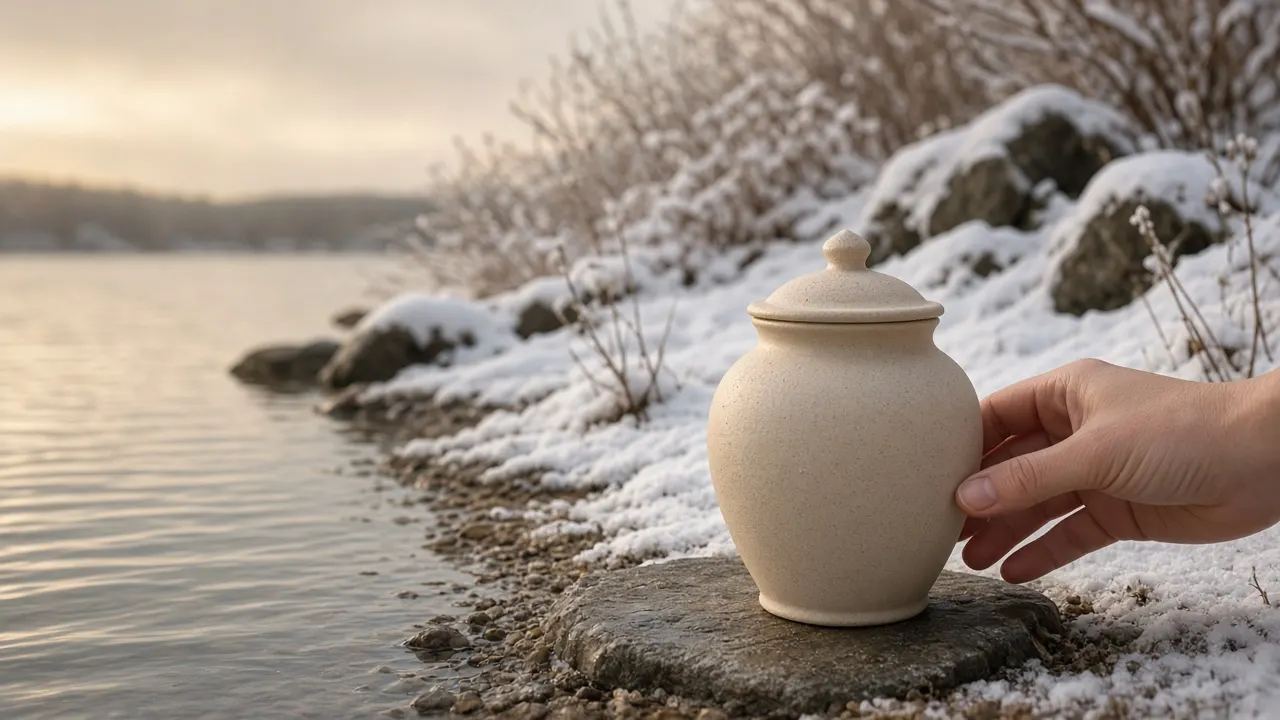
Many people near Kaukauna have a lake, pond or river they walked with their dog every day. A water-soluble urn released there can feel exactly right. Before you do it, check who owns or manages the water: a private pond needs the owner's say-so, a public lake is usually managed by a state or county agency, and some reservoirs supply drinking water and don't allow anything to be released. Choose a quiet time and let nothing float away.
About 18,517 people live in Kaukauna, which makes it the 47th-largest of the 50 Wisconsin communities we cover.
Families in Kaukauna often end up using a provider from Appleton (6 miles, a larger centre), Menasha (9 miles) and Fox Crossing (11 miles). That is normal: crematories serve a radius, not a single town, and the drive is priced into collection.
Our estimate
6,800
Estimated dog- or cat-owning households in Kaukauna
How we calculated this
18,517 ÷ 2.5 = 7,407 households; × 53% (dog) + 39% (cat) = 6,800. Homes are counted once however many pets they keep.
Our estimate
570
Estimated dog and cat losses in Kaukauna each year
How we calculated this
6,800 dog/cat-owning homes ÷ average lifespan (dog: 12.69 yrs + cat: 11.18 yrs) ≈ 570 a year. Treat it as a minimum.
53%[1]
53% of US households own a dog, which is about 71 million households.
12.69 years[2]
US dogs have an average life expectancy at birth of 12.69 years.
39%[3]
39% of US households own a cat, which is about 53 million households.
11.18 years[4]
US cats seen at Banfield hospitals have an average life expectancy at birth of 11.18 years.
Where these figures come from: Montoya et al. 2023, Frontiers in Veterinary Science and American Pet Products Association (APPA) 2025 State of the Industry.

Why cremation culture in Wisconsin shapes your options
With roughly 70.7%[5] of people in Wisconsin cremated, the local funeral culture leans firmly toward ashes rather than graves. That has a practical upside for a living memorial. Nurseries, crematories and even some parks departments are used to questions about ashes, and you'll usually get a straight answer. It's still worth asking before you plant or scatter anywhere you don't own, because common practice isn't the same as permission.
For the Wisconsin figure we rely on NFDA 2024 Cremation & Burial Report state projections (via Occasional Sage) (2024). Read it as a picture of local custom around death and remembrance in Kaukauna rather than as pet data.
When to plant in Kaukauna's climate
Water releases need open water, and in Kaukauna lakes and ponds may ice over around January. Never walk out onto ice to release an urn. If a lake or river was your pet's place, plan the release for spring or summer, when the shoreline is safe and a water-soluble urn can float and dissolve as it's meant to. Keep the ashes at home until then.
Early spring in Kaukauna is when nurseries sell bare-root trees, often at a lower price than trees in pots. They need planting quickly, as soon as the ground can be dug after January, February, March, November and December, which fits well with ashes that have waited through the winter. Have the soil blend ready beforehand, soak the roots for an hour, and plant on a calm, overcast day.
Eco memorial prices, from urn to tree
Add up every part before you commit. Beyond the cremation, a living memorial in Kaukauna can include the bio urn, compost and bark, a pH kit, the tree or shrub, a guard against deer or rabbits, and perhaps a marker. Our memorial budget planner lists each line so nothing surprises you. Most families find the tree is the cheapest part and the cremation the most expensive.
Prices for Kaukauna track the wider Wisconsin market, so use the Wisconsin price table as your baseline and the services page to see what is included.

Free tool
Memorial budget planner
Add up cremation, urn, keepsakes and a farewell so the total holds no surprises.
What Wisconsin allows for ashes, in general terms
Natural burial grounds and some pet cemeteries in Wisconsin accept ashes in biodegradable urns, and a few ask for nothing else: no plastic, no metal, no varnish. If you're considering one, ask what the urn may be made of, whether a tree or marker is allowed above it, and whether the fee includes looking after the plot.
Wisconsin keeps an official directory of local governments; use it to reach the county or city office that covers Kaukauna.
For Wisconsin's rules on burying a pet at home or scattering ashes, see the Wisconsin guide. Local rules in Kaukauna can be stricter than the state's, especially in homeowners' associations and rentals.
Planting a memorial in Kaukauna, step by step
- If the ashes have been on a shelf for years, planting is still an option. Ashes don't degrade with age, so nothing has been missed.
- Open the container carefully somewhere sheltered from wind, and check whether the ashes are in a sealed bag inside.
- Weigh or measure what you have, then use our urn size calculator to see which planting urn or water urn fits.
- Decide whether to keep any back. After years at home, some families like to plant most of the ashes and keep a spoonful.
- Pick a date that carries meaning, perhaps the day they died or the day they were born, and ask the people who loved them to come.
- Treat the old urn kindly afterwards. Many people reuse a wooden or ceramic urn as a plant pot or keepsake box.
Living memorials beyond the backyard
Kaukauna families often have relatives across the Fox Cities and up in Green Bay, and dividing ashes lets several households share in the remembering. A family might keep one urn, hand two small keepsake vessels to adult children, and reserve a portion to scatter later on the home farm. Share the plan with the provider in advance so the containers come back filled and labeled.
go deeper with the guides or catch up on recent articles, For a plain comparison of the choices, open services, the planning tools turn your pet's details into figures, or see how other readers answered in our polls. More local pages: Kenosha, Madison, Milwaukee and Appleton, the Wisconsin overview and every city in the United States.

Reader polls
What would you choose?
Vote anonymously and see how other readers answered. The results are live counts from people who visit this site, so they show real opinions, not a scientific sample.
What kind of tree or plant would you choose?
Tap an answer to vote and see how others answered. Anonymous.
If water cremation (aquamation) were offered near you, would you choose it?
Tap an answer to vote and see how others answered. Anonymous.
If you had to decide today, which aftercare would you choose for your pet?
Tap an answer to vote and see how others answered. Anonymous.

Free tools to help you plan
Memorial budget planner
Add up cremation, urn, keepsakes and a farewell so the total holds no surprises.

Memorial tree finder
Pick a tree for a planting urn that suits your climate, space and pet.

Aftercare options compared
Compare private, communal and water cremation with burial on cost, timing and what comes home.
Questions people ask
How many pet owners live in Kaukauna?
By our estimate, about 6,800 households in Kaukauna have at least one dog or cat, and around 570 are lost each year. We calculate this from the city's population of about 18,517, the average household size and national ownership and lifespan figures, so treat it as a floor rather than an exact count.
Does the Kaukauna climate change what I should do first?
Only the timing. In July, with highs near 81°F, cool the body and book collection the same day. In January, February, March, November and December, when lows sit below freezing, a home burial may have to wait for a thaw, so cremation with ashes returned keeps your options open.
Why does the Kaukauna page quote a human cremation rate?
Because it is the best local signal we have. NFDA 2024 Cremation & Burial Report state projections (via Occasional Sage) (2024) reports about 70.7%[5] of Wisconsin residents are cremated. There is no official pet equivalent, and inventing one would be worse than quoting a real, clearly labelled number.
Which nearby towns can I compare with Kaukauna?
The closest communities we cover are Appleton (about 6 miles), Menasha (about 9 miles) and Fox Crossing (about 11 miles). Providers based in those places often serve Kaukauna too. Ask each one for a written total that includes collection, so the distance is priced in.
How long does it take to get ashes back for planting?
Most private cremations return ashes within one to two weeks, and water cremation cycles themselves take 12–20 hours[7], so allow a similar time. In a smaller place, if the cremation happens in a larger centre such as Kaukauna, it may take a little longer. Planting can wait, so there's no need to rush.
What if my pet dies when it's too hot or cold to plant?
Wait. Ashes don't need to go into the ground quickly, and a tree planted in the wrong season is more likely to fail. Keep them in the container from the crematory, use the time to choose a species and prepare the soil mix, and plant when the weather in Kaukauna is kind to young roots.


Sources and our estimates
- [1] 53% of US households own a dog, which is about 71 million households. American Pet Products Association (APPA) 2025 State of the Industry, 2025.
- [2] US dogs have an average life expectancy at birth of 12.69 years. Montoya et al. 2023, Frontiers in Veterinary Science - Banfield Pet Hospital life expectancy tables (13.3 million dogs, 2.4 million cats, 2013-2019), 2023.
- [3] 39% of US households own a cat, which is about 53 million households. American Pet Products Association (APPA) 2025 State of the Industry, 2025.
- [4] US cats seen at Banfield hospitals have an average life expectancy at birth of 11.18 years. Montoya et al. 2023, Frontiers in Veterinary Science - Banfield Pet Hospital life expectancy tables (13.3 million dogs, 2.4 million cats, 2013-2019), 2023.
- [5] The NFDA projected Wisconsin's cremation rate at 70.7% for 2024. NFDA 2024 Cremation & Burial Report state projections (via Occasional Sage), 2024.
- [6] If just 10% of U.S. pet cremations moved to aquamation, about 4,200 t CO2e a year would be avoided. Our estimate: 1.5M x 10% x 31.3 kg x 90% reduction. How we calculate.
- [7] A PET-550 aquamation cycle takes 12–20 hours for a single pet and 14–20 hours for segregated or communal cycles, with up to 14 compartments. Bio-Response Solutions — PET-550 Aquamation System product page, 2026.
Tell us about your pet and your garden
Tell us what you need and where you are. We'll reply by email with clear options and prices so you can decide in your own time.