A living memorial for your pet in Olympia
By our estimate, around 21,000 households in Olympia share their home with a dog or cat, and roughly 1,750 of those pets die each year. More of those families now ask about planting or water memorials. Here's how to do it well.
- A memorial that moves with you
- Why pure ashes harm young roots
- Written prices you can compare

Olympia, Washington
Bio urns, trees and water in Olympia
Olympia's farmers market, galleries and craft fairs mean many families here turn to local makers for a memorial: a wheel-thrown urn, a carved cedar box, a hand-stitched pillow made from an old blanket or a small painting. These often take a few weeks to create, and the crematory's plain container is perfectly fine to keep in the meantime while the piece is made.
Olympia has many state workers, students and retirees whose families live elsewhere in Washington or out of state. If a sibling or grown child wants a portion too, say so at booking and the remains will be split before they return. Small vessels or wearable pieces travel easily, and the main urn can stay in the home where the animal lived.
Getting a bio urn in Olympia is mostly a matter of ordering online, but getting the soil right is a local job. Ask a nursery or your county extension office whether the ground is chalky, clay or sandy. Clay holds salts near the roots and drains poorly, so dig a wider hole and mix in more compost. Sandy soil drains well but holds little, so water the young tree more often in its first summers.
With roughly 56,724 residents, Olympia is the 24th-largest of the 67 Washington communities we cover. The nearest larger centre is Tacoma, about 26 miles (42 km) away, which is where some providers serving Olympia are based.
Families in Olympia often end up using a provider from Tumwater (3 miles), Lacey (5 miles) and Lakewood (20 miles). That is normal: crematories serve a radius, not a single town, and the drive is priced into collection.
Our estimate
21,000
How many dog- or cat-owning households Olympia has (estimate)
How we calculated this
56,724 ÷ 2.5 = 22,690 households; × 53% (dog) + 39% (cat) = 21,000. Homes are counted once however many pets they keep.
Our estimate
1,750
Estimated dog and cat losses in Olympia each year
How we calculated this
21,000 dog/cat-owning homes ÷ average lifespan (dog: 12.69 yrs + cat: 11.18 yrs) ≈ 1,750 a year. Treat it as a minimum.
53%[1]
53% of US households own a dog, which is about 71 million households.
12.69 years[2]
US dogs have an average life expectancy at birth of 12.69 years.
39%[3]
39% of US households own a cat, which is about 53 million households.
11.18 years[4]
US cats seen at Banfield hospitals have an average life expectancy at birth of 11.18 years.
Sources for the statistics above: American Pet Products Association (APPA) 2025 State of the Industry and Montoya et al. 2023, Frontiers in Veterinary Science.

What local attitudes to cremation mean in Washington
Cremation accounts for roughly 79.1%[5] of human deaths in Washington, and a lot of those ashes end up waiting on a shelf. That's true of pets as well. If you already have an urn at home from an earlier pet, a bio urn can be a way to finish that story: the older ashes and the new can go into one planting, or two trees side by side, whenever you feel ready.
For the Washington figure we rely on Direct Cremate (citing CANA) (2024). Read it as a picture of local custom around death and remembrance in Olympia rather than as pet data.
What Olympia's climate means for a living memorial
Damp, mild air suits fungus as well as trees. In Olympia, choose a species or variety known to resist the leaf spots, mildews and cankers that local gardeners complain about, and plant it where air moves freely rather than in a sheltered, stagnant corner. A nursery that has sold trees locally for years will know which ones stay clean.
Mild weather in Olympia makes almost any month workable for a planting ceremony or a water release, so choose a date that means something: a birthday, the anniversary of adoption, the first warm weekend of spring. If you're releasing on water, check the forecast for wind; a calm morning lets a water urn float for a moment before it sinks, which is the part many families remember.
What a greener goodbye costs in Olympia
For a medium-size dog, published private aquamation prices at two US providers sit around $200–$259[6], and one Arizona provider's individual aquamation price of $75–$349[7] includes an urn, nameplate and ink paw print. Whether an Olympia provider bundles extras like that makes a real difference when you compare. Add the bio urn or tree separately, and use the planner below to see the total.
For a line-by-line price table, see the Washington overview; for what's included in each option, see our services.

Free tool
Memorial budget planner
Add up cremation, urn, keepsakes and a farewell so the total holds no surprises.
Rules worth knowing in Washington before you scatter
Rules change more often than most people realise, and many local policies about ashes were never written down at all. Treat any general guide for Washington, including ours, as a starting point. Whoever looks after that particular field, park or shoreline is the one whose answer counts, so it's worth getting it by email where you can.
To find your county or city office in Washington, start with the official Washington local government directory.
For Washington's rules on burying a pet at home or scattering ashes, see the Washington guide. Local rules in Olympia can be stricter than the state's, especially in homeowners' associations and rentals.
Your next steps, whatever your situation
- If you're remembering more than one animal, settle at the start on one shared planting or separate ones. Either works, but once the ashes are combined there's no undoing it.
- Label each container clearly with the name and date as it comes back, especially if the ashes return months or years apart.
- Choose a bigger planting area for several sets of ashes: a hedge, a group of shrubs or a small orchard spreads the mineral load across more soil.
- Keep a spoonful of each in separate keepsakes if anyone in the family wants to remember one animal on its own.
- Plan for the pets still living with you. Fresh soil with the scent of bone in it invites digging, so fence or cover the spot until it has settled.
- Add a marker for each name, or a single stone carrying all of them, so anyone visiting understands who is remembered there.
Keeping the memorial alive in Olympia
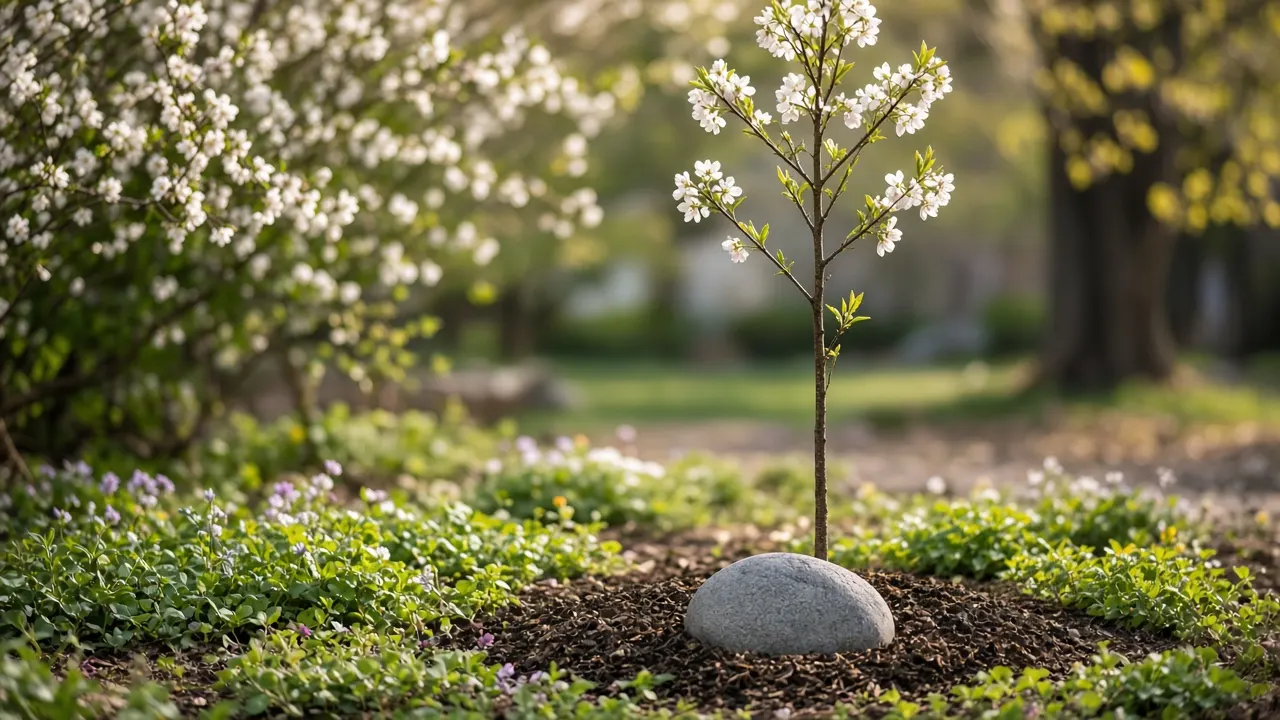
With so much rain, moss and algae quickly cover rough stone and concrete in Olympia gardens, especially under the firs on the west side. Polished granite and bronze resist them. Choose an open, bright spot for any marker and brush it off each spring. Households with an ecological bent sometimes skip the marker entirely and set a Douglas fir or vine maple seedling above a handful of the ashes.
run the numbers with the free planning tools, browse in-depth guides or recent articles, or see how other readers answered in our polls, Our services overview lays out every option side by side. You can also browse every city in the United States. Nearby, we also cover Spokane, Kent, Vancouver and Seattle, and every city in Washington.

Reader polls
What would you choose?
Vote anonymously and see how other readers answered. The results are live counts from people who visit this site, so they show real opinions, not a scientific sample.
If you rent or might move, how would you handle a memorial planting?
Tap an answer to vote and see how others answered. Anonymous.
What kind of tree or plant would you choose?
Tap an answer to vote and see how others answered. Anonymous.
If you had to decide today, which aftercare would you choose for your pet?
Tap an answer to vote and see how others answered. Anonymous.

Free tools to help you plan
Memorial budget planner
Add up cremation, urn, keepsakes and a farewell so the total holds no surprises.

Memorial tree finder
Pick a tree for a planting urn that suits your climate, space and pet.

Aftercare options compared
Compare private, communal and water cremation with burial on cost, timing and what comes home.
Questions people ask
Will I have to travel to Tacoma to arrange things?
Not usually. Providers based in Tacoma (roughly 26 miles from Olympia) collect from here as a matter of routine, and the paperwork is done by email or phone. If you want to be present for a witnessed cremation, that is when the drive matters.
Can a provider from a neighbouring town collect from Olympia?
Usually yes. Tumwater is about 3 miles away, Lacey is about 5 miles away and Lakewood is about 20 miles away, all inside a normal collection radius. Get the mileage written into the quote so there is no surprise on the day.
Why does the Olympia page quote a human cremation rate?
Because it is the best local signal we have. Direct Cremate (citing CANA) (2024) reports about 79.1%[5] of Washington residents are cremated. There is no official pet equivalent, and inventing one would be worse than quoting a real, clearly labelled number.
How does Olympia's weather affect pet aftercare?
August is the hottest month in Olympia, with average highs around 78°F, so prompt collection matters most then. Winters are mild, with average lows staying above freezing, so outdoor burial or scattering is usually possible year round.
Is it safe to plant a fruit tree with my pet's ashes?
Cremated remains are mostly bone minerals, and once they're thoroughly blended into plenty of compost and garden soil, many gardeners grow fruit trees over them. The high pH and salt are the real concern for the tree, so dilute generously and test the pH. If eating fruit from the memorial feels wrong to anyone in your family, choose an ornamental tree instead.
How many dogs and cats are there in Olympia?
By our estimate, about 21,000 households in Olympia have a dog or a cat, and around 1,750 of those pets die each year. We calculate this from the city's population, average household size and national pet ownership and lifespan figures. The method is shown on this page, and the real number of animals is higher.


Sources and our estimates
- [1] 53% of US households own a dog, which is about 71 million households. American Pet Products Association (APPA) 2025 State of the Industry, 2025.
- [2] US dogs have an average life expectancy at birth of 12.69 years. Montoya et al. 2023, Frontiers in Veterinary Science - Banfield Pet Hospital life expectancy tables (13.3 million dogs, 2.4 million cats, 2013-2019), 2023.
- [3] 39% of US households own a cat, which is about 53 million households. American Pet Products Association (APPA) 2025 State of the Industry, 2025.
- [4] US cats seen at Banfield hospitals have an average life expectancy at birth of 11.18 years. Montoya et al. 2023, Frontiers in Veterinary Science - Banfield Pet Hospital life expectancy tables (13.3 million dogs, 2.4 million cats, 2013-2019), 2023.
- [5] Washington had a 79.1% cremation rate in 2024, among the highest in the US. Direct Cremate (citing CANA), 2024.
- [6] Private aquamation for a 21–50 lb dog costs about $200–$259 at two posted US price lists. Our estimate: Delaware 10–49 lb $200; A Greener Place 21–50 lb $259. How we calculate.
- [7] A Greener Place in Mesa, Arizona, charges $75–$349 for individual pet aquamation by weight, including an urn, nameplate and ink paw print. A Greener Place Pet Aquamation – Pricing, 2026.
- [8] If just 10% of U.S. pet cremations moved to aquamation, about 4,200 t CO2e a year would be avoided. Our estimate: 1.5M x 10% x 31.3 kg x 90% reduction. How we calculate.
Tell us about your pet and your garden
Tell us what you need and where you are. We'll reply by email with clear options and prices so you can decide in your own time.